Sharing RISE research insights on household resilience to climate challenges
10 June 2026
By Hemali Oza
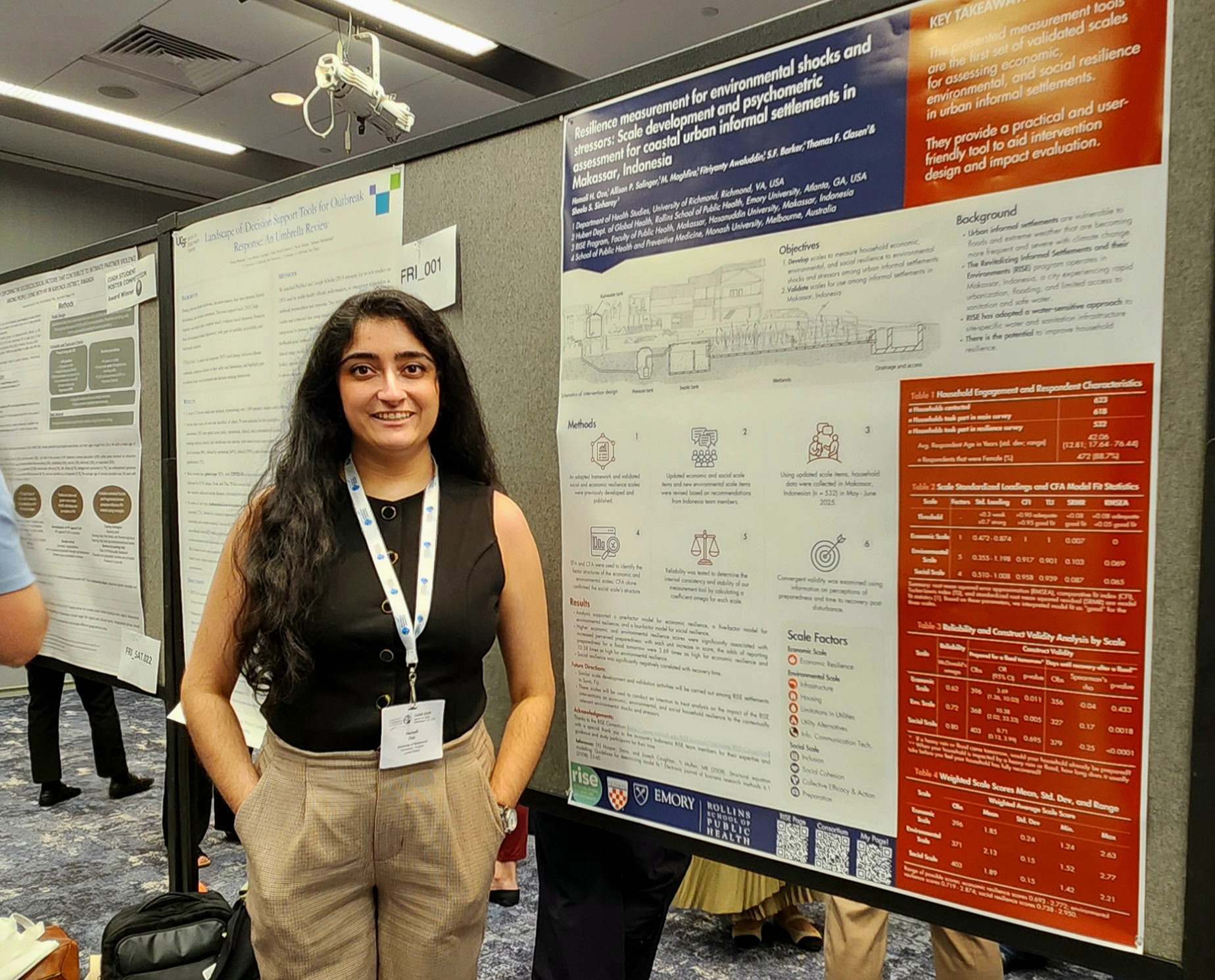
At the Consortium of Universities in Global Health (CUGH) 17th annual conference, The Future of Global Health, in Washington D.C., I presented research on measuring household resilience to extreme weather and climate change-driven disturbances in coastal urban informal settlements in Makassar, Indonesia.
Urban informal settlements are often highly exposed to flooding, poor drainage, limited sanitation, and unreliable access to safe water. These challenges are worsening as climate change increases the frequency and severity of extreme weather events. While the RISE infrastructure upgrades were primarily designed to reduce environmental contamination and improve health, the interventions may also improve household resilience, defined as the capacity to cope with, absorb, and adapt to a changing environment.
To understand whether resilience is improving, we first need a way to measure it. Because resilience cannot be directly observed, our team developed and validated measurement scales to assess three types of household resilience: economic, environmental, and social resilience. Based on our previously published adapted framework and validated household resilience scales and input from our Indonesia team members, we revised our surveys and collected data from 532 households in RISE settlements in Makassar between May and June 2025. Our analyses showed that the scales performed well and could meaningfully distinguish different dimensions of resilience. Parallel data were collected in Fiji between February-April 2026, with similar scale development and validation analyses underway.
These tools will help us evaluate whether RISE interventions improve household resilience. They may also be adapted and re-validated for use in other communities facing similar extreme weather and climate change-related challenges, helping governments, aid organizations, and researchers assess the impact of programs designed to improve resilience.