
New approaches to research can help make progress on sustainable development goals (SDGs)
Read the paper: Brown, R., Davis, B., French, M., Wong, T., Ramirez-Lovering, D., Chown, S.L., Clasen, T., Johnston, D., Ansariadi, A., Turagabeci, A., Burge, K., Greening, C., McCarthy, D., Luby, S., Leder, K. 2026,. iScience
Summary
By Karin Leder and Frankie Sadler
In this paper, leaders from the RISE program share key insights on how a research framework that supports delivery of both development impact and novel research outcomes can help to address sustainable development challenges. As a large-scale, multi-stakeholder initiative, RISE is confronting the often-present tension between innovative research and effective development by addressing both simultaneously through ‘transdisciplinary impact research’ - an approach designed to concurrently implement solutions for complex real-world sustainability hurdles while critically evaluating their efficacy.
Drawing from years of experience, the authors identify four essential pillars for turning ambitious research into global change. The first focuses on stakeholders and partnerships, emphasising that success depends on active participation from everyone - from local communities to global policymakers. The RISE program demonstrates that a tailored engagement model does more than just build relationships; it fosters local ownership and helps promote solutions that are culturally relevant and built to last.
The second pillar centres on a mission-driven strategic agenda, guided by a singular goal: producing interventions that can be adapted to diverse settings worldwide. By aligning its research goals with infrastructure needs, RISE has successfully leveraged scientific funding to secure the large development investment required for its settlement upgrading work - an accomplishment that requires constant, transparent navigation of stakeholder expectations. 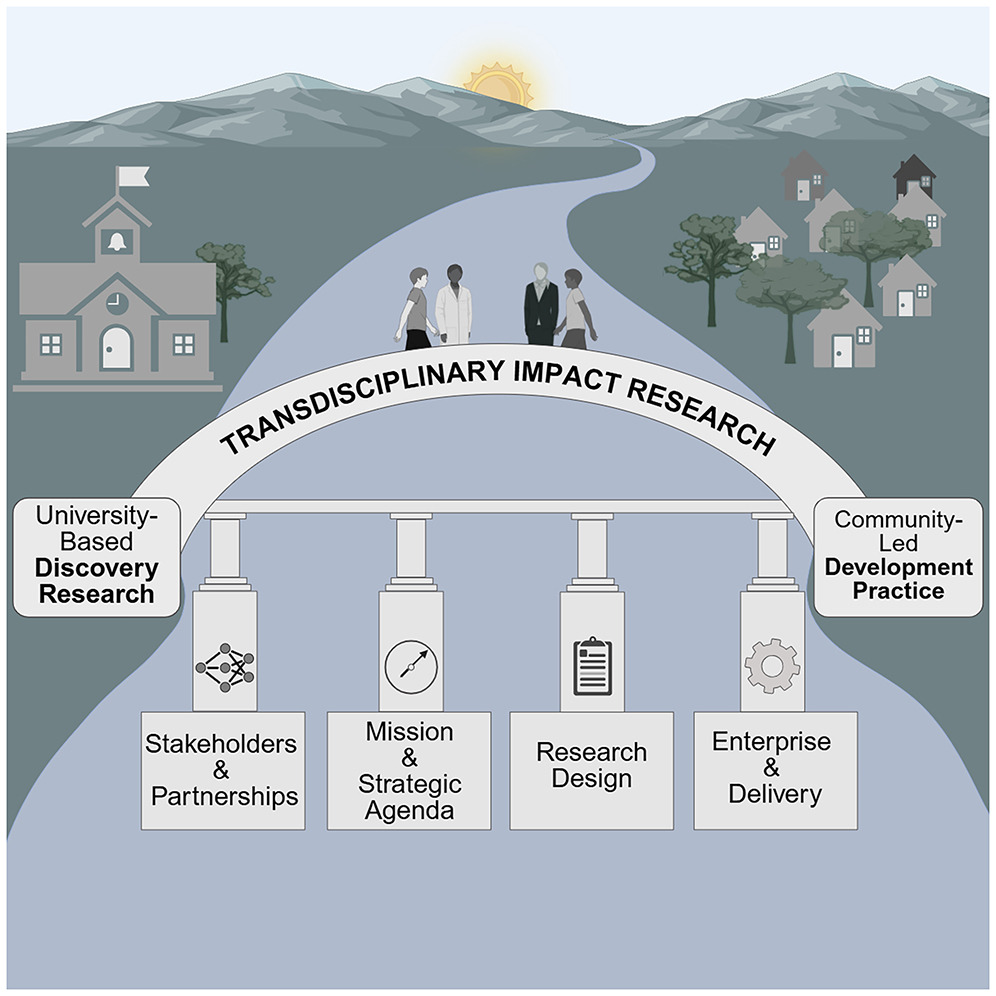
Above: graphic representation of transdisciplinary impact research and four pillars that can progress sustainable development goals. Source:
The third pillar proposes that the research framework and the real-world intervention must be co-designed from the start, and must balance scientific rigor with practical implementation realities.
The final pillar - enterprise, expertise, and culture - acknowledges that solving global crises requires a specialised professional infrastructure. It takes a diverse ‘program enterprise’ featuring scientists, engineers, architects, data managers, and community engagement experts. It acknowledges that research programs addressing significant global problems require flexible timelines and explicit attention to complex operational issues that are capable of supporting future scaling.
While the paper highlights the inevitable hurdles of this model, such as lengthy timeframes and complex international coordination, it also emphasises the potential for unlocking new funding streams, accelerating the transition from small-scale pilots to systems-changing solutions, and for global impact aimed at transforming lives at scale.