
Bootsock sampling: a promising technique for estimating E. Coli in soil in informal settlements
Read the paper: Bata, L., Henry, R., Barker, F., et al. 2025, Science Advances

Summary
By Lamiya Bata
Soil can pose a significant risk to human health, particularly in areas with high environmental contamination, such as informal settlements. But accurately gauging contamination levels and associated health risks is challenging due to the limitations of current standard methods, which often focus on specific spots, and fail to provide a comprehensive picture. These methods overlook the broader distribution of pathogens in soil, making it difficult to fully understand the extent of contamination, and its impact on public health.
To address this gap, we tested the boot sock sampling method – where RISE community fieldworkers wore fabric boot socks over their shoes. This method is designed to cover more ground, and collect a composite sample of surface soils. It offers a more comprehensive view of contamination levels, and as a result, better reflects the way humans interact with contaminated environments in real-world settings.
Our key finding was that the boot sock method provided more sensitive detection of E. coli and showed less variation between samples, making it a more efficient tool for assessing health risks. The approach also requires fewer samples to achieve adequate spatial coverage compared to traditional methods, offering potential improvements in time and cost efficiencies.
Further applications of this research could involve using the boot sock technique to study other pathogens and environments, improving its application in public health risk assessments.
Next steps may include adapting this method for broader use in diverse settings, like indoor environments, and expanding its application to guide interventions in high-risk areas with limited sanitation infrastructure.
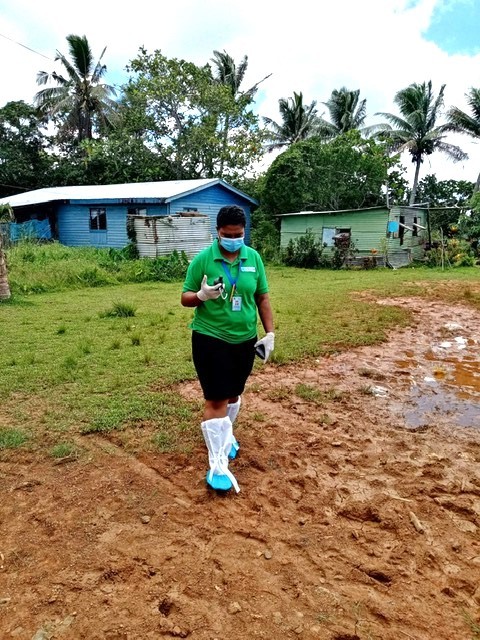
Research Field Team Lead Meiva Setoka conducts surface-soil sampling
with bootsocks in a settlement in Suva, Fiji.