
Essays on the economic and health effects of environmental shocks
Read: PhD thesis by Dr Michelle Escobar, Monash University, Centre for Health Economics

Summary
By Dr Michelle Escobar
Climate change is a substantial public health threat that could endanger the health, wellbeing and economic welfare of billions of people around the globe. With it, extreme weather shocks such as large floods and heatwaves are set to increase in frequency and intensity over the coming decades.
The aim of my thesis was therefore to explore how these environmental stressors affect the health, decision-making, and liveability of vulnerable people living in tropical developing countries such as Indonesia and Fiji.
This knowledge is key in order to accurately quantify the adaptation costs of climate change, and inform policy-makers on how to best target limited public resources in cost-effective and pro-poor ways.
To this end, I conducted three independent studies answering the following questions: first, how lasting are the physical and mental health effects of floods among the Indonesian urban poor, especially those living in informal settlements? My findings show that floods can significantly increase the incidence of self-assessed poor health and acute morbidities such as cough, nausea and diarrhoea, even five months post-flood. These effects dissipate when assessed by 10 to 11 months. In contrast, mental health effects on both adults and children remain significant beyond the one-year mark.
Second, does heat affect peoples’ ability to make good economic decisions? What are the mechanisms, and who suffers most? To answer these questions, I combined longitudinal household surveys from Indonesia and temperature records from NASA. My research shows that high night-time temperatures can alter people’s decision-making abilities by increasing economic impatience and irrational behaviour. Disturbed sleep, leading to lower math skills, likely drives these effects. People with the least ability to adapt to heat, bear the largest toll.
Lastly, I investigate what are the health effects of heat stress among informal settlement residents and the mediating effects of wealth for thermal exposure inside their homes. My research shows that even in tropical countries, where heat is ubiquitous, short-term temperature spikes can significantly increase poor health and lethargic symptoms, affecting the quality of life and productivity of some of the most vulnerable urban poor populations. I show that dwellings in the settlements provide no protection against outdoor heat.
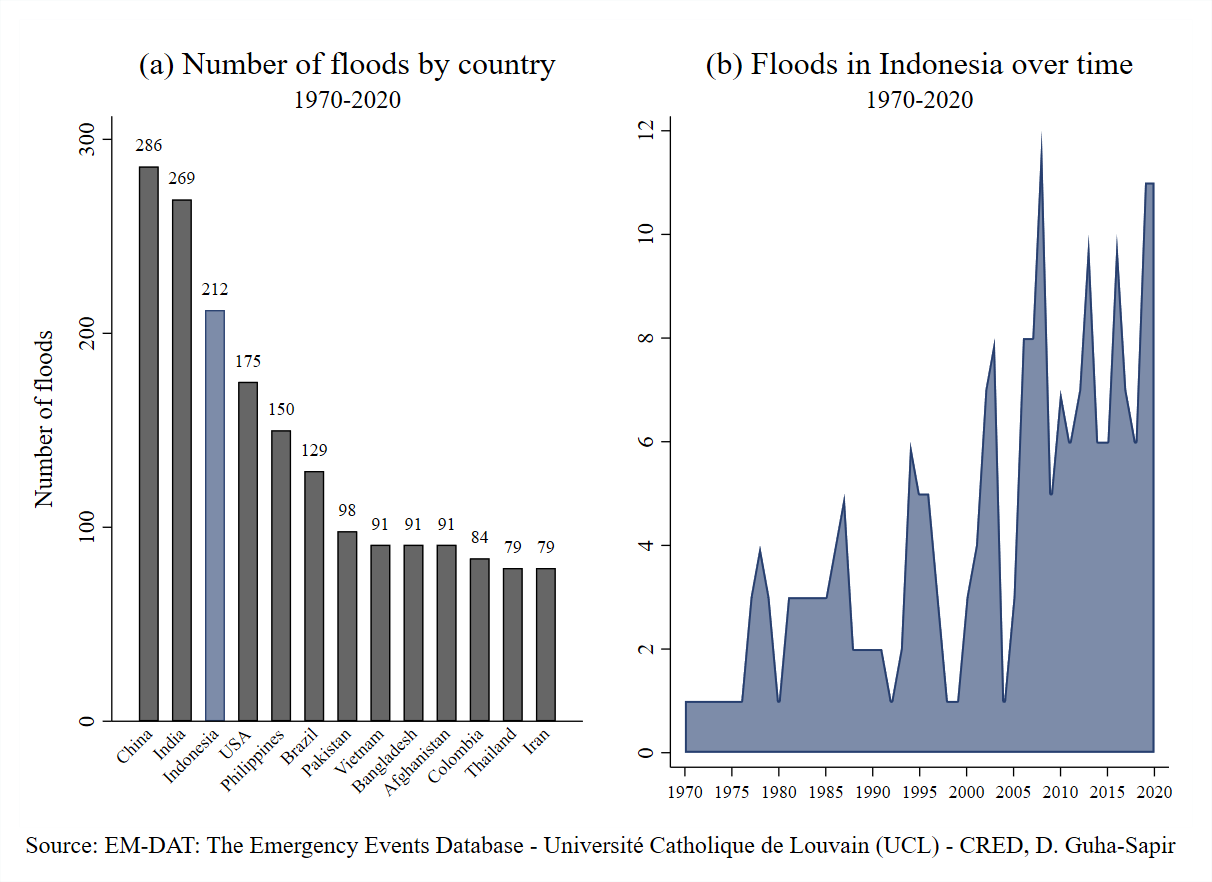
Graphs created by authors based on flood occurrence data by country available at the Emergency Events Database (EM-DAT) by the Université Catholique de Louvain (UCL), CRED, D. Guha-Sapir.