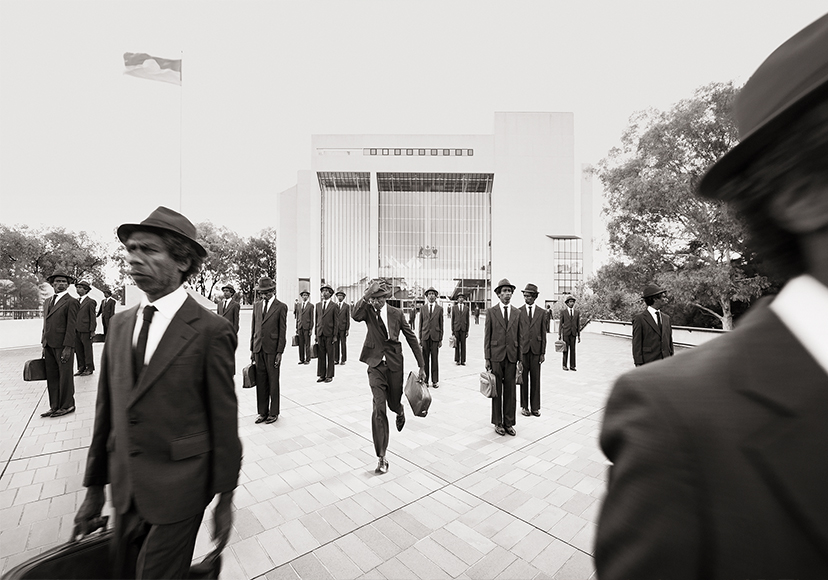
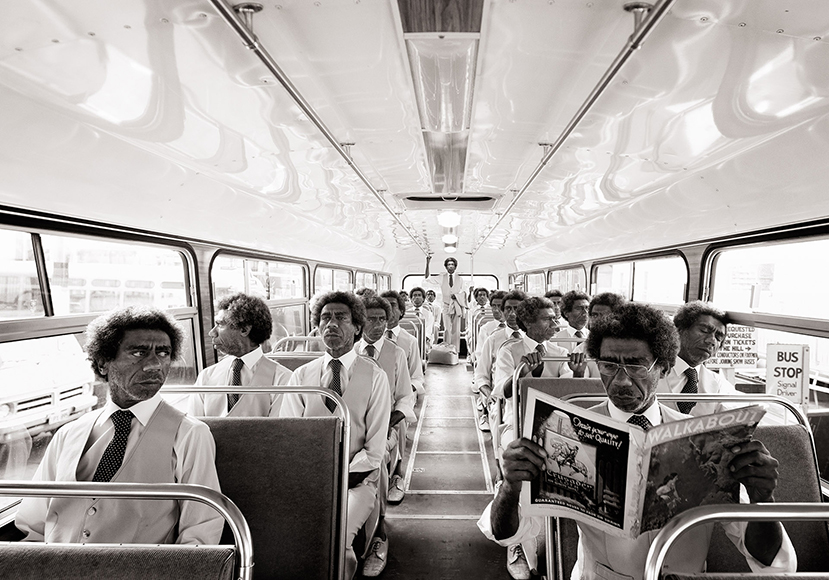
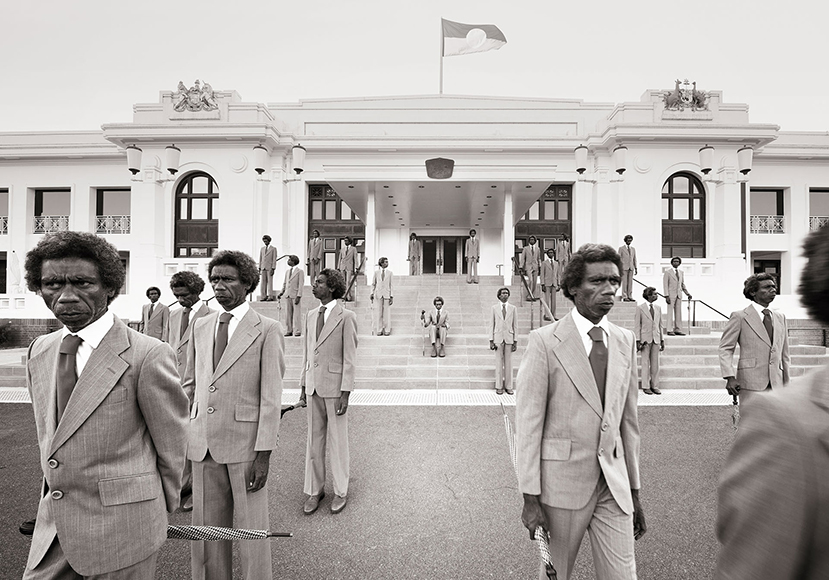
Michael Cook is a Brisbane-based artist and Bidjara man who invites audiences to reimagine the conflicted colonial history of Australia and reflect on the present-day treatment of Aboriginal and Torres Strait Islander people. Touching on the discriminatory nature of Australian society, his images often subtly reveal inconvenient truths and challenge ingrained belief systems. In his Majority Rule series, Michael Cook asks audiences to speculate about the question, what if Indigenous people were ninety-six percent of the Australian population and non-Indigenous people only four percent?
All my work is about making people aware of our history so they can find a little bit more empathy around why situations are what they are in Australia and find direction about how we can respond to things in the future. It’s about looking to the past to build a better future.
So, with the Majority Rule series I did a role reversal on the majority of Australia and the fact that only about four percent of the population identify as being Indigenous. Having my model Joey repeated over and over is something I never saw as a kid growing up. I never saw lots of Aboriginal people getting around, going to and from work. This work references the late sixties because that is when we had a lot of political change in Australia with the Referendum at that time. For that series, I shot in old Parliament House and the photograph of Joey standing up is where Neville Bonner used to sit. As an Aboriginal kid growing up, being adopted and knowing about my Aboriginality, the first Aboriginal person I ever remember meeting was Neville Bonner. He and my mum were friends and he helped me identify with my own Aboriginality.
I was raised in Hervey Bay. The traditional owners from that area are Butchulla but my ancestry is from the Charleville area which is Bidjara Country. I was adopted at birth and raised with my non-Indigenous family. I’ve always understood my Aboriginal heritage through my adoptive mother who was heavily involved in human rights politics when I was growing up.
I produce artwork quite differently to a lot of contemporary Aboriginal artists—using a soft approach. During my upbringing as an adopted child I was encouraged to ask a lot of questions about myself and society, and now I ask questions through my art. I am interested in creating dialogues rather than trying to push a direct message. That way audiences come up with their own thought processes around the work. My art asks a lot of questions. Leaving it open invites people to explore it in their own way from their own limits and potential to come up with their own answers.
You can go as shallow or as deep as you want to go with Majority Rule and that’s my intention, to allow a whole bunch of people from different backgrounds to view the art and get something out of it. We’re all telling the same story at the end of the day about the same history. Hearing what people get out of my work makes me feel good. Occasionally they will tell me something they got out of looking at the art that I didn’t think of when producing it. That feels amazing—I feel like I have done a good job!
Growing up I experienced the kind of racism everybody talks about. In 1970s Australia you were made to feel ashamed to be Aboriginal. The racism didn’t come from my family who always told me to ‘stand up and be proud of who you are’. Sometimes at school my friends would just be mucking around and having fun, but if you heard them talking now, they would sound extremely racist. I learned to laugh it off. Times have changed and now kids grow up in a more politically correct society.
— Michael Cook
Discussion Prompts and Learning Activities
Spend some time looking carefully at images from the series Majority Rules. What kind of questions arise from this artwork? Based on what you know already, how would you answer them?
Michael Cook says, ‘We’re all telling the same story at the end of the day about the same history’. What story and history do you think the artist is referring to here? Discuss.
Majority Rules refers to the historical time of the 1967 Referendum in Australia. How has Michael Cook used costumes, props and locations within the photographs to refer to this time period? Research the amendments made to the Australian Constitution at this time and the impacts they had on the lives of Aboriginal and Torres Strait Islander people.
Michael Cook describes a personal connection with Neville Bonner. Who was Neville Bonner? Why is he so significant to Aboriginal people? How did Michael Cook pay homage to Neville Bonner’s legacy in the series Majority Rules?
Michael Cook conceives of each of his bodies of work as a photographic series. Research some of his other projects and describe the subject matter and stories that they explore.
Michael Cook has developed a very distinctive aesthetic style using digital retouching and layering to create compositions that look convincingly real. To create Majority Rules, the artist photographed his model Joey performing various poses within the frame from a fixed camera on a tripod. Experiment with some of the digital techniques used by Michael Cook to create a composite portrait of one of your friends in Photoshop.