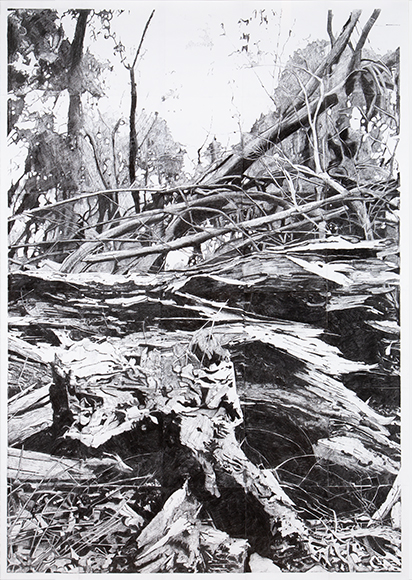
Born in Redfern, Brian Martin is a descendent of the Muruwari, Bundjalung and Kamilaroi peoples. His monumental charcoal drawings depict places that are deeply significant to him. Methexical Countryscape Kamilaroi #10 is a landscape work that is composed from a grid of smaller sections that have been brought together. Each panel draws on inspiration from black and white photographs taken on Country. Every mark made on the paper depicts the experience and texture of being connected to place.
Methexical Countryscape Kamilaroi #10 is a charcoal drawing. For the Kamilaroi and Bundjalung Countryscape series of drawings, I travelled to where my grandmother was born and took photographs of specific areas of Country that hold meaning for me. These photos are taken with analogue film as opposed to digital. I liken it to drawing with the camera—with analogue film, you need to compose the image carefully. I am Bundjalung, MuruWarri and Kamilaroi and this has significance when thinking about our relationality with Country and practice. My grandmother was born on Kamilaroi Country in 1911, so the Kamilaroi series of drawings have significance for me. When I create work, I do a mix of things. When I first started making art at a young age, it started with drawing, then I painted for many years. In recent times, I have returned to drawing as drawing is immediate, it’s all about mark making, whereas painting is more laboured and cerebral.
Place is important for Indigenous peoples and also for creative practice. I grew up in Redfern in Sydney and at that time there was a good sense of community there, and the only issues we experienced as a community were really from authoritative bodies such as the police. Redfern has always been represented in a negative way, especially in the media and from people who had no relationality with it. It was a dynamic place, lots of things going on. I am not too sure about Redfern now, but I grew up there in the ’70s and ’80s and it was an amazing place to be.
I think all lived experience shapes us. People view negative things as having a negative impact on people, but I also see them as a positive thing. Growing up I got to see many different worlds, especially the justice system, in terms of family members going in and out of these systems and therefore I had different interactions with them. This means you have a different perspective on things and through this it means you have an eclectic experience.
Being from a large family, a colourful upbringing, meant that for me making artwork was a space that was mine and no one else’s—a niche that I could escape to. That’s why it’s sad finishing a work, as it is no longer yours in a way and it goes into the world. So, when it is just you and the artwork, it’s the most beautiful thing; that space that you’re in and it’s like anything can be going on around you. It’s phenomenal to be in the act of making.
When you create something, eventually someone is going to look at it and talk to you about it, or if you make things together you collaborate. Those conversations and relationships have been going on for millennia in our culture. It is about connection and it’s about relationality to people, to entities, to Country. It’s always about some sort of relationality to the world, that might be political or involve a reclamation of culture, or ancestral memory, or—whatever it may be—there’s a deeper connectedness.
We need to remember the dynamic of colonisation was premised on the non-relational and on self-regard and disregard. When we think about the massacres of our peoples and the assimilation policies of removal, we need to consider the importance of culture, history and place. My grandmother was removed from Country, and this reminds us of the complexities facing our relationalities. I think the idea of culture is premised on the idea of place. But place isn’t just Country, place is people and events in time. We’ve been displaced and reconfigured through colonisation and government policy. I think sometimes we can fall into the trap of thinking that we must have this unbroken connection to Country to be an Indigenous person. I don’t think that’s the only case. We have connection to other things, and a lot of our people didn’t grow up on Country. People grow in multiple different ways, and that is what culture is about today—always moving, surviving, mutating, transforming. If it doesn’t, it dies. This is the significance of our collective cultures, its and our ability to adapt and survive.
— Brian Martin
Discussion Prompts and Learning Activities
Why do you think Brian Martin made an artwork inspired by his grandmother’s Country? Compare and contrast the place that Brian Martin has depicted in Methexical Countryscape Kamilaroi #10 to the environment where the artist spent his childhood in Redfern.
Imagine that you had the opportunity to meet Brian Martin. What would you most like to ask him?
Reflect on your own family history, cultural background and lived experience. Can you think of any experiences that have been influential in shaping your identity? Discuss.
Methexical Countryscape Kamilaroi #10 is a large-scale charcoal drawing. Charcoal is one of the oldest drawing mediums. It can be used to draw lines or it can be smudged onto the surface of the paper or layered to create tonal density. Look closely at Methexical Countryscape Kamilaroi #10. What kind of tones, textures and marks can you see within the work?
Go for a walk in your local neighbourhood. Seek out and create an artwork about a tree that you like or that is important to you. Take a series of photographs of the tree you have chosen. Use this photographic documentation as a starting point for creating your own charcoal drawing.