Artist Statement: Dhambit Munungurr
This text is drawn from a conversation between Dhambit Munuŋgurr (Djapu, Waṉḏawuy and Dhuwa) and Will Stubbs (Co-ordinator of Buku-Larrnggay Mulka Art Centre) in Yirrkala, Northern Territory during October 2025:
I am Dhambit Munuŋgurr. Dhambit means rock in Elcho Island. A rock in the beach represents Dhambit. That’s where my name is from. I am Munuŋgurr, Djapu Clan, and my totem is shark. The shark eats the small fish. Deep in the open Sea. My mother’s name is Gulumbu Yunupingu. She is Gumatj. Married to my dad. Dad had two wives, but they were sisters. I was born in Yirrkala, in Yirrkala Clinic, same wäŋa (place) that is the Yirrkala Art Centre that I paint in now. My homeland isWaṉḏawuy, that’s where my grandfather with 30 wives lived! His name was Woŋgu Munuŋgurr.
I paint in blue, and I think about what’s in the deep blue Sea. Baru—crocodiles, fishes, whales, Ŋarrpiya—octopus, miyapunu—turtles. We live next to a deep Sea. We are not out in the inland, Diltji—away from the sea. I paint in blue because that’s how we live, the blue in my paintings, we can see the Sea outside. The Deep Sea. The Art centre gave me blue from the blue ink cartridges. I can’t grind the guṉḏa (ochre) myself, the rocks to make colour, because of my disability.
Ṉuwayak (Bark) is important to Yolŋu . My people have been cutting bark long time. Up here, for many generations. My husband collects the barks for me in the Wet season. He hunts for the bark from the Eucalyptus Tree. It is hard to get the bark. Traditionally it is cut with an axe, but my husband uses a chainsaw. He cuts the tree down, because the tree dies anyway. The good straight bark. I was there watching him. Gurtha (Fire) straightens the bark. We straighten the bark with Gurtha, but my husband does it at home, with a gas torch, and then he brings the bark to the Art Centre two weeks later for me to paint. All my bark comes from my husband Tony. I don’t trust anybody else. He’s the only husband I met.
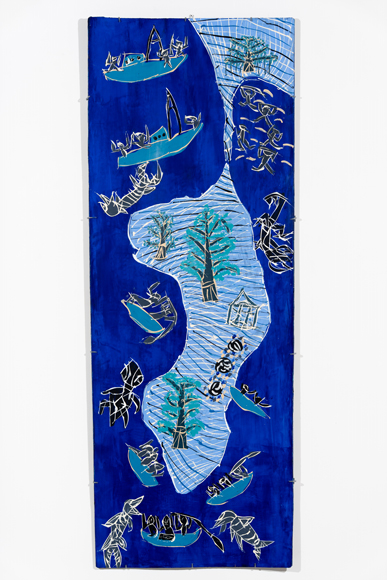
In my painting we see Yolŋu people meeting the Makassans. It was a good exchange. The Makassans came to see the place, and to introduce ŋarali (tabacco). Yolŋu people could get ŋarali or anything from the traders. They collected the Dharripa—the trepang (sea cucumber)—for their food. I have memories of friendship and cultural exchange with the Makassans from my mother who told me. Other people talking about Makassans. Old people. I could hear them talking.
It is important to me to tell the Makassan Story through my art because I heard a lot of Creation talking. Of nature. I paint it because it’s my ancestor’s Story, my grandmother’s Story. It’s part of the history of the place where I live, Gunyaŋara. Makassans came to Yirrkala, the rangi (beach) at Yirrkala. Dhalakarr, near the beach at Yirrkala. Makassans came to see the place. All the Makassans came in first.
Learning activities and discussion prompts for the classroom
- Artist Dhambit Munuŋgurr is a senior Yolŋu woman from coastal Northeast Arnhem Land in the Northern Territory whose practice shares her deep understandings of Country and the Creation on the Land and the Sea. Look carefully at the artwork Gunyaŋara Makassans (Gunyangara). What symbols and motifs can you see Dhambit has included within the artwork to connect audiences with her ideas?
- Dhambit is a custodian of important stories and she makes art to preserve and share knowledge with the people who see her work. What does it mean to be a custodian? How do you think being a custodian influences Dhambit’s art-making?
- Dhambit’s totem animal is a shark. What do you know about the importance of totem animals for Aboriginal and Torres Strait Islander peoples in Australia and First Nations peoples around the world? Do some research to find out more. Reflect on whether there are any animals in your own culture and life experience that are of special significant to you and why?
- Dhambit is the first Yolŋu (Yolngu) artist to have permission to create artwork with blue paint, and it has become a signature colour in her practice. What does Dhambit reflect on about her use of the colour blue within her artists statement? What kind of ideas within her painting relate to the colour blue? Are there some other artists in art history that are renowned for working with blue as part of their practice? Who are they? Choose one of these artists to do some further research about. Then in a visual analysis compare and contrast Dhambit’s practice with the artist you have selected.
- Dhambit painted her artwork Gunyaŋara Makassans onto bark and in her artists statement she shares some insights about the processes used to harvest and prepare this material for painting. How have these processes that have being going on for millennia changed in contemporary times?
- For many centuries before European colonisation, the Yolŋu and Makassan seafarers from Indonesia were both friends and trading partners. The subject matter in Gunyaŋara Makassanspresents the history of Makassans on Yolŋu Country and the places where the visiting Makassans camped, which is important knowledge for the community. In her role as a custodian of these stories, Dhambit depicts boats, coastline and trees in the painting Gunyaŋara Makassans and speaks to the Country and places where the Makassans prepared the Dharripa (sea cucumber) for many generations. Why do you think it is important for Dhambit to honour and share these stories of friendship and cultural exchange though her artwork with wider audiences? Discuss.