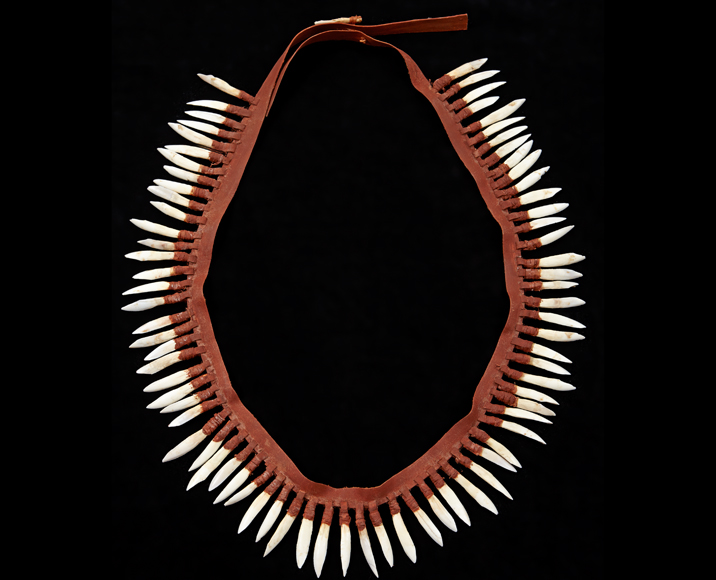
Maree Clarke is a Mutti Mutti/Yorta Yorta and Boonwurrung/Wemba Wemba woman who grew up in northwest Victoria, on the banks of the Murrumbidgee River. She is an acclaimed multidisciplinary artist and a pivotal figure in the revival of southeast Australian Aboriginal art practices that were disrupted during colonisation. Clarke’s process of research and cultural restoration is collaborative and generous, involving a passing on of cultural knowledge and practices to the next generation through the creation of traditional possum skin cloaks and kangaroo teeth necklaces. She also uses contemporary materials and technologies such as photography, holograms, 3D printing, glass and video to further connect with the ceremonies, rituals and language of her ancestors.
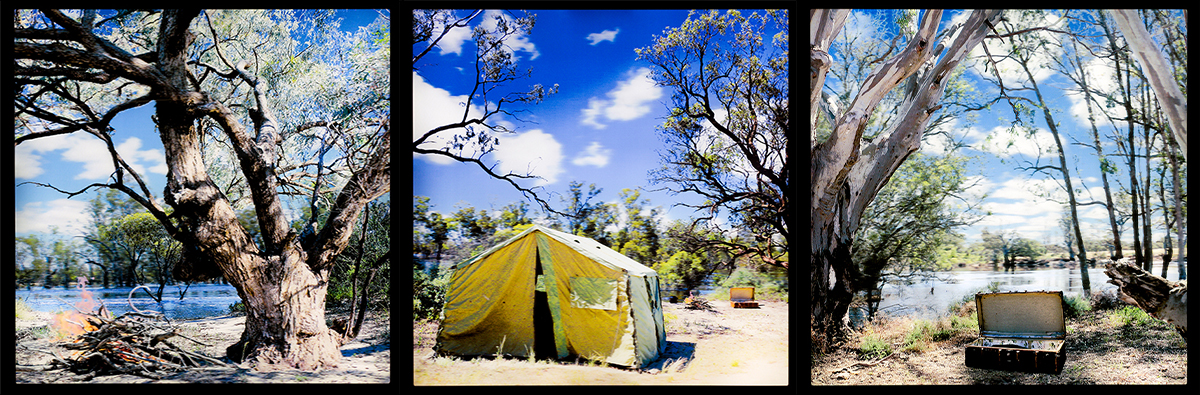
Clarke’s triptych of lenticular photographs, On the Banks of the Murrumbidgee River, was created as a site-specific work for the Sir Louis Matheson Library at Monash University's Clayton campus. These extraordinary lenticular prints explore the artist’s personal history and notions of family and place .
My art tells stories of my family and connection to Country, culture and place. On the Banks of the Murrumbidgee River is a series of lenticular prints about the time we lived behind the mission in Balranald, down near the riverbank. My grandparents had a camp and our camp was not far from theirs. We lived in a tent and my bed was a suitcase. This was a time before the 1967 Referendum. These lenticular prints are compiled of many layers to make them appear three dimensional.
I grew up in Mildura but lived on two missions before moving there. We lived for a time on the mission in Balranald and Munatunga Mission in Robinvale. I am a Mutti, Wemba and Boon Wurrung woman. I claim these traditional lands through my father and mother. I am one of eleven children. I had seven brothers and have three sisters. It was great. We had our own individual friends, but we also hung out together a lot.
I had three brothers die close together twenty years ago, which was devastating for our family. So now I do a lot of work around traditional mourning practices. In 2010, I was invited to be part of an exhibition about life, death and spirituality. At that time I did not know about our traditional mourning practices. So, I did some research and got permission from my elders to work with Aboriginal women from different backgrounds living in Victoria: thirty-eight women to represent the thirty-eight Victorian Aboriginal tribes. I invited these women to come and make a Kopi mourning cap as part of this project and share their stories about loss, sorrow and mourning. To create the installation, I had to travel back to Country where this practice is from. I collected sticks to represent the huts women would sit in during mourning and had the thirty-eight Kopis sitting on red dirt representing the Country. The individual stories were projected onto the floor in front of the installation.
Then I ended up working with forty-five Aboriginal men, designing seven T-shirts representing the scars men would bear on their arms during ceremony. I photographed the men in the T-shirts, with my own interpretation of the scars and the stories men have around mourning. I have since shown different versions of this work in New York, London and Cuba. In Cuba, despite the language barrier, people understood the work. With art you do not have to speak the same language; art speaks for itself. The message comes through what I put into the works. And what I put in is what I get out of my work.
I created my first photographic hologram two years ago and had to engage with a physicist. I have artworks at the University of Melbourne and at the National Gallery of Australia made using glass with white, brown and red ochre and combining white cockatoo feathers with crystal glass or eighteen-carat gold-plated kangaroo teeth. I have made 3D-printed kangaroo teeth true to size, then enlarged them; and made 3D-printed echidna quills and 3D-printed crow feathers in bright colours—such as hot pink—as jewellery and body adornments. They are just beautiful. I love the fact that I am moving into different mediums to create different artworks. Unless you know the story behind them and me, you do not know if they are Aboriginal or not. This challenges people’s ideas—we do not fit into a box and there are not stereotypical Aboriginal people or art.
Down south we are invisible. I just can’t believe that we’re still invisible today. When people think of Aboriginal art they still think of the Central Desert and top end. Mind you, the work of Central Desert mob on the ground has become contemporary, being painted on canvas only since the early ’70s. However, everyone is telling stories from Country. I do not know an Aboriginal person who is not telling stories of culture, family and place through their artwork. I like to tell these stories in a contemporary way to get people to notice. You have to keep pushing the boundaries and putting it out there.
— Maree Clarke
Discussion Prompts and Learning Activities
On the Banks of the Murrumbidgee River is a triptych that evokes Maree Clarke’s memories of childhood. Look carefully at the symbols and visual cues the artist has used within the artwork. Describe what you can see in a short story or poem.
Maree Clarke says, ‘there are not stereotypical Aboriginal people or art’, and her practice often challenges preconceived notions of Aboriginal art. Do some research about more of Maree Clarke’s artworks and examine how she has explored a wide range of materials, technologies and processes in innovative and unexpected ways to tell stories about Country, culture and place.
Research lenticular photography and, if you can, find an example of a lenticular postcard to look at together in the classroom. How does the experience of viewing a lenticular print compare to a typical photographic print? Why do you think Maree Clarke decided to create On the Banks of the Murrumbidgee River using this process?
In the artwork On the Banks of the Murrumbidgee River Maree Clarke tells a personal story through images. Use photography to produce your own series of images that tell a story about a memory that is important to you.