Artist Megan Cope is a Quandamooka woman from North Stradbroke Island/Minjerribah. Working across print making, installation, sound, video and public art she investigates issues relating to identity, geography and language, often drawing upon historical sources including colonial maps of Australia.
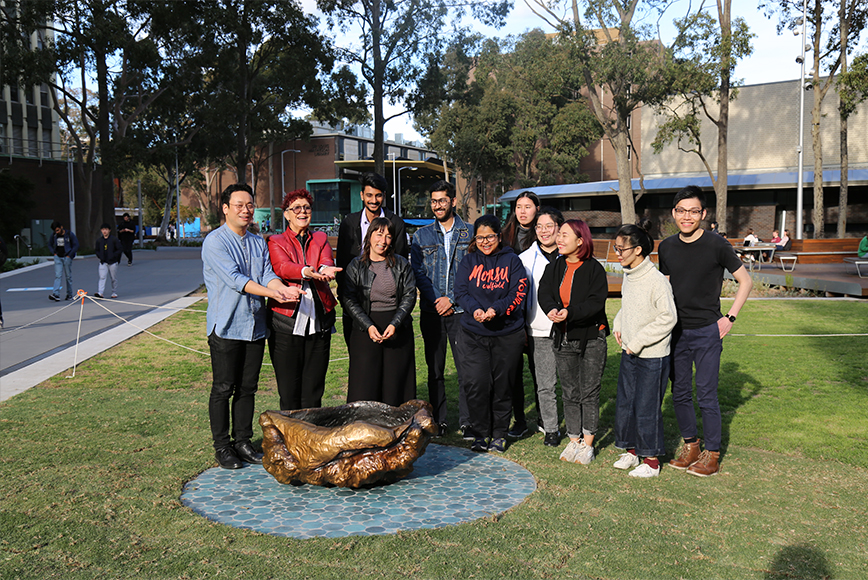
Weelam Ngalut (Our Place) is a public artwork that welcomes students, teaching staff and visitors onto the Country of the peoples of the Kulin Nation, the traditional owners of the land and waterways at Monash University. This artwork relates to ceremonies of cleansing and welcome.
‘Weelam Ngalut’ means ‘Our Place’ in Woi Wurrung language, which is the language of this land. The installation is a series of elements that have been integrated into the landscaping of the Menzies Courtyard to show visitors and students the diversity of Aboriginal people working and studying on campus at Monash University.
The first part of the work is words for welcome and hello in various Aboriginal languages, which are the first words we say when we meet one another. The second part is the pathway displaying the impressions of five different types of gum leaves to pay respect to the five groups of the Kulin Nation: the Wurundjeri, Boon Wurrung, Wathaurong/Wada wurrung, Dja Dja Wurrung and the Taungurung.
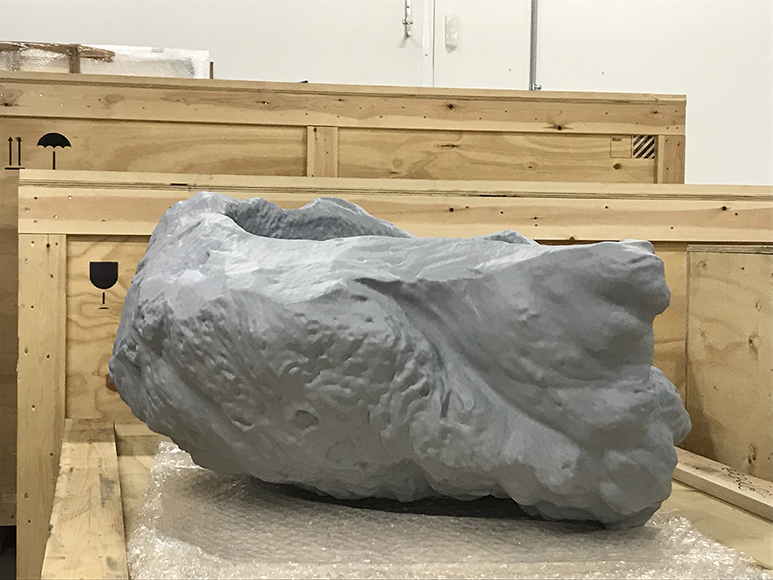
The gum leaves on the pathway lead you to the bronze tarnuk, a traditional water vessel and smoking bowl. This tarnuk is a replica from one of the oldest pieces in the Melbourne Museum, collected in 1888. We 3D-scanned the tarnuk, increased the scale and then 3D-printed it to make the mould for the bronze. To me this tarnuk is very important because the original wooden one is so big and heavy it subverts the myth that Aboriginal people did not have permanent settlements. The tarnuk will become part of living Koorie culture on campus and will be activated by elders for cultural events.
I was born in Brisbane and as a baby spent a lot of time with family in the Redlands and Brisbane. I also travelled with my dad a lot, living in his panel van and camping in the bush up the coast to Cairns, and then in Chillagoe while he worked in a marble mine. We moved to Tasmania when I was five and ended up there for about ten years. I visited Queensland every holiday and stayed with nanna on Minjerribah country. I came back to live in Queensland as a teenager.
I am a saltwater woman and I have always been close to the sea. Fishing and oystering are a big part of our culture. Many things I was taught by mob in Tasmania were connected to our Quandamooka mob, but also different of course.
My Country is where I belong, where my families belong and so all my art talks to that. It’s been important for me to continue learning our Jandai language, and for that to be the main thing visible: our knowledge of our Country and how that defines us and connects us as Quandamooka people. I use mapping as a premise to inform my art and convey the way we see Country—in our language and knowledge of the sea rising and the shifting sands.
I’m always trying to find ways to overturn the grand narratives perpetuated by the settler colonial state. The beautiful tarnuk does that. It’s important to me to continue to challenge these prescribed notions of Aboriginality in Australia because we have been defined by the colonial state since invasion. My grandparents on dad’s side and our Quandamooka ancestors survived attempted cultural genocide. Up until quite recently it was taboo to speak about our history and survival in these terms. Art allows me to articulate the things that our families have endured and are now in a process of remembering, reclaiming and practicing again—such as language, cultural mapping and remaking of our tools and everyday objects.
— Megan Cope
Discussion Prompts and Learning Activities
Megan Cope has embedded greetings in various Aboriginal languages within Weelam Ngalut (Our Place). As a class, read and speak some of these words together.Do some research to find out more about how Megan Cope uses text within her artistic practice.
How does the location of Weelam Ngalut (Our Place) near the entrance to Monash University Clayton Campus contribute to its meaning?
As a Brisbane-born, Quandamooka woman commissioned to create a site-specific artwork in Melbourne, Megan Cope needed to work with cultural protocols. She consulted with N’arweet Dr Carolyn Briggs AM along the way. What are cultural protocols and why are they important? Discuss how they support the integrity of Weelam Ngalut (Our Place).
Megan Cope selected a tarnuk held in the collection of Museums Victoria to transform into a bronze sculpture. The original tarnuk would have been used for holding water and for smoking ceremonies. It is created from a gnarl of a gum tree hollowed out by gouging and fire. Megan Cope explains, ‘because the original wooden one is so big and heavy it subverts the myth that Aboriginal people did not have permanent settlements’.As a class, research and discuss some more examples of Aboriginal cultural practices and places that indicate a continuous connection to the land.
The form of the tarnuk in Weelam Ngalut (Our Place) has been cast in bronze from a mould made from a 3D-scanned and printed version of the original, thus marrying traditional and new technologies. Research some historical examples of bronze public sculptures. Why do you think Megan Cope chose to use this material for this new work?
If your school has a 3D scanner and 3D printer, experiment with creating some sculptures using small found objects.
Casting is a sculptural process in which a liquid material is usually poured into a mould (which contains a hollow cavity of the desired shape) and then allowed to solidify. As the liquid hardens, it adopts the shape of the mould. Explore the sculptural process of mould-making and casting with materials such as clay, plaster and wax.
Photo: Megan Cope with N’arweet Dr Carolyn Briggs AM and students from Multimedia Design, Faculty of Art, Design and Architecture, Monash University, viewing Weelam Ngalut (Our Place), 2017–19