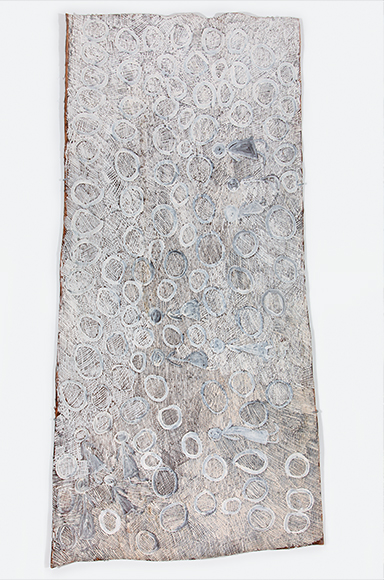
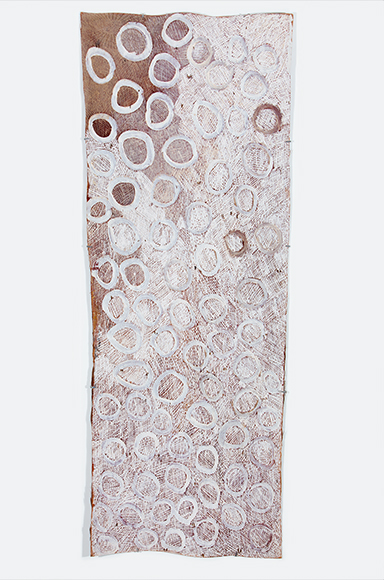
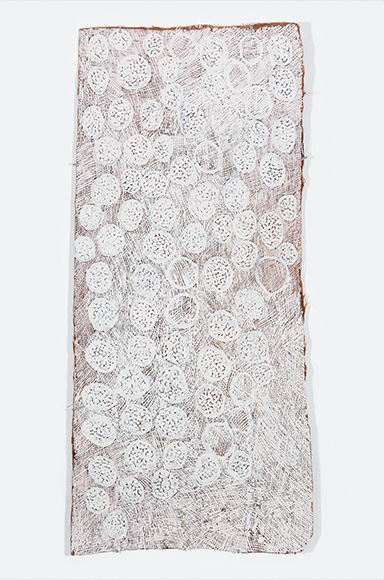
During her life, Yolŋu and Gumatj clan artist N. Yunupiŋu lived in Yirrkala and worked at the Buku-Larrŋgay Mulka Art Centre in the north-east Arnhem Land region of the Northern Territory. Taught to paint by her father—the late artist and cultural leader Munggurrawuy Yunupiŋu AC—she developed a personal approach to painting that moved away from the inherited stories and embedded meanings typical of Yolŋu art-making. Known for her ochre bark paintings and distinctive white crosshatching, Yunupiŋu liked to use what was at hand; this led her to create larrakitj, prints, works on paper and acetate, and animations. Yunupiŋu’s subject matter was also varied, ranging from bush food to the Sydney Harbour Bridge and abstract mark-making..
I was born on the beach at Yirrkala near where the Dhawu (large Banyan tree) stands. My father Muŋgurrawuy lived there with my mum, Buŋay, who was one of his many wives. We lived near where Banduk’s house is now. I had lots of siblings but from my own mother I was the eldest. I had two younger sisters, one who is deceased who was the mother of Waykarr and Mulmupa, and one other daughter who is now deceased but I will say her name now although it makes me sad, Nyunany. There were so many other brothers and sisters, but my mother lived closely with my father. He used to hug me and hold me close on his lap. If I would play too long on the beach, he would call for me, ‘Come here my dear don’t let the crocodile get you!’ We did not travel to Birany Birany, the Gumatj homeland, until the 1970s. We would visit Gunyuŋarra another Gumatj homeland but there were no houses then. We would go and sleep just on the beach. We would travel by Land Rover on a rough track in those days.
I used to watch my father painting and he would tell me that later I would paint on my own. I spent many hours watching him. Painting was always happening and creating small sculptures for sale to the mission. My mother would make Wayin (birds), Mokuy (spirits) and Waŋ'kurra (bandicoots). We would cut the wood from the jungle, shape it and sand it, paint it and incise it. I would always help my mum with this.
When I married Djapu leader, Djiriny, we went to Garrthalala and I lived side-by-side with his other wife, Gunygulu, and we worked together on our art: small bark paintings and sculpture. She was impressed that I knew how to make and do these things and encouraged me to work and paint in my own right. I lived in Garrthalala for a long time. We worked and we lived from the land. We ate seafood and shellfish mostly. When our husband died, I came back to Yirrkala. Since then I have been making art most days and that is what I do. This is how I have come to be. I paint because I think my art looks lovely.
— N. Yunupiŋu
Excerpt from a statement by N. Yunupiŋu, Yirrkala, 18 March 2019, translated from Yolŋu matha and published with permission from Buku-Larrŋgay Mulka Art Centre.
Discussion Prompts and Learning Activities
Look carefully at the three paintings by N. Yunupiŋu. Brainstorm a list of adjectives to describe them.
Bark painting is a traditional cultural practice in Arnhem Land. N. Yunupiŋu chose to paint on bark primarily instead of canvas. Speculate on the ways this choice of material impacts how audiences experience and respond to her artworks. Do some further research about bark paintings and compare some historical and contemporary examples.
How did N. Yunupiŋu learn about how to prepare and paint on bark?
The element of line plays an important role in communicating ideas and meanings in artworks. Lines can direct our attention around an artwork. They can also evoke emotions. How did N. Yunupiŋu use lines and gestures to create images? What kind of feelings do they convey?
Ochre is a fine earth pigment sourced from the land. White ochre is highly prized and very sacred to Aboriginal communities across north-east Arnhem Land. It was traditionally used for body painting during ceremony and is also used in paintings like the ones made by N. Yunupiŋu. Consult with a local Aboriginal artist or community organisation to learn more about the cultural significance of materials that come from your local area.