About Pitcha Makin Fellas
The Pitcha Makin Fellas are a group of artists, or arts collective, based on Wadawurrung and Dja Dja Wurrung land (Ballarat) who are passionate about their culture and community, and share their pride through their art. The group first began in 2013 at the Ballarat and District Aboriginal Cooperative where they had a meeting to create a children’s book. At the end of this meeting, seven artists and writers came together to form the collective.
Throughout the years, the Pitcha Makin Fellas have had many different people be part of their collective. They currently have three members: Dja Dja Wurrung-Gunditjmara-Yorta Yorta woman Aunty Alison McRae, Dja Dja Wurrung-Gunditjmara Yorta Yorta man Jack Shilvock, and Gunditjmara man Uncle Ted Laxton, who was one of the original seven when the group first formed.
The Pitcha Makin Fellas have become known for their tongue-in-cheek humour and the signature stamps that they make to create their brightly coloured paintings with messages of caring for Country and community. If you would like to explore ways you can care for Country and communities you are living in, or create your own collective artwork with stamps, you might like to try some of the student learning activities below.
If you would like to learn more about the Pitcha Makin Fellas, you can hear them share more about their storytelling, creative practice, and a special project they shared with students at Melbourne Indigenous Transition School (MITS) in the video below.
Watch the Makin Our Mark video here.
Student learning activities:
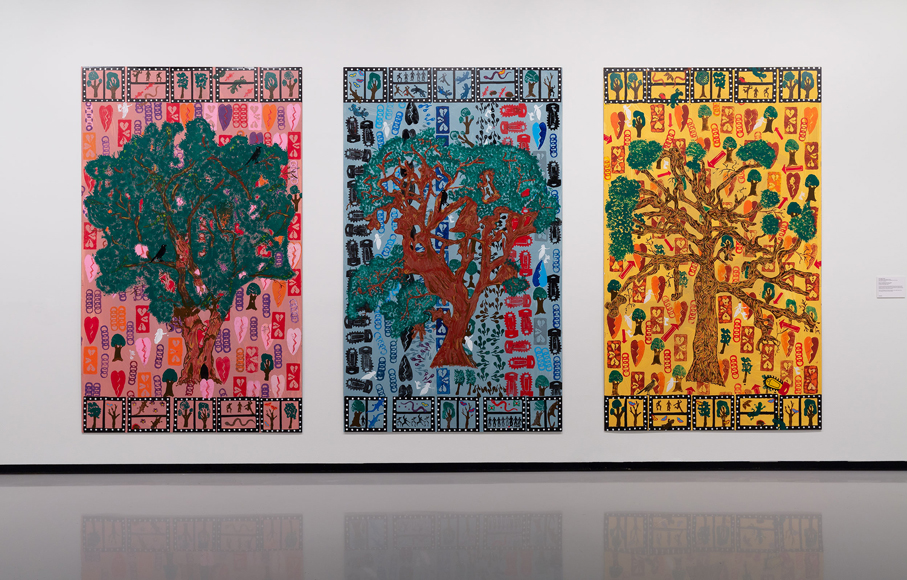
In their 2022 work Why Don’t Whitefellas Like Trees? the Pitcha Makin Fellas pay homage to Djab Wurrung peoples’ care for Country and their ongoing efforts to protect sacred trees and sites from destruction.
- What Country do you live on and go to school on?
- With a partner or in small groups, share what caring for Country means to you.
- As a class, brainstorm some of the kinds of actions you can take to care for the Country you live on, and some of the potential benefits of doing these activities. Can you achieve the best outcomes alone or will you need to work together? How can you help each other to care for Country?
Do you know of any groups or movements working to protect Country and culture where you live?
- As a class, do some research to find out about the organisations, community groups and movements that are working together to protect Country near you.
- Find out more about the actions these groups are taking to care for Country.
- Who are the leaders of these groups? Are they First Peoples who are custodians of this place (Traditional Owners)?
- Caring for Country is intricately connected to First Peoples’ protocols and teachings about how we live with respect and reciprocity for the land, skies, waterways and cosmologies of a particular place. As a class reflect on why First Peoples’ leadership is important in the ongoing protection of Country and culture.
The artwork Why Don’t Whitefellas Like Trees? features many colourful motifs and repetitive patterns made using the artists’ signature stamps.
- As a class, make your own collective artworks inspired by the Pitcha Makin Fellas about the environment. Create your own stamps out of recycled cardboard, offcuts from an old yoga mat and some acrylic paint.
- Along the way, consider the environmental impact of making art. Are any of the art materials able be reused, recycled or repurposed? If so, how? For example, could you consider sharing your stamps with other students in the class to use less resources?
- In the art classroom, create a community list of actions to care for Country. Give the list a stamp each time you achieve an action. Remember, caring for County is an ongoing practice so you might stamp the same action many times a week, or even in a day!
- What does your list look like at the end of the week? What about the end of the school term? Have you created your own colourful artwork through actions?
The Pitcha Makin Fellas are known for their ‘tongue-in-cheek’ humour in their artistic storytelling, which can be seen in the title of their artwork Why Don’t Whitefellas Like Trees?
- What do you think the importance of humour is in the The Pitcha Makin Fellas artwork?
- How might humour be a powerful way to ‘speak up and speak back to incidents of racism, discrimination and the ongoing impacts of colonialism’?
Monash University Museum of Art acknowledges the support of the Department of Education, Victoria, through the Strategic Partnerships Program