Brisbane-based artist Vernon Ah Kee is a member of the Kuku Yalandji, Waanji, Yidinji and Gugu Yimithirr peoples. His multidisciplinary practice encompasses large-scale drawings, text-based works, video and installation art. Through his work Ah Kee exposes the hard truths and impacts of colonisation and the continuing racism of Australian society, challenging our civic complacency.
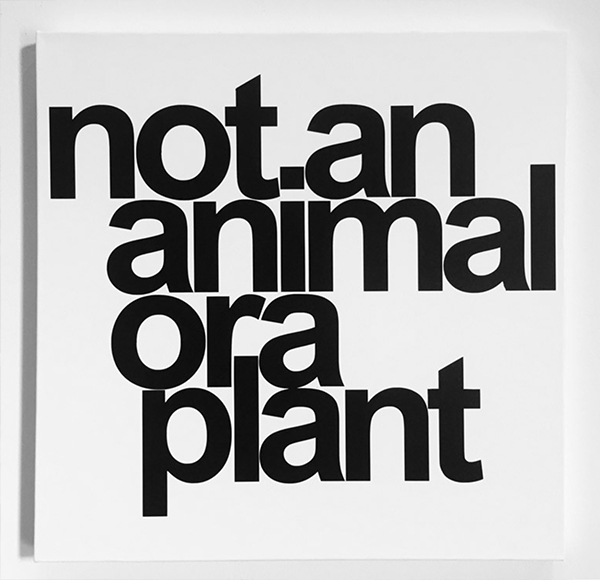
notananimaloraplant is a print. It was originally conceived as a vinyl text installation directly on the wall. They’re meant to be big flashy examples of smart design and sloganeering and playing with words and fonts. I did a year of design before I did fine art and I still love design theory. That clearly also informs my approach, particularly around text and fonts, and the minimalist aesthetic. In the very early days, I also made a T-shirt of it. I understand T-shirts as a format and as a platform. A lot of the text works I make are for T-shirts. They also function very well as prints.
I grew up with this idea that we were part of the Flora and Fauna Act and I never took it seriously—I still think it’s funny. But the truth of the matter of course is that the joke came about because we had no status. We simply did not exist—we were written out of history. So, this work refers to that. And, I was born in 1967. So, referendum year. Referendum was in May that year and for the first few months of my life, I really didn’t exist as a person. In fact, nobody did—not my older brother, or my parents or grandparents. And the government could do anything to us that they wanted. It was legal. The first time Aborigines were officially counted was in the ’70s in this country. So, this is not a sort of history game we are playing, this is my own life. I was essentially born as a non-person; that was my status and my existence, when I was a baby.
I was born in a little country town in north Queensland called Innisfail. I had my boyhood there before I went to high school in Cairns. Mum still lives in Cairns. I’ve got lots of cousins in north Queensland. My dad is Yidinji—Cairns down to Innisfail is his Country and we grew up there. My mum was born on Palm Island. Her people are Kuku Yalandji, Waanji and Koko Berrin. Waanji is in the desert north of Mount Isa, Koko Berrin is the West Cape. And on my dad’s side I am also Gugu Yimithirr, which is on the coast, around Hope Vale.
The government and legislation around native title essentially makes promises that they can’t keep. In lots of ways native title is designed to prolong and convolute things, and that’s especially true in north Queensland where you have so many groups. Some people think there is a lot of money in it, when there never is. The government promises great things but ultimately there are built-in caveats. There is an interesting sense of self and identity resulting from it because when I was a kid growing up, we didn’t go around declaring our language groups to each other, to other blackfellas; we would just know who we were. That would’ve been crazy. But that’s what is expected now because it’s a form of validation.
There are a lot of blackfellas who don’t know where they’re from and in the eyes of government and Aboriginal art they feel lessened by it. Whereas before there was this idea that you take people at face value. If they say they are blackfellas, then there is a certain level of acceptance that is already there. Not anymore.
For me it is very clear, I’ve grown up with a sense of identity that is solid. We never questioned ourselves. We grew up very poor. So, the conversations were about where we come from and who we are. Hardship is relevant across generations. There are several times in my life when I’ve known that I have been poor. But that is nothing compared to my parents. And that is nothing compared to my grandmother’s existence on Palm Island as a girl, which would have been very hard.
I think as an Aborigine, there is an idea that we have to say who we are. Who you are must show in what you do, what you say, how you speak and how you conduct yourself. That’s why it’s important that when Aborigines see my work, they know that I am speaking to them. And it is important that other native people from other countries know that I am speaking to them. Art is unifying. But it also stands up when it needs to. And you must know when to keep your mouth shut and when you are being asked to stand up and say something. I think art does that. I think that’s what art should be.
— Vernon Ah Kee
Discussion Prompts and Learning Activities
Imagine being considered part of the Flora and Fauna Act rather than as a person or citizen. How would that make you feel? Why did Australia have this law and when and how was it changed?
What is minimalism? How does the minimalist design aesthetic of notananimaloraplant contribute to its impact and meaning?
Vernon Ah Kee uses humour and sarcasm in his work to what effect? Do some further research to find other Aboriginal and Torres Strait Islander artists who also utilise humour as a strategy in their art-making.
notananimaloraplant is a bold, text-based artwork. Develop your own slogan that responds to a current issue in the world today. Research typography and experiment with various fonts and layouts to create your own T-shirt design. You might like to explore the T-Shirt designs from MUMA’s Art You Can Wear project as a source of inspiration.