



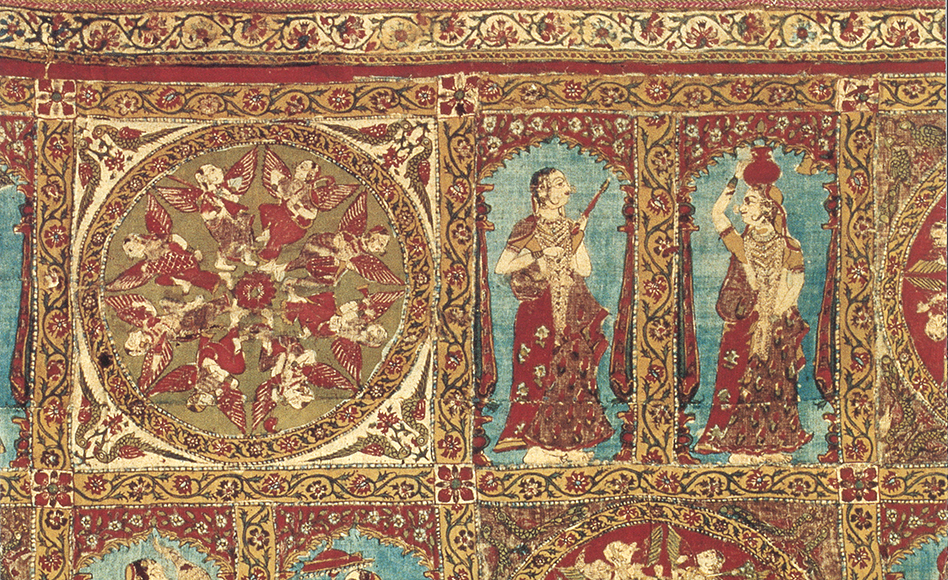
Woven Magic: Indian Textiles and their Influence in South-East Asia
Dates:
28 February – 12 April 1997
Curators:
Dick Richards and Robyn Maxwell
Location:
Monash University Gallery
Monash University, Clayton Campus
About the exhibition
Woven Magic presented fifty textiles from India, Cambodia and Indonesia, dating from the eighteenth century. Ranging in scale from small delicate silks to five metre lengths of printed and painted cotton, all exhibits were drawn from the collection of the Art Gallery of South Australia.
The textiles showcased a rich array of traditional motifs—floral, dragon and Buddhist symbols—as well as designs associated with Thai and Indian decorative traditions. The exhibition traced the historical significance of Indian textiles in Southeast Asia, particularly their role in trade and their far-reaching influence on regional design. It also highlighted the technical sophistication of Asian dyeing practices—such as fast dying —which predated comparable developments in Europe by centuries.
Among the garments on display was a rare example of Indonesian tailoring: a pair of trousers and two sashes from Yogyakarta, made from imported patola silk and reputedly created for the Sultan.
MUMA Online Exhibition Archive
MUMA’s online archive is expanding. We welcome your feedback and input. Please contact muma.communications@monash.edu with any information that could help enrich the archive for future audiences.
Image: Catalogue cover showing a religious hanging, pichvai or chandova (medallions and pairs of female figures) c.1780, Burhanpur, India, Central Deccan cotton, mordant painted, pigment painted, batik wax resist, braid, 75 x 96 cm. Collection of the Art Gallery of South Australia, Adelaide. Gifted by Michael and Mary Abbott