
Parent Policy
Preamble
Promotion at Monash University is based on merit following a thorough and fair process. The University is committed to the principle of equal opportunity in promotion and recognises that staff contribute to its vision and goals in diverse ways. The achievements of candidates for promotion are assessed relative to the particular circumstances of their career progression and the opportunities which have been available to them.
Teaching and research (including education-focused) candidates who satisfy the relevant promotion committee that they meet the criteria for promotion are to be promoted irrespective of considerations such as the increased cost of staffing.
Research-only candidates will be promoted if they satisfy the promotion committee that they meet the criteria for promotion and provided that the relevant grant holder and/or head of unit can confirm that there is funding available for the promotion.
This procedure applies to all academic staff who:
- have a current performance development plan which complies with the requirements of the Performance Development Process: Academic Staff; and
- are seeking promotion to senior lecturer or senior research fellow, associate professor or professor.
This procedure should be read in conjunction with the Staff Development Procedure - Academic Promotion Committees Levels C-E.
Definitions
Academic performance standards: faculty or discipline-specific performance standards for all academic staff against which academic performance will be measured, particularly for the purpose of probation, promotion and performance development. The standards are qualitative, quantitative or a mixture of both across the three key areas of academic activity - research, education and service. They include identified ‘minimum’ performance standards, below which the staff member would be managed for unsatisfactory performance, and aspirational standards, which are relevant for promotion, in accordance with the requirements outlined in this procedure.
Achievement(s) relative to opportunity: is an evaluative framework in which the overall quality and impact of achievements is given more weight than the quantity, rate or breadth of particular achievements. Assessing achievements relative to opportunity involves giving consideration to circumstances, arrangements, career histories and overall time available to the staff member. This in turn allows appropriate evaluation of achievements in relation to:
- the quantum or rate of productivity,
- the opportunity to participate in certain types of activities, and
- the consistency of activities or output over the period of consideration.
Achievement relative to opportunity is a positive acknowledgement of what a staff member can and has achieved given the opportunities available and is not about providing “special consideration” or expecting lesser standards of performance.
Assessor: An expert in the field able to offer a balanced and confidential assessment of the candidate's standing in the field and of the merits of the application based on stated criteria. Assessors may or may not be known personally to the candidate and should be selected by the Dean/Pro Vice-Chancellor and President (Monash University Malaysia).
Conditional promotion: A conditional promotion means that the committee authorises the chair of the committee to approve the promotion if certain specific criteria are met before 1 May in the following year. A conditional promotion will come into effect on the date that the chair approves the promotion or 1 January in the year following the candidate’s application, whichever is the later.
Education-focused candidate: A candidate for promotion who occupies an academic role of engagement characterised by innovation and leadership in educational design and delivery.
Head of Unit: head of an academic or organisational work unit, for example Head of School, Head of Department or where applicable, a person acting as his or her nominee. If there are no heads of unit within the faculty, a deputy dean or equivalent may be delegated the head of unit’s responsibilities for the academic promotion process.
HR Business Partner: is a key member of the Monash HR Business Partnering Community and provides strategic advice, guidance and solutions that underpin key client goals, HR strategy and organisational vision to a particular client group.
HR Operations Centre: is a centralised HR team that brings together the HR Advisory, HR Business Support and HR Recruitment functions. The HR Operations Centre delivers a broad range of HR operational services at all stages of the employee lifecycle including recruitment and appointment of staff, staff enquiries and contract renewals.
Performance Development Plan: documents the annual work goals and career aspirations and development goals for the staff member and the specific targets and progress towards achieving those goals. The performance development plan forms the basis for the annual performance planning and review cycle.
Procedural irregularity: refers to where the University has not followed a process that is articulated in this procedure or the Staff Development Procedure - Academic Promotion Committees Levels C-E.
Promotion committee: means the relevant committee constituted in accordance with the Staff Development Procedure – Academic Promotion Committees Levels C-E that is responsible for assessing and determining the promotion application.
Promotion coordinator: is a designated staff member within Monash HR who is responsible for administration and coordination of the promotion process. The relevant promotion coordinators are:
- for applications to professor (Level E), the Senior Adviser, Policy and Academic Promotion in Monash HR;
- for Australian-based applications to senior lecturer or senior research fellow (level C) and associate professor (level D), a dedicated staff member within HR Operations, Monash HR; and
- for Malaysian-based applications to senior lecturer or senior research fellow (level C) and associate professor (level D), a member of the HR team at the University's Sunway campus.
Research Achievement Record: is a report that details the candidate's research outputs, funding applications, and HDR supervision during the relevant promotion period. For Australian candidates, this report is generated via the University's Business Intelligence system.
Research-only candidate: A candidate for promotion who is employed on a research-only contract of employment and who is appointed to undertake predominately research and research-related activities.
Rex: is Recruitment Express the University's online recruitment system, which administers requests to advertise, selections and appointments and generates employment contracts and variations of contract. For the purposes of this procedure, Rex is the online application system for promotion for all candidates excluding Monash University Malaysia candidates applying for promotion to levels C and D.
Student Evaluation Record: is a record of a candidate's student evaluation results for units that they have taught in or had a leadership role in. The record will cover the period relevant to the promotion application and is generated by University Planning and Statistics.
Eligibility for promotion
A successful application for promotion takes time to assemble and requires candidates to plan ahead to prepare the documents and consult with the required parties.
Promotion candidates must satisfy the promotion committee that he or she has, in accordance with the academic performance standards:
- been a sustained high performer at the current level of appointment; and
- has the capacity to perform satisfactorily at the level to which promotion is sought.
It will normally take several years at the current level of appointment to develop a track record which demonstrates that the above criteria have been met. A candidate's capacity to perform commensurate with the academic performance standards forms one component of the case for promotion and does not on its own constitute grounds for promotion. All relevant evidence of a candidate's performance and achievements as outlined in the case will be considered by promotion committees in making their decision. Each application is viewed holistically and the decision will be informed by, but not determined by, the relevant academic performance standards.
Overview of academic promotion process

Step 1. Candidates attend information session and discuss intention to apply
1.1 Candidate Information Sessions
It is highly recommended that prospective candidates attend a promotion information session in the year prior to applying for promotion and in the year an application will be submitted.
Candidates should refer to the academic promotion website for dates and further information.
1.2 Intention to apply
Candidates must discuss their intention to apply with their performance supervisor and head of unit:
- at least one year ahead and record it in their performance development plan; and
- confirm their intention with their performance supervisor and head of unit prior to the commencement of the promotion round.
Candidates considering applying for promotion to professor (level E) must discuss their intentions with the dean. It is expected that professorial candidates will have the support of the dean, the head of unit and their performance supervisor.
Research-only candidates who are employed on another person's grant must ensure they have the support of the grant holder in applying for promotion. Research-only candidates will also need to confirm with their head of unit whether there is funding available for the promotion. The funding need not come from the grant under which the staff member is employed, but where this is the case, the grant holder must confirm the terms and conditions of the grant contract allow for the staff member to be promoted and the use of grant funds to fund a higher level salary.
1.3 Candidates from Non-Faculty Areas
Candidates from non-faculty areas will be required to consult with their head of unit prior to the promotion round about the most relevant faculty to assess their application.
Non-faculty candidates should attend an information session in the faculty most relevant to their discipline.
Candidates will be required to advise the relevant promotion coordinator of the most relevant faculty to assess their application (or for professorial or Malaysia based candidates, the most relevant faculty to provide associate dean and dean reports) prior to applying.
Candidates must send a copy of their CV to the relevant promotion coordinator.
The relevant promotion coordinator will then seek agreement from the dean of that faculty on the candidate’s behalf that it is the most appropriate faculty to assess the application. If the dean agrees, the candidate will then liaise with the relevant promotion coordinator in preparing and applying.
Step 2. Academic promotion round opens
The academic promotion round normally opens in May and closes in June each year. Round dates are published on the academic promotion website.
Applications for promotion to senior lecturer, senior research fellow, associate professor and professor can only be lodged during the promotion round.
Candidates should be mindful of the need to consult early in the promotion round with their:
- performance supervisor and head of unit to negotiate timely completion of the case for promotion form; and
- relevant promotion coordinator to inform them of their intention to apply.
Step 3. Candidates prepare the case for academic promotion
Only achievements since a candidate's appointment to their current level can be included in the application for promotion. Candidates who moved to Monash from the same level of appointment (or higher) may include evidence of achievements from that level at the previous university or universities. However, achievements that pre-date the last appointment or promotion may be cited if they are still having a significant impact (for example a high profile publication that continues to be very highly cited).
A complete application for promotion is comprised of the Case for Academic Promotion Form: Levels C-E and the following supplementary reports as attachments:
- Research Achievement Record;
- Student Evaluation Record (not applicable for research-only candidates who have not allocated a weighting to education); and
- optional 5 pages (maximum) of supporting evidence.
Details regarding each of these attachments are included below.
Candidates will prepare their application for academic promotion by first sourcing their Research Achievement Record, Student Evaluation Record, and all other forms of relevant evidence to support their case for promotion. Candidates will need to be conscious of timing, as some report requests may take some time to generate.
Application Process for Candidates
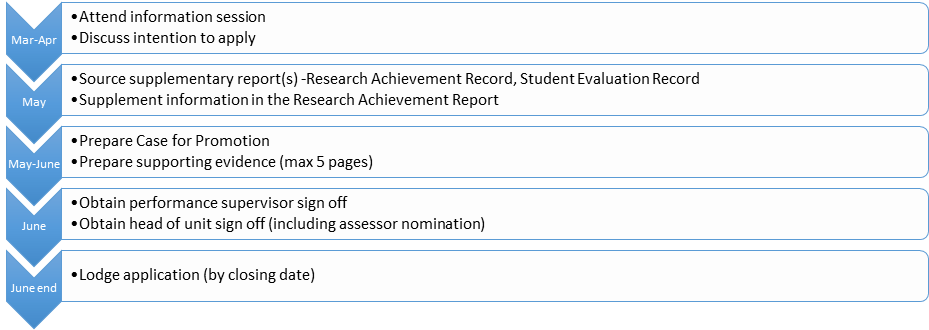
SUPPLEMENTARY REPORTS
Research Achievement Record
All candidates for promotion must attach a Research Achievement Record. For Australian candidates, this report is generated through the University's Business Intelligence system drawing on data from corporate systems, including Research Master, Callista and SAP. Candidates should ensure that their research data is accurate and up-to-date in the University's Researchers' Online Project Enquiry System (ROPES) prior to requesting the report for promotion purposes.
The Research Achievement Record can be obtained via email request, as follows:
|
Faculty |
Contact |
Please provide |
|
All faculties and non-faculty staff (excluding Monash University Malaysia) |
The relevant promotion coordinator
|
|
The Research Achievement Record will include the following:
- research outputs;
- research grants; and
- HDR supervisions.
Reports will list achievements and publications only for the period since the last promotion/appointment.
Candidates should carefully review the data in the reports. Any significant errors found in system-generated data should be advised to the contact listed above to determine if system corrections are required and another report generated.
Candidates will then supplement the data contained in the reports by:
- adding any entries that are not captured in the report on the recent additions and errata page; and
- completing the final two columns on the research outputs page (ie. an estimate of their percentage of contribution and the number of citations).
Applicants are not disadvantaged if new entries are added to the recent additions and errata page. This additional data will be given the same regard as the system-generated data.
Candidates from the University's Malaysian campus will need to manually complete the Malaysia: Research Achievement Record Form.
Student Evaluation Record
Research-only candidates who have not allocated a weighting to education are not required to provide a Student Evaluation Record.
A personalised Student Evaluation Record is available via online request from University Planning and Statistics.
The report will contain the following:
- quantitative unit evaluation data (data for each unit offering for which the candidate was evaluated); and
- quantitative teaching evaluation data (eg. SETU, MonQueST).
Candidates should be prepared to provide full sets of all summarised teaching and unit evaluation data if requested by the relevant promotion coordinator.
CASE FOR PROMOTION
The above reports provide supporting evidence for a candidate's case for promotion. In the Case for Academic Promotion Form: Levels C-E the candidate provides personal details and outlines how he or she meets the criteria for academic promotion.
Part 1 - Candidate details, weightings and statement of ‘relevant personal circumstances'
1.1 Candidate details and weightings
Candidates are required to allocate weightings to each of the categories of research, education and service within the parameters relevant to their academic focus. Leadership is expected to be shown across each category. Weightings should represent the quality and impact of achievements (rather than workload allocations). The total weightings should add to 100% and meet the minimum requirements for each category below.
|
Weighting |
|||
|---|---|---|---|
| Candidate Contract Type | Education | Research | Service |
|
Teaching and research staff
|
20% minimum |
30% minimum |
10% minimum |
|
30% minimum |
20% minimum
|
||
|
Teaching and research staff: ‘special case' based on outstanding service |
40% for research and education combined, with a minimum of 10% for each, if it reflects the agreed performance development plan |
60% with significant emphasis on the impact that leadership has had on the University, community/discipline |
|
|
Education-focused staff |
85% maximum, with particular emphasis on educational design and delivery and educational leadership |
5% minimum |
10% minimum
|
|
Research-only staff |
Not required to assign a weighting towards education although may do so if relevant |
90% maximum |
10% minimum
|
A ‘special case’ for service may only be considered by senior lecturers or associate professors who are currently in a leadership role or have been in such a role within the University for a substantial period.
All candidates should:
- consider the weighting of their case carefully and seek advice from their performance supervisor, associate deans and head of unit before finally determining the balance;
- choose weightings that strengthen their case in relation to achievements and reflect the assessments made annually as part of the Performance Development Process: Academic Staff and also the minimum level as set out in the academic performance standards for the level to which promotion is sought; and
- ensure that they provide a thorough narrative and supporting evidence of achievements in the relevant areas of academic activity regardless of the weighting attached.
1.2 Relevant personal circumstances
Where relevant, candidates should specify any relevant personal circumstances to facilitate an assessment of his or her achievements relative to opportunity.
The promotion committee will evaluate relevant circumstances based on what the candidate has achieved given the opportunities available whilst ensuring that the indicators of quality and impact of achievements have been demonstrated.
Relevant personal circumstances may include:
- family responsibilities (for example child rearing, elder-care, illness of a partner or dependant);
- a temporary or permanent disability;
- relevant cultural expectations or circumstances;
- periods of part-time working; and/or
- absences due to ill-health or injury.
Candidates who would like a promotion committee to assess their achievements relative to opportunity should:
- identify relevant personal circumstances in their promotion application;
- provide a positive acknowledgement of what has been achieved given the opportunities available during the time period that is being considered in the application (i.e. since the last promotion or appointment); and
- if desired, briefly comment on their overall career history and trajectory in light of the opportunities available to them.
Candidates are not required to describe specific details about sensitive issues such as a medical illness, however if it is important for specific details to be shared, a short and private discussion with the chair of the committee will suffice.
For further information, refer to Preparing relevant personal cicumstances.
Part 2 - Career summary statement
Candidates must provide a brief outline of their overall career achievements to date. This summary should highlight the main focus of the candidate’s work and the impact of the candidate’s contributions in the wider context of their discipline.
Part 3 - The case for promotion: Achievements in research, education and service
A candidate's case for promotion must illustrate how the candidate meets the criteria for promotion in the relevant academic areas of activity. For most candidates this will include evidence of his or her achievements across the three key areas of academic activity - research, education and service. However, research-only candidates are only required to make a case against the research and service activity areas (consistent with their weightings).
The case for promotion must explain the quality and impact of the achievements claimed and may reference the attached research and education reports as well as other forms of evidence.
A maximum word limit of 2,600 words applies across Part 3 in total. Candidates may choose how to allocate the word count, but should do so relative to the weightings they have selected to frame their case.
3.1 Research
Candidates should:
- list up to five of their research achievements and provide evidence of their impact on the academic discipline, industry or profession, or community;
- outline their case for promotion, referencing the promotion criteria; and
- reference the attached Research Achievement Record in making their case.
Candidates should focus on outlining significant achievements since their last promotion/appointment, and avoid unnecessary duplication of data that are in the attached reports.
(Note candidates may elect to include achievements in research supervision in either the research or education category but not in both).
3.2 Education
Candidates are required to formulate their case for promotion in the area of education by addressing the learning and teaching criteria. It should be noted that the supplementary Student Evaluation Record is an indicator of teaching excellence, not the absolute measure.
Candidates will need to take into consideration the three distinct areas of practice:
- activities directly involved in the delivery of learning and teaching to students;
- the scholarship of teaching; and,
- continual professional enhancement and self-review.
All candidates involved in teaching must address criterion 6 as this is the basis of reflective teaching practice that will build and sustain excellence.
In addition to the above:
- teaching and research candidates must elect and address two additional criteria from 1 to 5); and
- education-focused candidates must address criteria 5 and elect and address two additional criteria from 1 to 4.
The criteria referenced above are available on the learning and teaching website.
Candidates should address each criteria as specified above on the basis of their teaching and research or education-focused role and use relevant evidence to support their claims against the criteria. Candidates are encouraged to access the academic promotion website for further guidance on how to prepare their application.
Research-only staff who have not allocated a weighting to education are not required to complete Part 3.2
3.3 Service
Candidates should:
- summarise service achievements; and
- explain the impact of their service activities to the discipline, faculty/University and the community.
Examples of service activities may include membership and contributions to Monash or external committees and to journal editorial boards, and contributions to public debate and policy development.
Committees will give due consideration to candidates who have significant service obligations due to being part of an under-represented group. This includes women in STEMM (Science, Technology, Engineering, Mathematics and Medicine) disciplines and Indigenous candidates.
Part 4 - Academic goals for the next three years
In this section, candidates should briefly articulate their goals for the next three years. Candidates should set their goals against the learning and teaching criteria to demonstrate a plan for ongoing excellence and the development of depth and breadth of achievement in the area of education. Similarly, candidates should provide goals relating to their research in line with the relevant academic performance standards.
Additional five pages of supporting attachments
Candidates may also include a maximum of 5 pages of supporting evidence. Examples of supporting evidence may include:
- letters of acceptance of research publications ‘in press';
- copies of media reports that provide evidence of impact of the candidate's research or educational research achievements;
- letters of support acknowledging candidate's positive contribution of service activities; and
- relevant material evidencing educational impact.
Candidates appointed from international universities must provide evidence that they held an equivalent appointment or higher at their previous university or universities, as part of their maximum five pages of supporting evidence.
Supporting evidence should not include an academic curriculum vitae or an extension of the word limit for the case for promotion.
Part 5 - Performance supervisor report
The candidate's performance supervisor must write a report commenting on the achievements across research, education and service, including a comment on the allocation of weighting given to each area and an assessment of the candidate's performance against the criteria for promotion.
Guidance regarding the learning and teaching criteria is available at the learning and teaching website.
Part 6 - Grant holder approval
If a research-only candidate is not the grant holder but is employed on another person's grant, the grant holder will also be required to endorse the candidate's application for promotion.
Part 7 - Head of unit report (including nomination of assessors)
The candidate's head of unit must indicate whether:
- the weightings chosen by the candidate are appropriate; and
- there is a prima facie case for the application to be considered by the promotion committee; or
- the candidate's case for promotion is premature.
Where the candidate's case for promotion is premature, the performance supervisor and head of unit will provide specific feedback on how the candidate can strengthen his/her academic performance to support an application for promotion in the future.
The head of unit may also provide comments on the case for promotion.
For research-only candidates, the head of unit will also confirm that there is funding available for the promotion and will identify the source of the funding. Where the source of funding is the research grant, the grant holder, acting on the advice of the Monash Research Office, will confirm that a promotion is permissible under the terms and conditions of the grant contract, including that the grant funds can be used to fund a salary at a higher level.
Nomination of assessors
The head of unit must liaise with the dean/Pro Vice-Chancellor and President (Monash University Malaysia) to determine the dean's nominees who will be asked to provide a confidential and objective evaluation of the candidate's case for promotion.
Candidates are required to have the following number of assessor reports:
|
Level of Application |
Assessors |
|
Senior Lecturer/Senior Research Fellow |
2 |
|
Associate Professor |
3 (international assessors) |
|
Professor |
4 (with at least 3 of the 4 to be international assessors) |
In nominating assessors, deans and heads of unit will make every attempt to ensure that assessors are independent of the candidate. It may not help the candidate if assessors are not arms-length. As a guideline, assessors should be:
- persons of eminence in the discipline; and
- at least at the level to which the candidate is applying, and preferably higher;
Assessors should not have:
- co-published or collaborated with the candidate in the past 5 years.
- supervised the candidate's PhD thesis or have been supervised by the candidate; and
- have a close personal relationship or association with the candidate.
Candidates seeking promotion to associate professor (level D) or professor (level E) will generally be expected to have international assessors.
Assessors will be asked to:
- provide an opinion drawn from their understanding of the education and research achievements expected of an academic at the relevant level in their particular field, including whether the candidate's work aligns with internationally recognised academic standards in that field;
- comment on the application submitted (in its entirety) and make an assessment of the candidate's achievements in a specific area of activity in the particular circumstances of the case;
- indicate the extent of their support for the candidate's application;
- indicate whether the candidate would be promoted at their university or institution and, if not, explain why; and
- at professorial level, comment on the candidates current international reputation in the field.
Assessors will be required to indicate whether or not they have a professional and/or personal relationship with the candidate and if so, the nature of the relationship. Where a close professional or personal association exists, the report will still be provided to the committee, however, the Chair may seek an additional assessor if he/she deems necessary.
Reports will be provided in English, unless prior arrangements are made with the relevant promotion coordinator.
Deans (or for applicants from Malaysia, the Pro Vice-Chancellor and President, Monash University Malaysia) should:
- discuss the nomination of assessors with the head of unit (and confer with other senior members of staff from the candidate's discipline for advice if needed);
- ensure assessors are impartial and independent, preferably with no known close professional or personal association with the candidate in line with the guidelines mentioned above;
- ensure assessors for candidates applying to associate professor, and at least three of the four assessors for candidates applying for professor, are from outside Australia (or for candidates from Monash University Malaysia, from outside Malaysia) except where the most eminent scholars in a particular discipline are based in that country;
- select assessors from institutions of comparable standing to Monash; and
- for cross disciplinary applications, consider assessors from different fields.
The head of unit must:
- contact each assessor on the dean's behalf to determine her or his willingness and availability to provide an assessment of the candidate as outlined above; and
- record the details of the assessors on the candidate's application form where indicated.
A candidate may object to the choice of any of the assessors by notifying the dean/Pro Vice-Chancellor and President (Monash University Malaysia) within seven working days of being notified of the assessors. The relevant promotion coordinator is to be copied into the notification. In this event, the dean/Pro Vice-Chancellor and President (Monash University Malaysia), in consultation with the head of unit, will provide the names of one or more replacement assessors within seven working days. The dean/Pro Vice-Chancellor and President (Monash University Malaysia) or head of unit may discuss the proposed replacements with the candidate but the candidate may make no further objections to the selection.
Part 8 - Candidate declaration
The candidate must sign the form and indicate:
- that he or she has read the contents of the performance supervisor's report and head of unit's comments; and
- indicate his or her intention to object to the assessors nominated by the dean/Pro-Vice Chancellor and President (Monash University Malaysia).
Step 4. Candidates lodge application
All candidates must lodge their completed and signed application online via Rex (except candidates from Malaysia who are seeking promotion to senior lecturer or associate professor) by close of business on the closing date of the promotion round.
Candidates from Malaysia seeking promotion to senior lecturer/senior research fellow or associate professor are required to lodge their application via email to the Malaysia promotion coordinator.
Any queries on the lodgement process should be directed to the relevant promotion coordinator.
Step 5. Promotion coordinator sources assessor and Associate Dean/ Dean reports
Following the round close, the relevant promotion coordinator will make all reasonable efforts to obtain the following reports:
- assessor reports;
- associate dean (research) and (education) reports; and
- deans reports (for professorial candidates only).
Assessor Reports
The relevant promotion coordinator will:
- be the contact point for communication with assessors;
- provide assessors with a copy of the candidate's application and a copy of this procedure;
- send a report form to assessors to complete; and
- ask for their considered opinion on whether the candidate has met the criteria for promotion.
On request, the assessor reports may be provided to the dean prior to the dean preparing their reports to the Professorial Promotion Committee.
Assessor reports are confidential and are not provided to candidates.
Associate Dean Reports
Associate deans responsible for research and education in a faculty must provide a report on the candidate's case for promotion that includes:
- an overview and assessment of achievements in the relevant areas of academic activity; and
- an assessment of achievements against promotion criteria.
An associate dean (education) report is not required for research-only candidates unless the candidate has allocated a weighting to education.
Copies of associate dean reports will be provided to candidates.
Deans Reports for the University Professorial Promotion Committee
The dean must provide two reports for recommended candidates to the University Professorial Promotion Committee:
- an individual candidate report addressing the case in the relevant areas of academic activity, referencing relevant academic performance standards (the dean will discuss the report with the candidate and provide the candidate with a copy); and
- where multiple applications have been received, a faculty report which ranks the candidates in terms of who has the strongest case for promotion. This report is confidential and not provided to candidates.
Where a candidate does not agree with the factual information contained within the dean's individual candidate report, the candidate may comment in writing to the Chair of the Professorial Promotion Committee. The candidate's comment is for information only and there is no requirement for the dean or the committee to respond.
Step 6. Applications reviewed by promotion committees
Applications for promotion are assessed and outcomes decided by the following committees:
|
Applications |
Promotion Committee |
Chair |
|
Faculty-based senior lecturer/senior research fellow (level C) candidates |
Faculty Senior Lecturer Committee |
Dean |
|
Faculty-based associate professor/associate professor (research) (level D) candidates |
Faculty Associate Professor Committee |
Dean |
|
Non-faculty based senior lecturer/senior research fellow (level C) and associate professor/associate professor (research) (level D) candidates |
the faculty committee of the faculty that is most relevant to their discipline/area |
Dean |
|
Malaysia based senior lecturer/senior research fellow (level C) candidates |
Malaysia Senior Lecturer Committee |
Pro Vice-Chancellor and President (Monash University Malaysia) |
|
Malaysia based associate professor/associate professor (research) (level D) candidates |
Malaysia Associate Professor Committee |
Pro Vice-Chancellor and President (Monash University Malaysia) |
|
Professor/professor (research) (level E) candidates |
University Professorial Committee |
Provost and Senior Vice President |
Refer to the Staff Development Procedure - Academic Promotion Committees: Levels C-E for further information and associated guiding documents are on the academic promotion website.
NEW INFORMATION
Candidates will be provided with the opportunity to present new information which has become available following lodgement of their application.
The nature of the new information is to:
- clarify or update information alluded to in their application, for example the success of a grant application listed as ‘pending'; or
- provide new information about a fact or event that significantly strengthens their case for promotion, for example the receipt of an award or admission to a learned body or academy.
Candidates have an obligation to correct any information that may mislead the promotion committee if left uncorrected, for example informing the committee of the outcome of a grant application or manuscript submitted to a publisher or journal that has been rejected.
Candidates may be requested to provide further information to their application, at the committee's request. Examples of this are the current year's agreed performance development plan and/or the previous year's performance development plan, or full sets of teaching and unit evaluations.
INTERVIEWS FOR PROMOTION TO ASSOCIATE PROFESSOR
Candidates applying for promotion to associate professor may be interviewed by the relevant promotion committee, at the committee's request. The interview allows the committee to clarify information contained in the application and for candidates to answer relevant questions.
It is the candidate's responsibility to be available for the relevant committee meeting date.
INTERVIEWS FOR PROMOTION TO PROFESSOR
All candidates applying for promotion to professor will be interviewed by the University Professorial Promotion Committee. The interview allows the committee to clarify information contained in the application and for candidates to answer relevant questions.
It is the candidate's responsibility to be available for all dates on which the committee will meet. Individual requests for a specific interview date or time will not normally be met.
Step 7. Candidates notified of outcome
Promotion committee chairs will inform candidates in writing of the committee's decision within seven working days of the final sitting day.
For professorial candidates, the chair will inform candidates in writing within fourteen working days of the final sitting day.
Written advice for candidates not recommended for promotion will outline the areas which require strengthening before a future application is lodged. Candidates are encouraged to meet with the chair (or a representative appointed by the chair) individually to discuss feedback. Candidates are encouraged to take their performance supervisor or their head of unit with them. Candidates should use this advice, in consultation with their performance supervisor, when revising performance development plans. Candidates are unlikely to be successful in subsequent promotion applications unless they have addressed recommendations.
Unless candidates have been offered a conditional promotion, all promotions will take effect from 1 January of the following year.
Copies of outcome letters are provided to the performance supervisor, head of unit and the HR Business Partner. The dean will also be copied into professorial outcome letters.
CONDITIONAL PROMOTION
The promotion committee may make a conditional promotion where the committee believes that the candidate's case for promotion is ‘borderline', however specified achievements by the candidate before the next promotion round would lead to a clear case for promotion.
The committee must:
- precisely define the conditions to be met;
- communicate these clearly in writing to the candidate; and
- base the conditions on the appropriate metrics for the level of promotion (senior lecturer, senior research fellow, associate professor, professor).
If the candidate does not meet the conditions before 1 May in the following year, and wishes to reapply for promotion, the candidate must submit a new application.
If the candidate succeeds in meeting the conditions before 1 May in the following year, the candidate must provide written evidence to the relevant promotion coordinator. The chair of the committee will review; and determine if the candidate will be promoted. In the case of a conditional promotion to professor, the relevant promotion coordinator will request that the dean review the evidence supplied, and provide a recommendation to the chair.
The decision of the chair of the promotion committee is final and there is no appeal process.
Rehearing
Candidates not recommended for promotion may lodge an application for a rehearing only on the basis there has been a procedural irregularity substantive enough to result in material disadvantage to them with regards to the committee's decision.
For further information on the rehearing process refer to the Staff Development Procedure - Academic Promotion Rehearing Process Levels B-E.
Responsibilities
Provost and Senior Vice-President
The Provost and Senior Vice-President is responsible for:
- academic staffing within the University including the oversight of the academic promotion process; and
- as the chair of the University Professorial Promotion Committee, the Provost and Senior Vice-President is responsible for ensuring that the committee members carry out a fair, confidential and objective assessment of applications for promotion.
Dean
The Dean is responsible for:
- undertaking the role of chair of the Faculty Senior Lecturer Promotion Committee and the Faculty Associate Professor Promotion Committee and providing feedback to unsuccessful applicants;
- ensuring that committee members carry out a fair, confidential and objective assessment of applications for promotion;
- nominating and approving impartial assessors for all Australian-based candidates for promotion;
- providing an individual candidate report to the University Professorial Promotion Committee; and
- providing a faculty ranking report to the University Professorial Promotion Committee.
Pro Vice-Chancellor and President (Monash University Malaysia):
As the chair of the Malaysia Senior Lecturer Promotion Committee and the Malaysia Associate Professor Promotion Committee, the Pro Vice-Chancellor and President is responsible for:
- ensuring that committee members carry out a fair, confidential and objective assessment of applications for promotion
- nominating and approving impartial assessors for all candidates for promotion in Malaysia; and
- providing feedback to unsuccessful candidates from Malaysia applying for Level C or D.
Associate Deans:
The associate deans responsible for education and research in a faculty are required to provide a report on the candidate's case for promotion in the relevant area of academic activity.
Head of Unit and Performance Supervisor:
The candidate's performance supervisor and head of unit are required to each provide a report that forms part of the academic promotion application form. If there are no heads of unit within the faculty, a deputy dean or equivalent may be delegated the head of unit's responsibilities for the academic promotion process. They are also responsible for being available to give confidential advice and other forms of support to potential applicants before applications are submitted.
Candidate:
The Candidate is responsible for complying with the requirements of this procedure and providing timely and accurate information to the performance supervisor, head of unit, relevant promotion coordinator and promotion committee. Candidates must:
- ensure their applications, including all relevant supplementary reports are lodged on time via Rex system;
- ensure their applications address the relevant criteria for promotion; and
- for level D and E, ensure they are available to attend scheduled interviews.
Monash HR - Promotion Coordinators
HR Operations
A dedicated resource within the HR Operations Centre is responsible for:
- administering and coordinating the promotion process for faulty-based senior lecturer, senior research fellow, associate professor and associate professor (research) (levels C and D); including requesting assessor and associate dean reports and administering outcome letters; and
- providing policy and procedural advice to candidates and committees.
Senior Advisor, Policy and Academic Promotion
The Senior Adviser, Policy and Academic Promotion is responsible for:
- calling for applications in annual promotion rounds and setting applicable dates;
- providing policy and procedural advice on the academic promotion process for Level E and non-faculty area candidates and committees;
- being the contact for candidates for non-faculty areas;
- administering and coordinating the promotion process for level E candidates including requesting assessor and associate dean reports and administering outcome letters; and
- providing support and advice to the Professorial Promotion Committee.
Malaysia Promotion Coordinator:
The Malaysia Promotion Coordinator is responsible for:
- coordinating the promotion process for Malaysian candidates to levels B-D; and
- providing secretarial support for the Malaysia committees.
Related procedures
- Staff Development Procedure - Academic Promotion for Candidates Level B
- Staff Development Procedure - Academic Promotion Committees Levels C-E
- Staff Development Procedure - Academic Promotion Rehearing Process Levels B-E
- Staff Development Procedure -Performance Development Process: Academic Staff
- Recruitment, Selection and Appointment Procedure - Translation of existing staff to an Education-focused academic role
- Recruitment, Selection and Appointment Procedure - Academic Titles
Related documents
- Academic performance standards
- Academic promotion website
- How to prepare relevant personal circumstances
- Monash Quality Unit
- List of Faculty/Malaysia and University Promotion Coordinators
Forms
- Academic Promotion Application Forms
- Application for Promotion Cover Page: Malaysia Levels B-D [Word]
- Malaysia: Research Achievement Record Form
| Version number | 9.0 |
|---|---|
| Effective date: | 24 February 2016 |
| Procedure owner: | Director, Workplace Relations |
| Procedure author: | Executive Director, Monash HR |
| Contact: |
|