Bird Lab research
Collaborations | Student research projects | Publications
About Professor Phillip Bird
I am a professor in the Department of Biochemistry and Molecular Biology at Monash University. The Department is part of the School of Biomedical Sciences and the Monash Biomedicine Discovery Institute within the Faculty of Medicine, Nursing and Health Sciences.
I am a molecular cell biologist interested in serpins and proteases operating in the immune and circulatory systems. I use biochemistry, structural biology, model cell systems and model organisms (mice, zebrafish) in my research.
I received my PhD in E. coli molecular genetics from the University of Melbourne in 1984. I then spent three years in the USA as a Damon Runyon-Walter Winchell Cancer Foundation Fellow working with Professor Joe Sambrook (FRS) on eukaryotic protein trafficking, first at the Cold Spring Harbor Laboratory and then at the University of Texas in Dallas. On my return to Australia I worked at the Commonwealth Serum Laboratories on the cloning and characterizing of pathogen antigens, and then joined Monash University to work on the molecular regulation of blood coagulation. While working at Monash I discovered a new group of human intracellular protease inhibitors (serpins), and my current research interests are focused on the biology and pathobiology of serpins and their target proteases.
Our research
Current projects
- SERPINB6 and adult-onset hearing loss. Serpins and cell death
- SERPINA1 and liver and lung disease
Visit Professor Bird's Monash research profile to see a full listing of current projects.
Research activities
The importance of proteolysis
Proteases cleave peptide bonds, degrading proteins or altering their structure and biological properties. They play key roles in processes ranging from blood coagulation to programmed cell death (apoptosis). Because peptide bond hydrolysis by a protease is irreversible, proteolysis must be strictly regulated. Uncontrolled destruction of normal cells and tissue by proteases underpins heart attack, stroke, arthritis, emphysema, and cancer.
Regulation of proteases by serpins
Many proteases are controlled by members of the serpin superfamily of proteins. Serpins mimic the true substrates or targets of particular proteases, and once a protease attempts to cleave a serpin it is trapped and degraded (Fig 1). Thus serpins act as scavengers, removing active proteases to prevent injury to normal cells or tissue. Serpins protect the interior or exterior of cells, and serpin deficiency in humans can cause blood clots, reproductive abnormalities, faulty complement activation, liver and lung disorders, deafness and dementia.

Figure 1. Serpins dynamically trap, distort and inactivate proteases.
Bird laboratory serpin research projects
A. SERPINB6 and inherited sensorineural hearing loss
Serpins inside cells protect their hosts against their own proteases, to prevent adventitious cell death. For example, in previous research, we have shown that SERPINB9 prevents suicide of cytotoxic lymphocytes caused by exposure to their own granzyme B, a lethal protease used to destroy infected or cancer cells in concert with the pore-forming protein, perforin. Mice lacking SERPINB9 fail to mount an effective immune response because thei r T cells are destroyed by their own granzyme B.
The human adult-onset hearing loss syndrome DFNB91 is caused by mutation of the SERPINB6 gene, which encodes an intracellular serpin. Using a knockout mouse model we have shown that lack of SERPINB6 results in progressive degeneration of sensory and support cells in the Organ of Corti within the inner ear (cochlea), starting with the outer hair cells (Fig 2). We have also shown that SERPINB6 rapidly rises in cochlear cells in response to noise. Given loss of a serpin exacerbates proteolytic tissue damage in other pathophysiological settings, we posit that SERPINB6 protects the inner ear from a protease unleashed by trauma. Current studies are aimed at identifying this protease.

Figure 2. Degeneration of the Organ of Corti in mice lacking SERPINB6.
B. SERPINA1 and inherited liver and lung disease
a1-antitrypsinencoded by the gene SERPINA1 is an acute-phase plasma glycoprotein that prevents injury to the lung by inhibiting proteolysis of elastin by neutrophil elastase. It is synthesized and secreted mainly by liver hepatocytes. In alpha-1 antitrypsin deficiency (AATD), individuals homozygous for the common Z variant allele (Z-AAT) suffer lung and liver damage. In hepatocytes, the Z-AAT protein misfolds and accumulates in the endoplasmic reticulum (ER) impairing its release into the circulation. This reduces plasma antitrypsin levels, increasing susceptibility of the lungs to injury and development of emphysema. Z-AAT retained in the hepatocyte ER aggregates, forming characteristic inclusion bodies. Hepatocyte stress response pathways are triggered to effect Z-AAT removal. Misfolded Z-AAT is removed from the ER and degraded by the proteasome via the ER-associated degradation (ERAD) pathway; and Z-AAT in inclusion bodies is removed by autophagy. Eventual overloading of these pathways results liver fibrosis, cirrhosis and hepatocyte death.
We have created and are studying zebrafish expressing normal human antitrypsin or Z-AAT in the liver (Fig 3) . Like human AATD subjects Z-AAT fish have far less antitrypsin in the liver and blood than normal, but unlike AATD subjects do not form ER inclusion bodies. This indicates that zebrafish hepatocytes possess a highly efficient system that removes misfolded Z-AAT, preventing inclusion body formation and liver injury. We are investigating how this system works.

Figure 3. Transgenic zebrafish expressing Z-AAT in hepatocytes (green) release less protein into the bloodstream.
Techniques/expertise
Recombinant DNA technology; protein purification; protein detection; enzymology; cell culture and manipulation; fluorescence microscopy; knockout mice; transgenic zebrafish
Disease models
We have developed genetically modified mice to study the human sensorineural hearing loss syndrome DFNB91.
We have developed genetically modified zebrafish to study the human hepatic endoplasmic reticulum storage disease, alpha-1 antitrypsin deficiency.
Collaborations
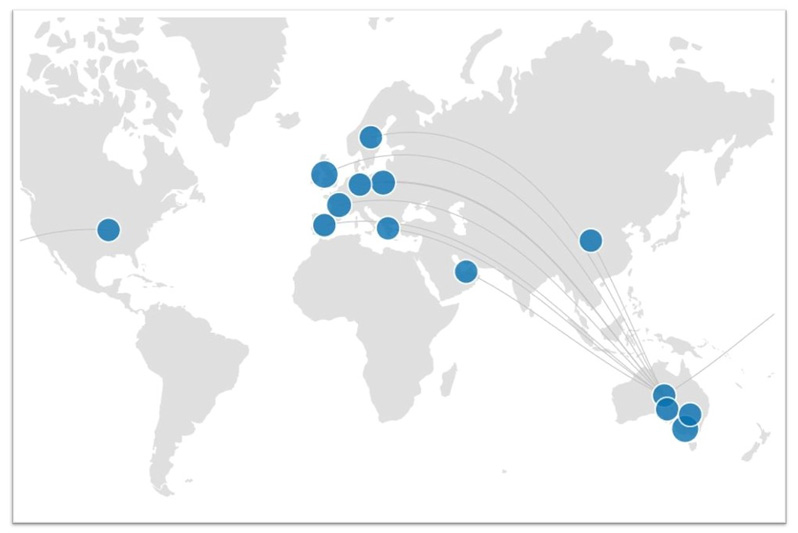
We collaborate with many scientists and research organisations around the world. Some of our more significant national and international collaborators are listed below. Click on the map to see the details for each of these collaborators (dive into specific publications and outputs by clicking on the dots).
Academic Collaborators
- Prof Jonathan Baell, Monash Institute of Pharmaceutical Sciences
- A/Prof Robert Bryson-Richardson, School of Biological Sciences, Monash University.
- Dr Charaf Benarafa, University of Bern, Switzerland
- Prof Stephen O’Leary, Department of University of Melbourne.
- Dr Julien Pardo, University of Zaragosa, Spain
- Prof Andreas Suhrbier, Queensland Institute of Medical Research
Industry collaborators
Student research projects
The Bird Lab offers a variety of Honours, Masters and PhD projects for students interested in joining our group. There are also a number of short term research opportunities available.
Please visit Supervisor Connect to explore the projects currently available in our Lab.