Boag Lab research
Collaborations | Student research projects | Publications
About Associate Professor Peter Boag
Peter Boag obtained a PhD from Melbourne University in Molecular Parasitology. Peter spent six years in the Blackwell lab at Harvard Medical School, Boston, USA where he studied mechanisms of gene regulation in the germline and early embryo of the model organism C. elegans. Peter is also an Honorary Research Fellow of the Faculty of Veterinary Science of the University of Melbourne (where in collaboration with Professor Robin Gasser they investigate the biology of parasitic nematodes of socio-economic importance).
Our research
Current projects
- Investigate how a conserved protein complex is required for translational repression of many mRNAs and localisation of specific RNA-binding proteins to key sites of post-transcriptional gene regulation in germ cells
- Investigate the biogenesis and function the “22G” family of small RNAs during germ cell development
- Investigating the role of poly(A)-tail in translational silencing (Collaboration with Dr Traude Beilharz)
Visit Peter Boag's Monash research profile to see a full listing of current projects.
Research activities
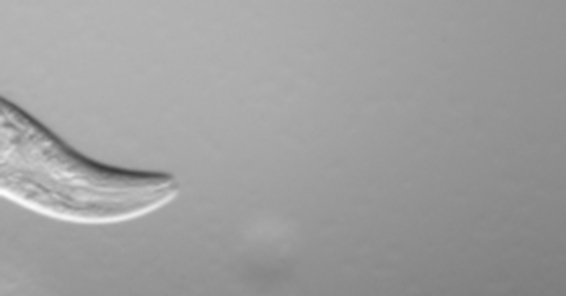
Movement of Wild-type C. elegans
The Boag lab is primarily interested in understanding how post transcriptional gene regulation influences development and cellular function. In a number of cell types, such as oocytes and neurons, many mRNAs are transcribed but are not immediately translated. Instead, these mRNAs are maintained in a translationally repressed state in predicted RNA-protein storage granules and only become translated upon specific cues. Some of the proteins involved in the storage of oocyte mRNAs are also present in Processing-bodies (P-bodies), recently identified cytoplasmic granules where many mRNA regulatory pathways are present, including decapping- and nonsense-mediated mRNA degradation and small RNA-mediated translational silencing (e.g. micro RNAs). The emerging similarities between germline storage granules and P-bodies suggests that the formation of RNA-protein granules is a conserved and important mechanism for maintaining cellular homeostasis. We are interested in elucidating the mechanisms governing the formation and function of germline mRNA storage granules and their requirement for fertility and embryonic viability.
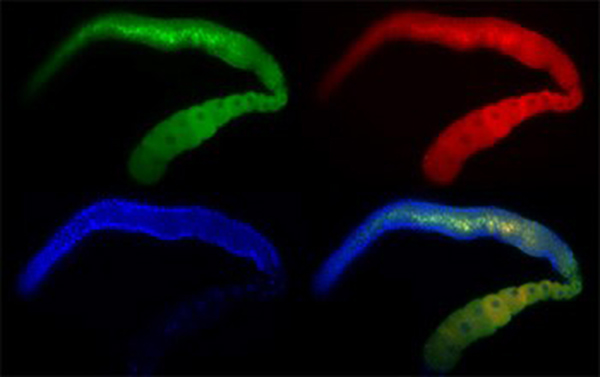
Dissected C. elegans gonads stained for key components of germline Storage granules. CGH-1 (green), CAR-1 (red) and DNA (blue)
The C. elegans Model System
C. elegans is a free-living, non-parasitic round worm that has become an important model organism for the study of a diverse range of biologically important processes of both basic and medical significance. Features that make C. elegans a wonderful research tool include:
- a quick life cycle (~3 days at 20oC)
- invariant cell lineage
- relatively small genome (~97 Megabases)
- powerful genetic techniques for gene analysis
- effectiveness of targeted gene knockdown by RNA interference (RNAi).
Together these attributes have made C. elegans a valuable research tool for analysis of many biological processes such as apoptosis, mechanisms of ageing, DNA damage response and gene regulation to name a few.
Collaborations
We collaborate with many scientists and research organisations around the world. Some of our more significant national and international collaborators are listed below. Click on the map to see the details for each of these collaborators (dive into specific publications and outputs by clicking on the dots).
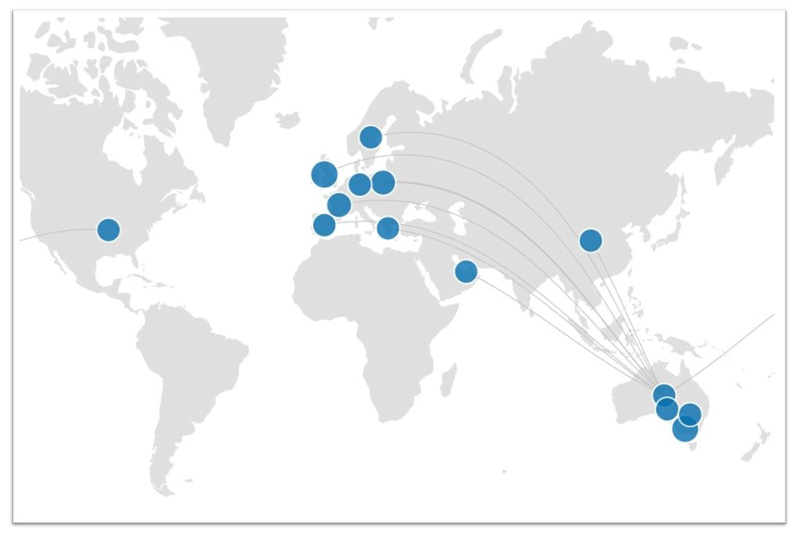
Professor Keith Blackwell - Harvard Medical School
Professor Robin Gasser - University of Melbourne
Professor Paul Sternberg - California Institute of Technology
Professor Ana Traven - Monash University
Dr John Kim - University of Michigan
Student research projects
The Boag Lab offers a variety of Honours, Masters and PhD projects for students interested in joining our group. There are also a number of short term research opportunities available.
Please visit Supervisor Connect to explore the projects currently available in our Lab.