Carroll Lab research
Collaborations | Student research projects | Publications
About Professor John Carroll
As the director of the newly established Monash Biomedicine Discovery Institute (BDI), Professor Carroll is a trailblazer in challenging the status quo in the medical research sector. In 2018, he presented to the Australian Senate advocating for legislative change so babies in Australia do not suffer with mitochondrial disease and he continues to help influence a thriving, gender equitable research sector as head of the Athena SWAN program for Monash University.
Professor Carroll obtained his PhD in 1991 from the University of Adelaide before moving to the MRC Experimental Embryology Unit in London. He then moved to University College London (UCL) in 1996 where he held an MRC Fellowship and an academic position. In 2004 Professor Carroll was appointed Professor and Head of Department of Physiology, becoming the Associate Dean and Director of the UCL Division of Biosciences in 2007.
Professor Carroll joined Monash University in September 2012 to take up the position of Head of School of Biomedical Sciences, now Dean of Biomedical Sciences and Director of the Monash BDI.
Our research
Current projects
1. Role of mitochondria in controlling meiosis in oocytes
2. Coordinating polarity and cell cycle progression in the meiotic divisions
3. Impact of maternal age and obesity on chromosome dynamics and oocyte quality (in collaboration with Rebecca Robker, University of Adelaide)
Visit Professor Carroll's Monash research profile to see a full listing of current projects.
Research activities
We continue to advance our understanding of how a woman’s egg makes the transition to a healthy embryo, with a particular focus on why this transition becomes so much more difficult for women trying to have children in their mid-to-late 30s and early 40s.
The mammalian oocyte is the largest cell in the body and undergoes two highly specialised asymmetric meiotic cell divisions. Coordination of organelle inheritance, polarity and meiotic progression is essential for the production of an oocyte capable of undergoing fertilization and development to term. We use molecular and genetic approaches combined with live cell imaging to investigate the cell biology of these processes in mice and humans. Investigating these questions allows us to understand how oocytes make the transition into a healthy embryo and why it goes wrong in cases such as maternal ageing.
Our research is focused on understanding the mechanisms of oocyte development, maturation and fertilization in mammals. Early embryo development in mammals is driven and underpinned by a healthy fertile oocyte. How the oocyte acquires this developmental potential is not understood and problems in oocyte quality are largely responsible for the high rates of infertility and miscarriage in the population.
Our work focuses on understanding how the oocyte undergoes the meiotic cell divisions and why the rate of chromosome abnormalities is so high in women in their late 30s and early 40s. A major factor in determining oocyte quality is the ability of mitochondria to generate ATP. We are studying mitochondrial dynamics and function in oocytes with the aim of modulating mitochondrial activity in order to improve oocyte quality. We have established a new collaboration with Monash IVF in order to translate our findings to the clinic. Our research has been funded by long term MRC Programme Grants and the ARC and the results are published in leading journal including Nature Cell Biology, Science, Developmental Cell, Development and Journal of Cell Biology.
Collaborations
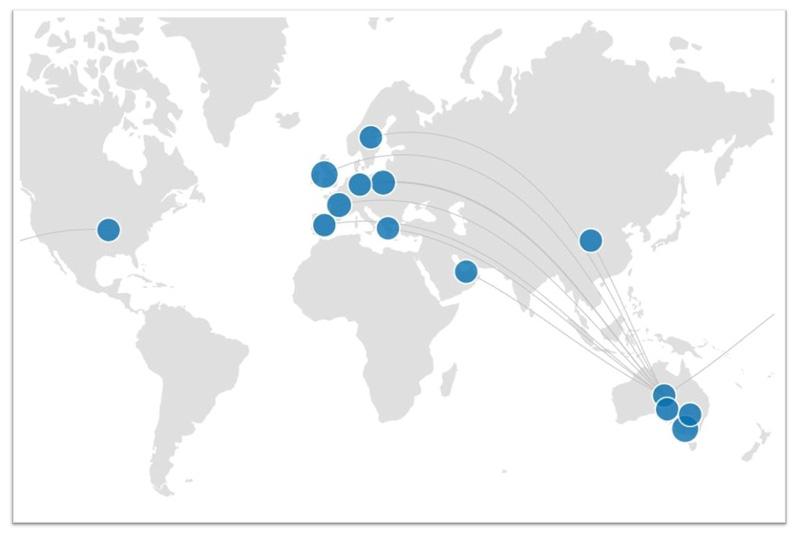
We collaborate with many scientists and research organisations around the world. Click on the map to see the details for each of these collaborators (dive into specific publications and outputs by clicking on the dots).
Student research projects
The Carroll Lab offers a variety of Honours, Masters and PhD projects for students interested in joining our group. There are also a number of short term research opportunities available.
Please visit Supervisor Connect to explore the projects currently available in the Carroll Lab.