Hansen Lab research
Collaborations | Student research projects | Publications
About Professor Hansen
Diana Hansen is a Professor of Microbiology and Associate Director of International Engagement at the Monash Biomedicine Discovery Institute, Monash University. Diana completed her PhD studies at the University of Buenos Aires in the context of a collaborative program between the National Institute of Parasitology in Argentina and the National Veterinary Institute in Uppsala, Sweden. She turned to malaria research during her postdoctoral training at the Walter and Eliza Hall Institute, Melbourne, Australia, where she established an internationally recognised program to investigate inflammatory responses responsible for the induction of severe malaria. Her current research focuses on understanding mechanisms regulating pathogenesis and induction of immunity to two devastating mosquito-borne infectious diseases, malaria and dengue fever, which together account for 600 million clinical cases worldwide annually. Diana has received funding from the NHMRC, e-ASIA, the Department of Foreign Affairs and Trade, the Australian Academy of Science, and LifeArc.
Our research
Mosquito-borne infectious diseases comprise the largest proportion of the global vector-borne disease burden and are a major threat to public health. Compounding this, in 2022, the Intergovernmental Panel on Climate Change concluded with high confidence that global temperature increases and severe weather events will contribute toward extending both the transmission season duration and spatial range for mosquito vectors of dengue and malaria.
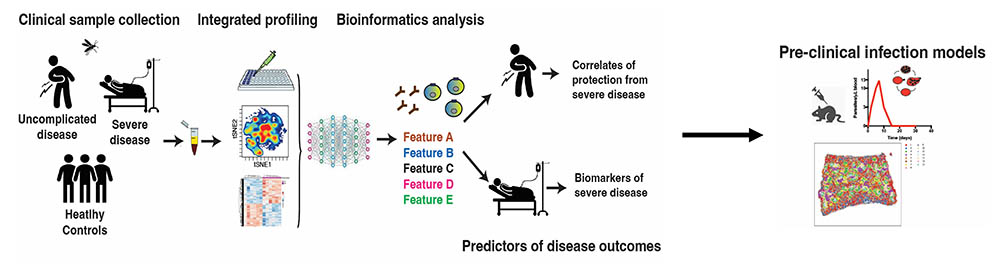
The Hansen laboratory has an extensive network of collaborators in different locations of Africa, South America, and Southeast Asia, where malaria and dengue are endemic. Through our international collaborations, we set up clinical studies to pursue a systems immunology approach, applying different techniques including single-cell RNA sequencing, high-dimensional single-cell mass cytometry, as well as analysis of soluble factors such as antibody responses to understand changes in the activity of immune cells in response to infection. We then validate our findings using pre-clinical models.
Current projects
Malaria
1.1 Mechanisms of immunity to malaria
Unlike other infections in which one single encounter with the pathogen is enough to induce long-lasting protection, immunity to malaria might take decades to develop in endemic areas. The Hansen lab investigates mechanisms by which Plasmodium infections prevent the acquisition of immunity. This work is undertaken in order to design therapeutic approaches to improve the induction of immune responses to the Plasmodium parasite, including effective anti-malaria vaccines. Clinical immunity to malaria is largely dependent on effective antibody responses. The acquisition of antibody-mediated immunity requires generation of high-affinity antibody-secreting cells and memory B cells, a process that is facilitated by T follicular helper cells in secondary lymphoid organs. In collaboration with partners in malaria-endemic countries, our group investigates how the induction of antibody-mediated immunity is dysregulated during clinical as well as subclinical malaria and how constant exposure to Plasmodium parasites over time modulates the development of these responses.
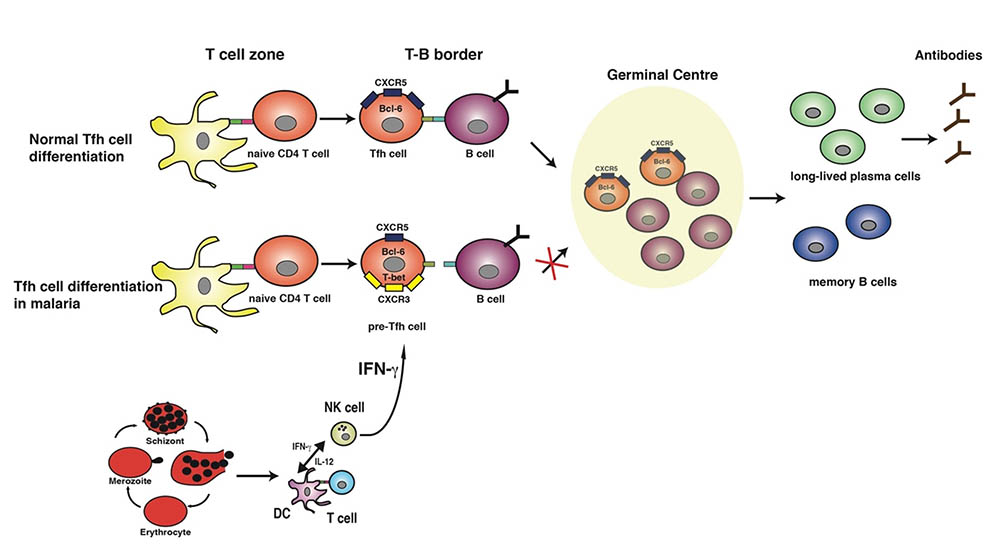
Figure caption: Our model on how inflammatory responses to blood-stage Plasmodium parasites inhibit the differentiation of a population named T follicular helper cells that are pivotal in the induction of antibody responses to infection.
1.2 Uncovering the burden of subclinical malaria
Clinical immunity to malaria is not sterilising but prevents clinical episodes by substantially reducing parasite burden, with adults often experiencing subclinical malaria. Historically, persistent subclinical malaria infections have been viewed as beneficial, as they were postulated to help maintain clinical immunity thereby reducing the risk of symptomatic re-infections. However, emerging views suggest that subclinical malaria might be detrimental to the host, with immunomodulatory, developmental, and productivity consequences as well as by providing a silent parasite reservoir that perpetuates malaria transmission. Despite deterring efforts of malaria elimination, subclinical malaria remains untreated, because the full impact of these infections is not understood.
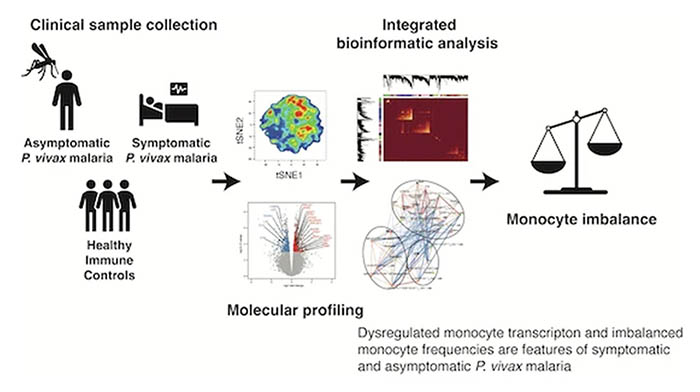
Our lab is applying systems immunology approaches to clinical studies conducted in malaria endemic areas of Indonesia and South America to understand immunosuppressive responses elicited by P. falciparum and P. vivax subclinical malaria infections. Our research provides a framework to support the screening and treatment of subclinical malaria in pre-elimination areas, and settings receiving vaccination.
1.3 Zoonotic malaria
Plasmodium knowlesi is a zoonotic malaria parasite originally found in macaques but increasingly recognized as a significant cause of human malaria in Southeast Asia. First identified in humans in Malaysian Borneo in the early 2000s, it has since emerged as a public health concern across the region, particularly in Malaysia, Indonesia, Thailand, Vietnam, and the Philippines.
Immune responses to P. knowlesi malaria either in its natural host or in response to human infection remain understudied. To address that knowledge gap, we are comparing blood transcriptional profiles of P. falciparum, P. vivax and P. knowlesi infected individuals. Our program will define how zoonotic malaria drives a unique pattern of immune responses to infection compared to the more host-adapted human malaria infections like P. falciparum and P. vivax.
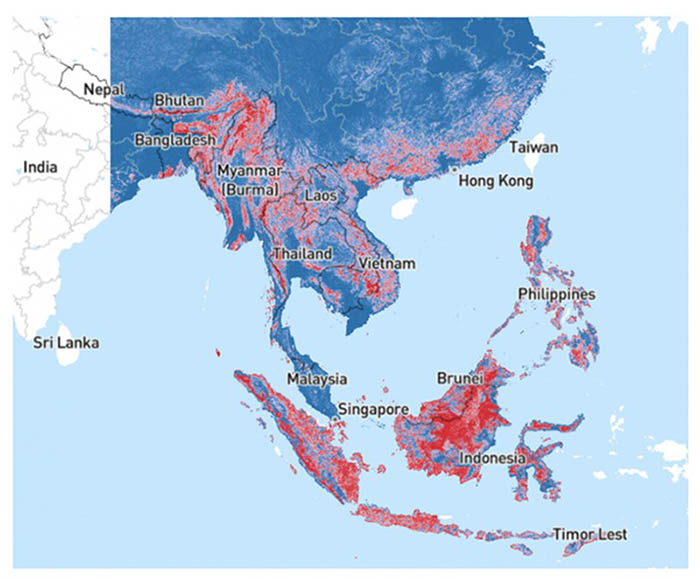
Figure caption: Macaque hosts of P. knowlesi are distributed across Southeast Asia. Red areas indicate higher density of macaque hosts, increasing likelihood of zoonotic transmission (Adapted from Malaria.com).
2. Identification of molecular and immunological factors predisposing to severe dengue fever
Typical symptoms of dengue include sudden onset of fever accompanied by headache, muscle pains, rash, cough, vomiting and haemorrhagic manifestations. Hospitalisation may be required depending on signs of severity such as dehydration, bleeding or comorbidities. There is no specific treatment for dengue, and care is mainly supportive. To date, there is no validated way of identifying which patients will progress to severe disease, meaning that in endemic areas, health facilities are often overwhelmed with patients admitted for inpatient observation, costing millions of dollars to health systems. To address this issue, this project undertakes a comprehensive immunological and transcriptional analysis of individuals with mild versus severe dengue fever recruited at local hospitals in different regions of Indonesia, Malaysia, and South America. The project will uncover key mechanisms involved in progression towards severe disease after initial patient presentation.
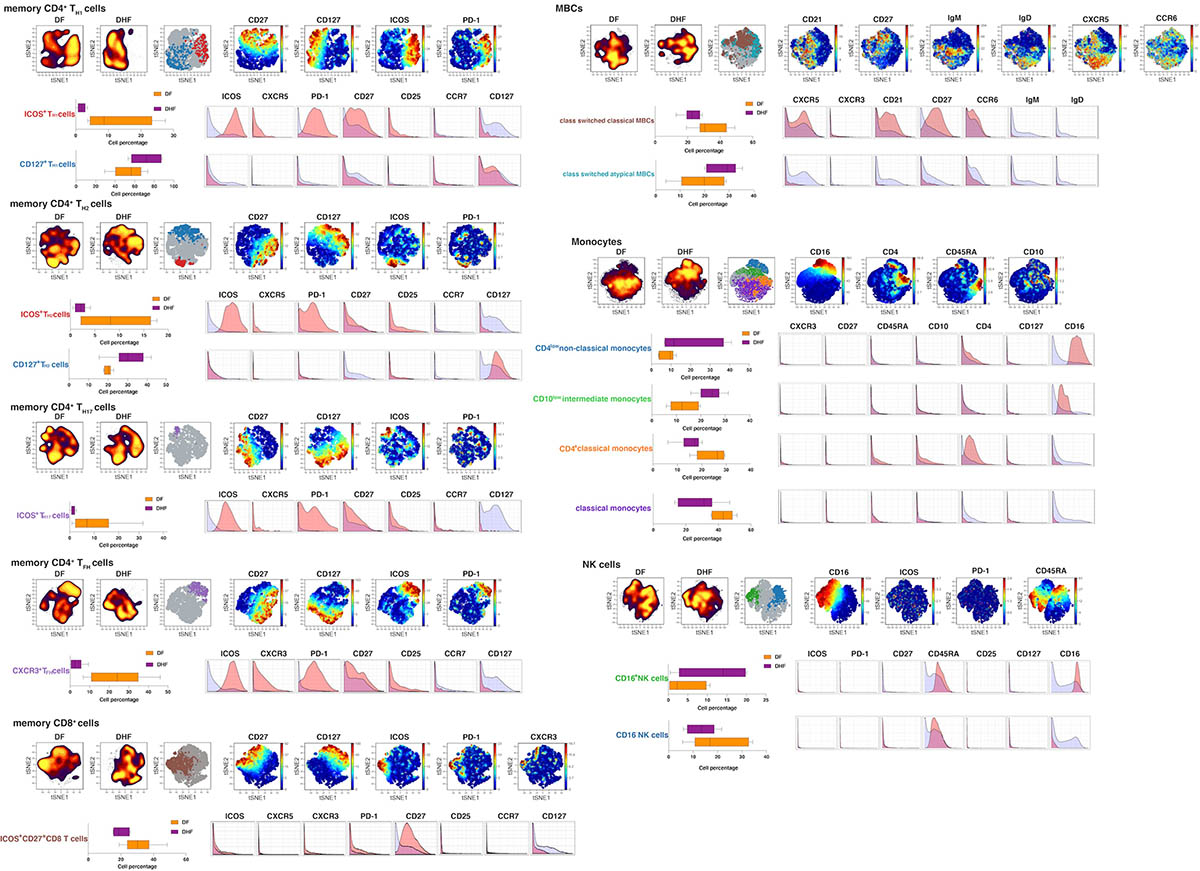
Figure caption: Differentially abundant blood populations in patients with uncomplicated dengue or severe dengue haemorrhagic fever identified by high dimensional mass cytometry.
Visit Professor Hansen's Monash research profile to see a full listing of current projects.
Techniques/expertise
- High-dimensional flow and mass cytometry
- Cytokine assays
- Antibody assays
- Next-Generation Sequencing (NGS)
- Bulk and single-cell RNA-seq
- ATAC-seq
- Bioinformatics analysis
- Differential gene expression analysis
- Pathway and enrichment analysis
- Network analysis
Disease models
- Plasmodium berghei
- Plasmodium chabaudi
Collaborations
We collaborate with many scientists and research organisations around the world. Some of our more significant national and international collaborators are listed below. Click on the map to see the details for each of these collaborators (and you'll be able to dive into specific publications and outputs).
- Prof Wei Shi, Monash University
- Prof Rory Bowden, WEHI
- Prof Matthew Ritchie, WEHI
- A/Prof Danielle Stanisic, Griffith University
- Emeritus Prof Michael Good, Griffith University
- Prof Katherine Andrews, Griffith University
- Prof Ric Price, Menzies School of Medical Health
- Dr Rintis Noviyanti, Eijkman Centre for Molecular Biology, Indonesia
- Dr Tedjo Sasmono, Eijkman Centre for Molecular Biology, Indonesia
- Prof Bachti Alisjahbana, Universitas Padjadjaran, Indonesia
- Prof Indra Widowo, School of Life Sciences and Technology, Bandung Institute of Technology, Indonesia
- A/Prof Henry Sudendra, Monash University Indonesia
- A/Prof Vinod Balasubramanian, Monash University Malaysia
- Prof Adeeba Kamarulzam, Monash University Malaysia
- Dr Han Ong, University Malaya, Malaysia
- Dr Sahrifah Syed Omar, University Malaya, Malaysia
- Pro Takafumi Tsuboi, Ehime University, Japan
- Prof Kouichi Morita, University of Nagasaki, Japan
- Prof Stephen Hoffman, SANARIA, USA
- Dr Karina Gómez, National Institute of Genetic Engineering, Argentina.
- Prof Ana Rosa Perez, National University of Rosario, Argentina
- Dr Ana Ceballos, University of Buenos Aires, Argentina
- Prof Katherine Torres, University Cayetano Heredia, Peru
Student research projects
The Hansen Lab offers a variety of Honours, Masters and PhD projects for students interested in joining our group. There are also a number of short term research opportunities available.
Please visit Supervisor Connect to explore the projects currently available in our Lab.