Mirabito Colafella Lab research
Collaborations | Student research projects | Publications
About Dr Katrina Mirabito Colafella
Dr Katrina Mirabito Colafella completed her PhD studies in the laboratory of Professor Kate Denton, Department of Physiology, Monash University. She was awarded a Monash Bridging Postdoctoral Fellowship and then obtained an overseas NHMRC CJ Martin Fellowship to continue her postdoctoral studies in Professor Jan Danser’s laboratory at Erasmus Medical Centre, The Netherlands. In late 2018, Katrina returned to Australia to establish her own research group within the Department of Physiology, Monash University, at the Monash Biomedicine Discovery Institute.
Katrina’s research program focuses on the pathophysiology and therapy of hypertension and cardiovascular disease, with a special emphasis on the renin angiotensin system, sex-specific risk factors (complications of pregnancy, menopause) and cardio-oncology. She has received numerous invitations to present her work at international meetings and has published in top journals in her field including Nature Reviews Nephrology and Hypertension. Katrina has won several prestigious international prizes including the American Journal of Physiology: Renal Physiology Paper of the Year (2014), the American Heart Association Council on Hypertension Best Early Career Oral Award (2017) and was a Finalist for the inaugural American Heart Association Council on Hypertension Stephanie Watts Career Development Award (2018).
Our research
Current projects
- Sex differences in hypertension and cardiovascular disease
- Unravelling the aetiology of preeclampsia
- Angiogenesis inhibitor-induced hypertension and renal injury: prevention by aspirin?
Visit Dr Katrina Mirabito Colafella's Monash research profile to see a full listing of current projects.
Research activities
The renin angiotensin system
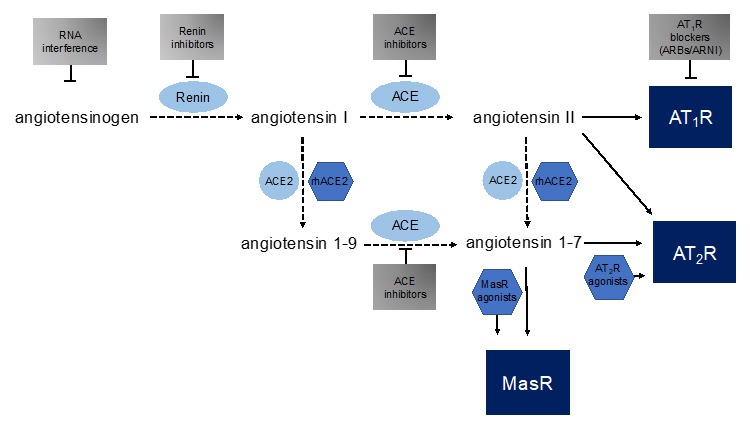
Drugs that target the renin angiotensin system (RAS) are a mainstay for the treatment of hypertension, cardiovascular disease and kidney disease. Our studies are determining the contribution of novel components of the depressor or so-called ‘protective arm’ of the RAS (angiotensin type 2 receptor and the angiotensin converting enzyme 2/angiotensin (1-7)/Mas receptor axis) in the regulation of blood pressure and renal function. Agonists that target these depressor components of the RAS may be a novel therapy for hypertension, cardiovascular and/or kidney diseases alone or in combination with classical RAS inhibitors. We are also involved in the pre-clinical testing the next generation of RAS inhibitors that target hepatic-derived angiotensinogen using RNA-based therapeutics. Targeting angiotensinogen with RNA-based therapeutics is a promising new tool to treat hypertension and diseases beyond. Their long-lasting effects are particularly exciting, and if translated to a clinical application of at most a few administrations per year, may help to reduce the clinical and economic burden of non-adherence.
Sex-specific risk factors for hypertension and cardiovascular disease
Hypertension and its associated complications affect men and women during different stages of their lives. Our research is focusing on what controls blood pressure in pregnant women and what largely protects women from cardiovascular disease until menopause. One in 10 women experience hypertension during pregnancy. Its life threatening for the mother and child and the only therapy we have at the moment is early delivery of the baby which may be severely premature. Since blood pressure medication may affect the baby, the goal in the clinic is to maintain the pregnancy for as long as possible to enhance fetal maturity and neonatal outcomes without adversely affecting the mother. Nevertheless, pregnancy complications such as preeclampsia, which is the severest form of hypertension during pregnancy, and gestational diabetes are associated with an increased risk of cardiovascular disease in later life. Ongoing studies examine: 1. what controls blood pressure during pregnancy, 2. the pathophysiology of preeclampsia and 3. the long-term consequences of hypertension during pregnancy and how this may contribute to the increased risk of cardiovascular disease in later life. Results from these studies may lead to the identification of novel treatments and biomarkers that reduce the risk of developing hypertension and associated disease.
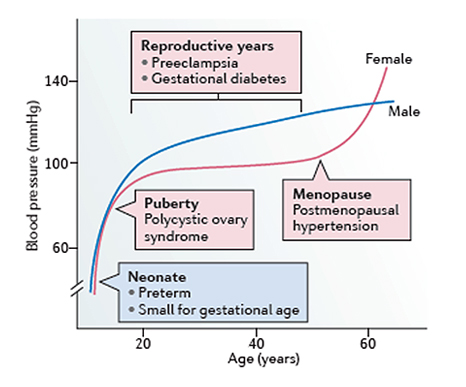
Image from: Mirabito Colafella KM, Denton KM. Sex specific differences in the mechanisms of hypertension and
associated cardiovascular diseases. Nature Reviews Nephrology. 2018. 14(3):185-201.
Cardio-oncology
Cardio-oncology is an emerging field aimed at the prevention, management and mitigation of cardiovascular disease in cancer patients. It is well established that patients with cancer and cancer survivors are at an increased risk of cardiovascular disease due to i) cardiovascular and metabolic complications associated with newer targeted therapies, ii) cancer itself being a risk factor for cardiovascular disease and iii) common modifiable and genetic risk factors that predispose to both malignancies and cardiovascular disease. We have a particular interest in angiogenesis inhibitor-induced cardiovascular and renal toxicity due to the clinical similarities between this condition and preeclampsia. In the last decade, angiogenesis inhibitors directed at the vascular endothelial growth factor (VEGF) pathway have become a first line treatment for several malignancies, including some previously untreatable cancers. However, VEGF inhibitors (VEGFi) can induce severe cardiovascular (most frequently hypertension) and renal (proteinuria, glomerular endotheliosis) toxicities. Furthermore, dose intensity and prolonged use of VEGFi may be limited by cardiovascular side effects, requiring dose reduction and/or early termination of treatment which compromises VEGFi efficacy and patient survival. Our research is developing novel strategies to prevent these unwanted side effects during angiogenesis inhibition to improve quality of life and survival in cancer patients.

Techniques/expertise
The Mirabito Colafella lab utilises state of the art techniques for the measurement of arterial pressure and renal function in rodents (e.g. radiotelemetry, transcutaneous measurement of GFR in conscious animals), ex-vivo assessment of vascular function (Mulvany myography), biochemical and molecular techniques (westerns, RT-PCR, assays, mitochondrial respiration and glycolysis via Seahorse extracellular flux analysis, flow cytometry), cell culture and the human ex-vivo dually-perfused placental perfusion model.
Disease models
- Preeclampsia (knockout mouse models, RUPP, sFlt-1 overexpression)
- Angiogenesis inhibitor-induced cardiovascular and renal toxicity
- Ageing
- Reproductive senescence
- Heart and/or kidney disease
- Hypertension (genetic, diet-induced (obesity, high-salt), DOCA-salt, angiotensin II-induced)
Collaborations
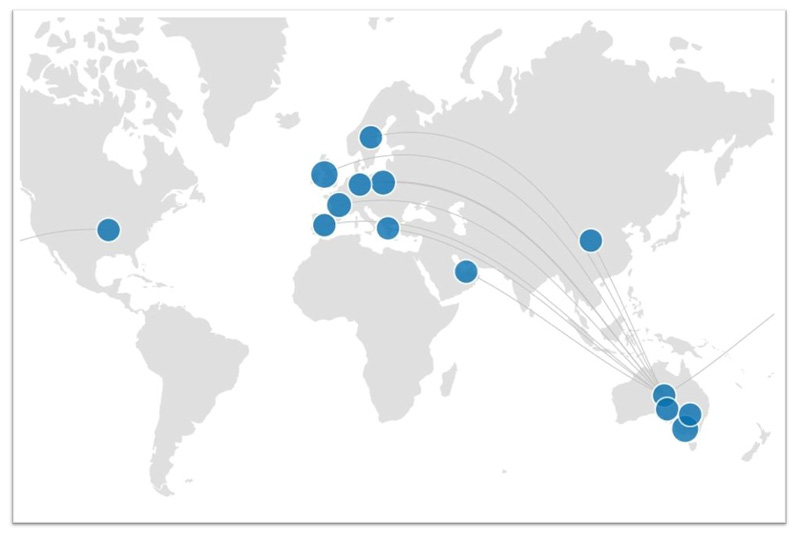
We collaborate with many scientists and research organisations around the world. Click on the map to see the details for each of these collaborators (dive into specific publications and outputs by clicking on the dots).
Student research projects
The Mirabito Colafella lab offers a variety of Honours, Masters and PhD projects for students interested in joining our group. There are also a number of short term research opportunities available. You are encouraged to contact Dr Katrina Mirabito Colafella regarding potential projects that align with the presented research themes.
Please visit Supervisor Connect to explore the projects currently available in the Mirabito Colafella lab.