Newton Lab research
Collaborations | Student research projects | Publications
About Professor Hayley Newton
Professor Hayley Newton is a cellular microbiologist with a keen interest in understanding the ways in which intracellular bacterial pathogens can manipulate their human host cells. She has worked with a range of bacterial pathogens, but her main research impact has come from studies into the zoonotic pathogen Coxiella burnetii. As a pathogen of both humans and animals, C. burnetii, remains an important example of the need for a one health approach for research into human health and disease.
After completing her PhD, studying pathogenesis of Legionella pneumophila at Monash University, Hayley was awarded a NHMRC Training Fellowship to undertake postdoctoral research at Yale University. Here she applied pioneering techniques to genetically manipulate C. burnetii and discovered key virulence factors of this poorly understood human pathogen. This research has led to a significant shift in our understanding of this mysterious intracellular pathogen. Hayley moved to the Department of Microbiology and Immunology, University of Melbourne, in 2013 where she established her independent research program and a substantial teaching portfolio. In 2022, Hayley was recruited to the Infection Program, Department of Microbiology and Biomedicine Discovery Institute, at Monash University.
Professor Newton is the current Deputy Head of the Department of Microbiology at Monash University with leadership portfolios in both teaching and research. She is also the Vice President for Scientific Affairs for the Australian Society for Microbiology and a co-editor in chief for FEMS Pathogens and Disease.
Our research
Current projects
Our research aims to create new knowledge in host-pathogen interactions driven by intracellular bacterial pathogens. Our team addresses how these pathogens can replicate inside eukaryotic cells and the different host pathways they manipulate to achieve this. We are particularly interested in pathogens, of both humans and animals, that use secretion systems to inject bacterial proteins, termed effectors, into the host cell. These effectors hijack different pathways in the host cell to allow the bacteria to replicate and cause disease.
We have active projects investigating Coxiella burnetii, Legionella species and Salmonella enterica. We are fascinated by Coxiella burnetii, the causative agent of Q fever, and Legionella species, the causative agents of Legionnaires' disease, which replicate inside human cells in a manner that requires the Dot/Icm type IV secretion system. This multi-protein nanomachine delivers a huge number of novel effector proteins into human host cells, manipulating many aspects of human cell biology, to facilitate intracellular replication of the pathogen. Very little is known about how individual effectors influence pathogen success. Our team employs a range of innovative and multi-disciplinary approaches to investigate the important functions of these novel bacterial effector proteins. Not only does our research shed light on the ways bacteria cause disease but we also use these effector proteins to learn about important processes for human health and disease.
Visit Professor Newton's Monash research profile to see a full listing of current projects.
Research activities
Manipulation of the lysosome by Coxiella burnetii:
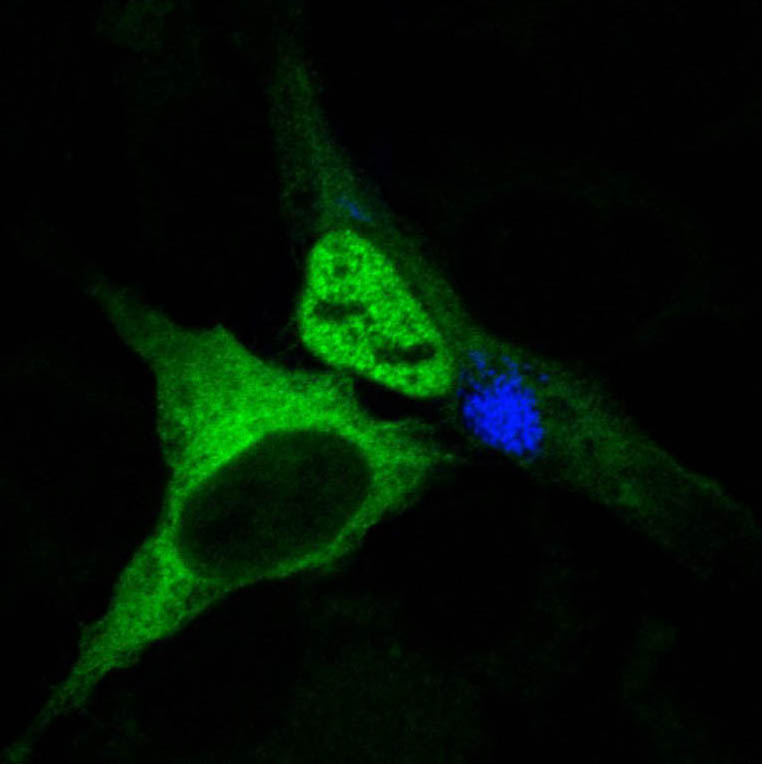
Caption: Confocal image demonstrating that C. burnetii infection (bacteria shown in blue) induces the nuclear recruitment of the host transcription factor TFEB (stained green).
C. burnetii establishes a replicative niche by modifying the human lysosome – the organelle designed to degrade foreign material. We have previously shown that infection with C. burnetii stimulates both autophagy and lysosomal biogenesis through the activation of the host transcription factor TFEB. We are currently exploring other ways in which this pathogen controls lysosome biology and the bacterial virulence factors responsible for this. This research informs our understanding of this pathogen while also uncovering novel strategies for lysosome control which has implications in a range of human disease states.
Dot/Icm effector function:
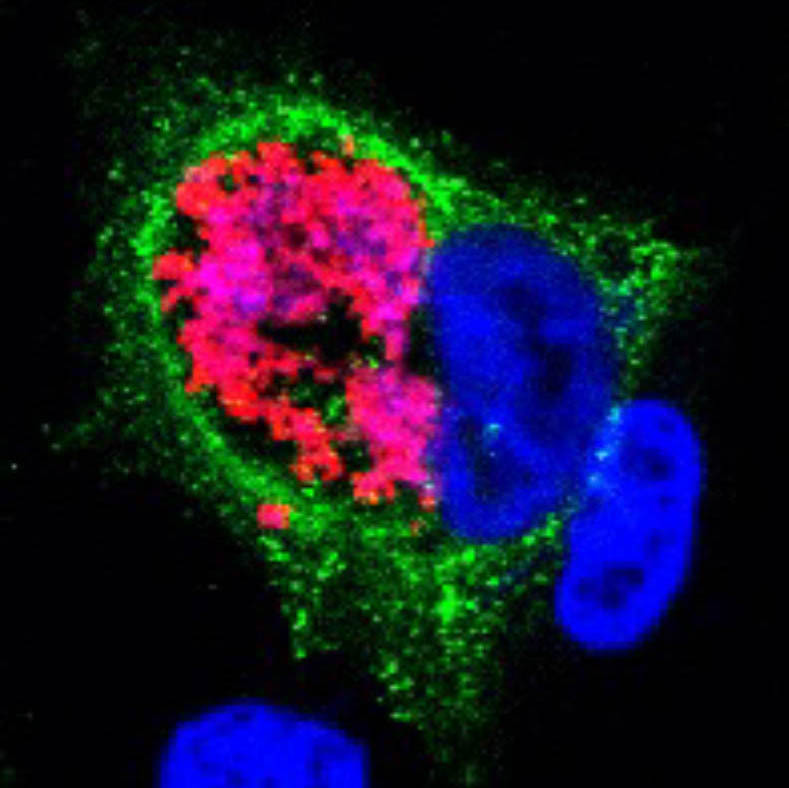 Caption: Confocal image of the large Coxiella-containing vacuole (bacteria shown in red) decorated by clathrin (green), host cell nucleus shown in blue.
We are pursuing biochemical understanding of the function of novel bacterial proteins introduced into eukaryotic cells via a Dot/Icm secretion system. Pathogens including Legionella species, Coxiella burnetii, Paracoxiella cheracis, depend on a Dot/Icm secretion system to deliver a large cohort of effector proteins into the host. These proteins manipulate many different eukaryotic processes. We have current research projects investigating the role of effectors localised to mitochondria, effectors that influence autophagy and lysosome biology, host cell death signalling and the response to reactive oxygen species.
Techniques/expertise
- Host-pathogen interactions
- Cellular microbiology
- Proteomics techniques
- High-resolution microscopy
- Protein biochemistry
- Genetic manipulation of bacteria and tissue culture cells
Disease models
- Tissue culture models of infection.
- Galleria mellonella wax moth larvae model of infection.
Collaborations
We collaborate with many scientists and research organisations around the world. Some of our more significant national and international collaborators are listed below. Click on the map to see the details for each of these collaborators (dive into specific publications and outputs by clicking on the dots).
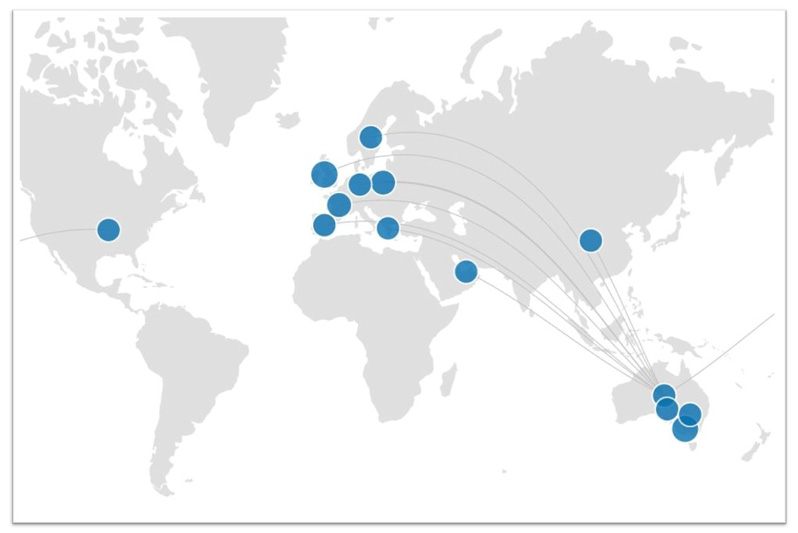
We have a diverse international collaborative network with ongoing research projects working with:
- Professor Dario Zamboni, University of São Paulo, Brazil
- A/Prof Diana Stojanovski, University of Melbourne, Australia
- A/Prof Alex Ensminger, University of Toronto, Canada
- Dr Danielle Ingle, University of Melbourne, Australia
- Dr Laura Edgington-Mitchell, University of Melbourne, Australia
- A/Prof Nichollas Scott, University of Melbourne, Australia
Student research projects
The Newton Lab offers a variety of Honours, Masters and PhD projects for students interested in joining our group. There are also a number of short term research opportunities available.
Please visit Supervisor Connect to explore the projects currently available in our Lab.
The Newton Lab offers a variety of Honours, Masters and PhD projects for students interested in joining our group. There are also a number of short-term research opportunities available. You are encouraged to contact Professor Newton regarding potential projects that align with the presented research themes.