Smith Lab research
Collaborations | Student research projects | Publications
Our research
Current projects
1. The role of G Protein Coupled Receptor 56 in Müllerian duct development.
2. Identification of novel genes regulating formation of the Müllerian duct.
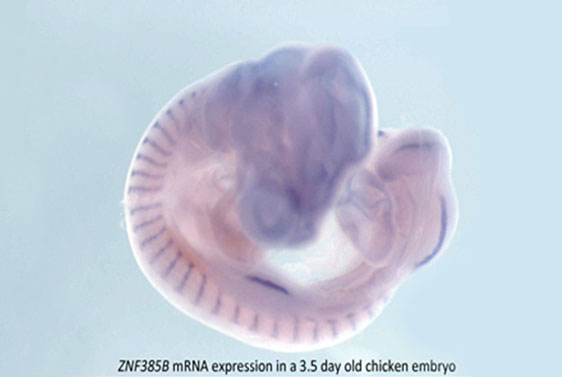
3. ZNF385B: A novel genes involved in gonadal sex differentiation in the chicken embryo.
4. Comparative analysis of limb morphogenesis in chicken and emu embryos.
Visit Associate Professor Smith’s Monash research profile to see a full listing of current projects.
Research activities
Our research broadly covers Evolutionary Developmental Biology, or how developmental mechanisms have evolved among animals. We focus primarily on the embryonic urogenital system and the limb, using avian embryos.
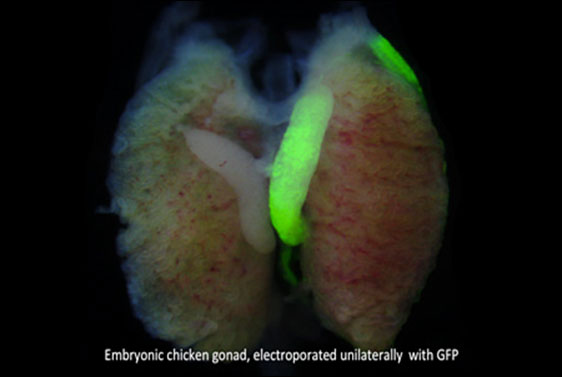
- Sex determination and gonadal development. We study known and novel genes implicated in gonadal sex differentiation (testis vs ovary formation) using avian models. This means using the chicken and quail embryos. Current projects involved over-expressing or knocking down gonadal genes and observing the effects upon sexual differentiation. We use methods of rapid functional analysis, such as in ovo electroporation. We are also using ChIP-seq and related methodologies to understand how key sex genes such as DMRT! And FOXL2, regulate testis and ovary formation, respectively. Most recently, we have been utilising the Monash Transgenic Quail Facility (MTQF) to producing quails modified for sexual development.
- Genetic regulation of Müllerian duct development. We have conducted RNA-seq to identify novel genes involved in development of the Müllerian ducts which form the female reproductive tract. Many new genes have been found, and these are being fully characterised and being functionally manipulated using CRISPR/Cas9 –based genome editing.
- Limb Evo-Evo. In collaboration with Prof Cliff Tabin (Harvard) we have ARC funding to explore the genetic basic of wing reduction among flightless birds such as the emu. We have identified a key gene involved in the formation of the vestigial emu wing which, when placed into chicken embryos, they develop small emu-like wings! We are further exploring the role of this gene, NKX2.5, in the emu model.
- We have collaborations with CSIRO Australian Animal Health Laboratories in Geelong to produce single sex lines of birds for the poultry industry. All females are required by the egg industry, and all males are preferred by the meat industry. Currently half of all hatchlings are often culled as they are of the un-wanted sex, a major animal welfare and economic issue.
1. Gonadal development and disease
We use the chicken embryo to model sex determination and gonadal development. The aim of this work is to define how genes regulate normal testis and ovary formation. This research has two applications. Firstly, it is of value to the poultry industry, where the production of single sex hatchlings is highly desirable. Females are required for the laying industry, while males are required by the broiler (meat) industry. Currently, half of all hatchlings are culled because they are of the unwanted sex, a major economic and animal welfare issue. With CSIRO colleagues, we are exploring ways of producing all male or all female hatchlings, using innovative RNA interference technologies. The second application this work is in the area of human sex determination and gonadal differentiation. Human disorders of sex development (DSD) account for a significant proportion of congenital abnormalities. Many cases of DSD cannot be explained. Using the chicken embryo as a model, we study the role of novel candidate sex genes in regulating proper ovary and testis formation during embryonic life. Mutations in these novel genes may underlie human DSDs.
2. Evolution and genetic regulation of limb morphogenesis
Development of the vertebrate limb is a well-established model for the genetic control of morphogenesis. We study the evolution and function of known and novel limb regulators, again in the avian model. We have identified a novel gene called ZNF385B expressed in the chicken limb bud, as shown opposite. Another aspect of the limb research is an Evo-Devo study of limb development in chicken versus emu embryos. The latter have very rudimentary wings and large legs. How has evolution shaped such limb diversity at the genetic level? An RNA-seq approach has yielded exciting candidate genes underlying emu limb development. Such studies provide clues to understanding how morphological diversity among animals is generated using a common genetic toolkit. This work has been funded through the Australian Research Council (ARC).
Techniques/expertise
Gene experession (RNA-seq, scRNA-seq, RT-PCR, I nsitu hrbirdisation,
Collaborations
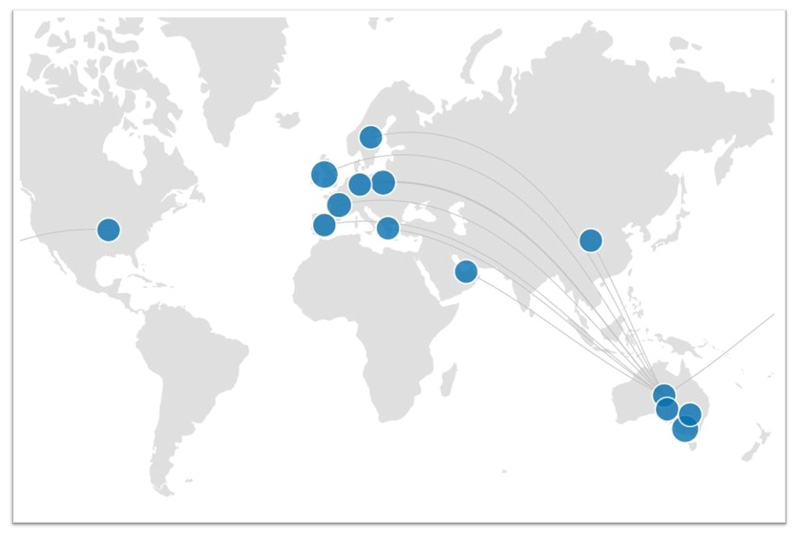
We collaborate with many scientists and research organisations around the world. Some of our more significant national and international collaborators are listed below. Click on the map to see the details for each of these collaborators (dive into specific publications and outputs by clicking on the dots).
National collaborators:
- Professor Andrew Sinclair and Dr Katie Ayes, Murdoch Children's Research Institute, Melbourne
- Professor Arthur Georges , Professor Tari Ezaz, University of Canberra, ACT
- Dr Tim Drona, Dr Mark Tizard, Dr Kirsten Morris et al., CSIRO, Geelong
International collaborators:
- Professor Asato Kuroiwa, University of Hokkaido, Japan
- Professor Cliff Tabin, Harvard Medical School, USA
Student research projects
The Smith Lab offers a variety of Honours, Masters and PhD projects for students interested in joining our group. There are also a number of short term research opportunities available.
Please visit Supervisor Connect to explore the projects currently available in our Lab.