Monash University logo

Monash Art, Design and Architecture Student Exhibition 2022

Aiman Ahmad Hilmi

How else can we densify an area to improve passive surveillance and interactions within a neighbourhood? Let’s start with nutrition. By pushing the boundaries of kitchens and dining areas, people will catch a glimpse of each other's lives. A vegetable garden at the centre of the wide footpath encourages residents and the public alike to gather, increasing their familiarity. Not only does the vegetable garden, or The Garden Avenue, improve social interaction, they also improve biodiversity by bringing animals into the picture.

Best in Studio: 'Walking the walk'

Most outstanding design project in the studio 'Walking the walk,' in the Bachelor of Architectural Design

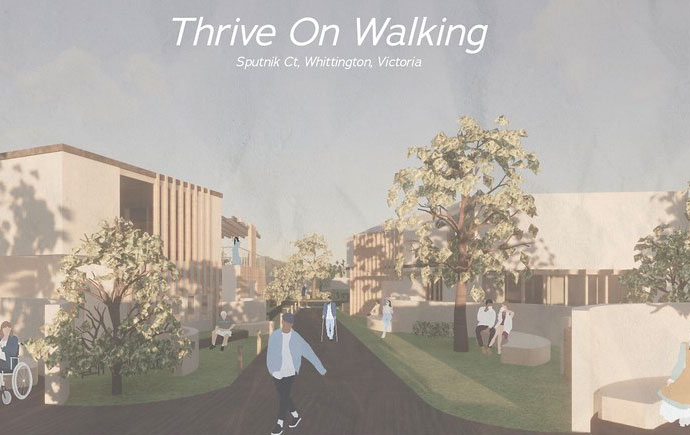
View into the Garden Avenue

A rendered image shows a pedestrian's view from the cul-de-sac entering the Garden Avenue at the end of Sputnik Ct. The boundaries of the houses curve alongside the footpath, allowing people to catch a glimpse of the life inside the boundary. It is evening, and a woman watches two children play near the pond, whether they're related or not is up to you. It is evening, and people are coming in and out of the avenue, maybe meeting up with friends, heading home from work or simply taking a stroll. It is evening, with the sun setting in the horizon casting an intimate hue around the neighbourhood, and the footpath is active.

Beneath the Pergola

The sun is out and the people are about (potential album title). A cat that is trying to catch a fish in the pond draws the attention of a little girl. "Whose child is this?" asks the cat internally. The cat notices the two adults pointing at the cricket park and scoffs. "I hope she falls into the water when they're not paying attention." Except that a man reading a book is already watching in case the child does fall into the water.

Unit 3-Garden Avenue Cross Section

A cross-section through Unit 3 shows the kitchen, an outdoor eating area and the garden avenue. The public and private zone is separated by a planter box that grows native plants. Not only do these plants help improve biodiversity, but their ideal growing height enables passive surveillance from those in the house, particularly when they're cooking or having a meal, to those outside. In this way, people will feel safer walking, knowing that there's life around them.

Unit 3-Footpath Longitudinal Section

A longitudinal section through Unit 3 shows a portion of the kitchen, the greenhouse kitchen and the footpath. The mini greenhouse acts as a barrier on the threshold between the private and public property. Passive surveillance is implemented here, where residents who are cooking a meal or pruning the plants, may be able to see outside whilst still being in the safety of their home. Who knows, the smell of their cooking wafting outside may even make someone feel nostalgic... What is a better way to bring people together than through a good meal?

Site Plan

The site shows the Garden Avenue cutting through the neighbourhood from the cul-de-sac to the park. A winding footpath adds to the dynamic atmosphere of the area, and various ground textures help increase water permeability, therefore reducing stormwater runoff. A shared pergola sits at the centre of every plot boundary, connecting the dining rooms from every unit and encouraging the residents to gather for a meal. Pedestrians on the footpath may in turn catch a glimpse of residential activity, perhaps they may be invited for a meal too...

Axonometric View of New Sputnik Ct.

This view explores the various forms and materials used for the proposed Sputnik Ct. within the Garden Avenue. Ground textures change to indicate the transition from public to private property. The house facades reflect the organic materials used for the environment, including the wooden pergola and the stonework paths. The aim for these varying styles is to reduce the monotonous atmosphere of the existing neighbourhood, while also increasing feelings of inclusion.

Explore more

View all

Other years

Back to top