Monash University logo

Monash Art, Design and Architecture Graduate Exhibition 2024

I’m a fifth-year architecture student focused on architecture and urban design. My project, the Menindee Aqueducts, addresses water quality issues at Menindee Lakes caused by mismanagement and reduced inflows from the Darling River. Inspired by Roman aqueducts, the design channels water through a phytoremediation system with a sloped green roof, where plants filter contaminants before returning the water to the river. This project restores water quality and serves as a research and educational facility, promoting community awareness and ecological stewardship, while utilising sustainable materials like adobe and bioplastics.

Construction Drawing

The drawing shows the large structure being built. Given the scale of the project, concrete mixer trucks will be used to mix soil, clay, and hay for the adobe blocks. Silos will store large quantities of these materials to streamline the construction process. Trucks and machinery will also be necessary to install the fabric mesh and adobe moulds.

Site Plan

The project is located just outside the Lake Menindee outlet. It aims to phytoremediate water that comes out of the lake and the water that flows through the river before it goes down the Murray and gets distributed to other water channels.

Plan

The project also serves as a research and education facility where students, scientists, and researchers can learn and engage with the restoration process. Public spaces, like the visitor centre and education rooms, are positioned in the north where the roof is more open and elevated, making it easily accessible from the main road. Whilst, private areas, such as laboratories and testing spaces, are located to the south where the roof's elevation is lower and more secluded, designed specifically for researchers. A central control room ensures the smooth operation of the facility and oversees water management systems.

Sections

The water system relies on controlled pumps that lift water from the lake to the roof, where it is distributed through the filtration systems. As the water flows through, the plants filter out pollutants before it’s sent down to the water lock for final discharge into the river.

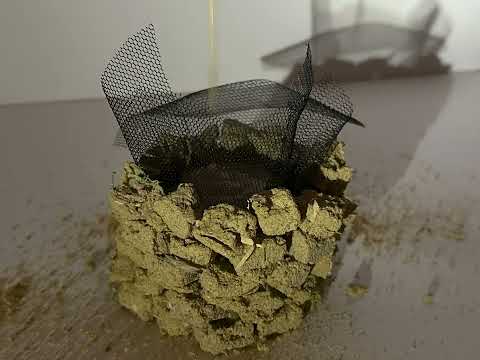
The materials used are adobe blocks and bioplastic. Adobe blocks, made from soil, clay, water, and hay, are used as a sacrificial mould during construction. They’re combined with a fabric mesh to allow easy removal once the bioplastic mixture is poured. Meanwhile, bioplastic, made from renewable resources, hardens and shrinks over time, creating habitable spaces

Stop Motion Film

The stop motion film explores the construction process of the bioplastic structure, and captures its spatial qualities.

[View full video here]

Material Studies

The material studies from the beginning of the semester influenced my design, shaping both its structure and choice of materials.

Explore more


View all


Back to top