As an Industrial Design student at Monash University, I have a strong interest in creating clever, human-centred design solutions. My work focuses on improving everyday experiences through design, accessibility, and spatial interactions. I enjoy researching the potential for seamless interactions between digital systems and real-world environments, whether through concept development, model prototypes, or navigational interventions. My most recent project reimagines the wayfinding experience at Caulfield Station by combining digital and tactile interfaces with inclusive design principles to help all users navigate difficult public areas.
Touch to Travel
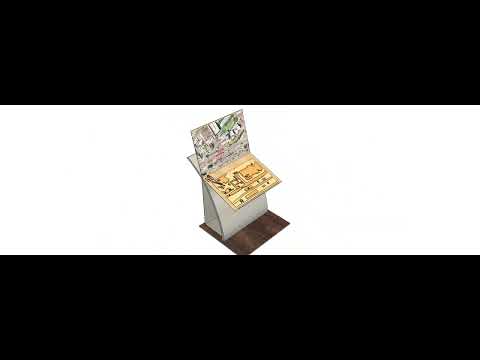
Touch to Travel, an accessible wayfinding kiosk, was developed to enhance navigation at Caulfield Station. The system includes a digital display, augmented reality, and tactile maps to assist users in navigating real-time station information. The prototype, which was constructed using acrylic and laser-cut basswood panels, has an ergonomic design and material efficiency suitable for public areas. The design prioritizes universal accessibility, robustness, and easy interaction to provide a practical solution for inclusive transportation infrastructure.
Tactile Map
The tactile map is a laser-cut navigational tool made to make Caulfield Station's spatial arrangement easier for people with visual impairments to comprehend. It has raised walkways, platform outlines, and etched station details for tactile readability. It is made of 3mm basswood layered on top of each other. For better orientation, the design guarantees precise scale representation of tectural contrasts. Integrated Braille labels and directional markers give natural guidance, making the map an essential component in fostering inclusive and independent travel.
Storyboard
This storyboard shows the user path and interaction flow for the Touch to Travel wayfinding kiosk. Every step of the trip is explained in detail, from arriving at the station to confirming the route and available accessibility features like QR code-based AR navigation, tactile exploration, and auditory feedback. Created digitally using Adobe Illustrator, the storyboard serves as a visual aid to demonstrate how inclusive design principles enhance usability for all commuters.
Structural model overview
The sophisticated design and material composition of the kiosk are exhibited by the exquisite physical model. The main structure's polished steel frame provides stability and a realistic appearance of durability suitable for public areas. The base is stable and has a smooth, clean surface thanks to the PVA-coated wood. These elements work together to create a polished, well-balanced prototype that captures the structural and visual intent of the finished kiosk design.
Full scale view
The finished Touch to Travel kiosk in 360 degrees. Because the video focuses on the streamlined structure, user interface, and material detailing, viewers can experience the design from all angles and understand its spatial presence within the station environment.
In the spirit of reconciliation Monash University acknowledges the Traditional Custodians of country throughout Australia and their connections to land, sea and community. We pay our respect to their elders past and present and extend that respect to all Aboriginal and Torres Strait Islander peoples today.