Combes Lab research
Collaborations | Student research projects | Publications
About Dr Alex Combes
Dr Combes is interested in how cell fate is determined and regulated in the dynamic three-dimensional context of the developing embryo. Investigating kidney development provides insight into how complex tissues form and often identifies disease mechanisms as disruption of developmental programs gives rise to renal birth defects, susceptibility to kidney disease as an adult, and other pathologies such as kidney cancer. Knowledge of how the cell types and tissue structure of the kidney forms during development also forms the basis of recreating human kidney tissues from pluripotent (stem) cells. While the production of miniature human kidney ‘organoids’ from stem cells has been a major milestone for the field, further research is required to understand how to improve the structure and cellular composition of these tissues for disease modelling and regenerative medicine. These advances are likely to be achieved by applying further knowledge of kidney development through cell and tissue engineering. As such, the goals of our research are to define the signalling pathways, transcriptional regulators, and cellular interactions that drive kidney development, and to use this knowledge to engineer improved models of human kidney tissue and disease. To address these goals, we take an interdisciplinary approach, using genomics, bioinformatics, imaging, and gene editing in animal and stem cell models.
Awarded a PhD from The University of Queensland (UQ) for graduate studies in Professor Peter Koopman’s laboratory, Dr Combes undertook postdoctoral studies in the laboratories of Professor Emma Whitelaw (QIMR), and Professor Melissa Little at UQ & Murdoch Children’s Research Institute (MCRI). He spent several years developing and applying new imaging approaches to assess normal kidney development and the contribution of genetic and environmental stressors to kidney disease. Dr Combes was awarded a DECRA fellowship in 2015 at the University of Melbourne and led a team focused on the molecular regulation of kidney development securing funding from the ARC, NHMRC, and charitable organisations before starting his own lab at Monash in 2020. In addition to his role as Lab Head, Alex serves as the Director of the Monash Genome Modification Platform (MGMP), where he leads an expert team dedicated to generating new cellular and animal models of disease with current gene editing approaches.
Our research
Current projects
Tissue engineering and disease modelling
The development of protocols to generate miniature human kidney ‘organoids’ from stem cells has led to considerable progress in modelling human kidney development and genetic drivers of early-onset disease. However, improvements in the cellular composition, maturation, and patterning of kidney organoids are likely required to extend the impact of organoid technology to common adult disease states and regenerative medicine. We aim to deliver on these goals by determining the molecular programs that control kidney development using emerging single cell and spatial profiling technologies and implementing our findings in the lab.
Furthermore, we aim to broaden the impact of organoid technology to model aspects of chronic kidney disease, which is estimated to affect over 850 million people worldwide and 1 in 10 Australians. Chronic kidney disease is defined by a progressive loss of kidney function. End-stage patients require a kidney transplant or dialysis. However, transplants are in short supply and dialysis has a substantial impact on quality of life. In collaboration with clinicians and disease experts we are carefully evaluating the capacity of organoids to model aspects of chronic kidney disease. If successful, our efforts will provide a platform to accelerate the development of novel therapies to target this pervasive and debilitating disease.

Human kidney organoid (left) compared to developing mouse kidney (right).
Image adapted from Little and Combes, Genes and Development 2019.
Regulation of progenitor cell fate in development and disease
An average human kidney contains 1,000,000 specialised filtration units called nephrons that cooperate to filter the blood and regulate fluid homeostasis in the body. However, nephron number varies 10 fold in the human population. Low nephron number is a major risk factor for chronic kidney disease and is associated with environmental and genetic factors that impair kidney development. Despite this, we have a poor understanding of how nephron number is regulated. Nephrons arise from a nephron progenitor (NP) population located at the periphery of the developing organ. Self-renewing NP cells produce factors that drive kidney growth, while differentiating NP cells build the functional capacity of the organ by forming nephrons. The balance between NP self-renewal and differentiation determines final nephron number and is critical for optimal kidney development.
We are investigating the molecular mechanisms of nephron progenitor regulation using single cell analysis and live imaging of kidney development in knockout mouse models. We anticipate these efforts will lead to increased control over nephron progenitor expansion and differentiation in culture, and may offer avenues to enhance nephron number in at-risk individuals.
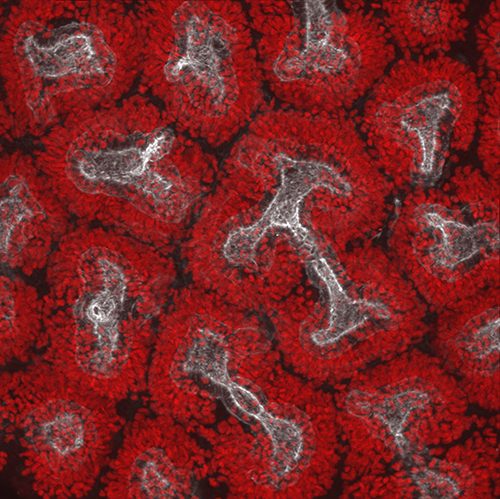
Nephron progenitor cells (red) cluster around the tips of the ureteric epithelium (white).
Visit Dr Combes’ Monash research profile to see a full listing of current projects.
Collaborations
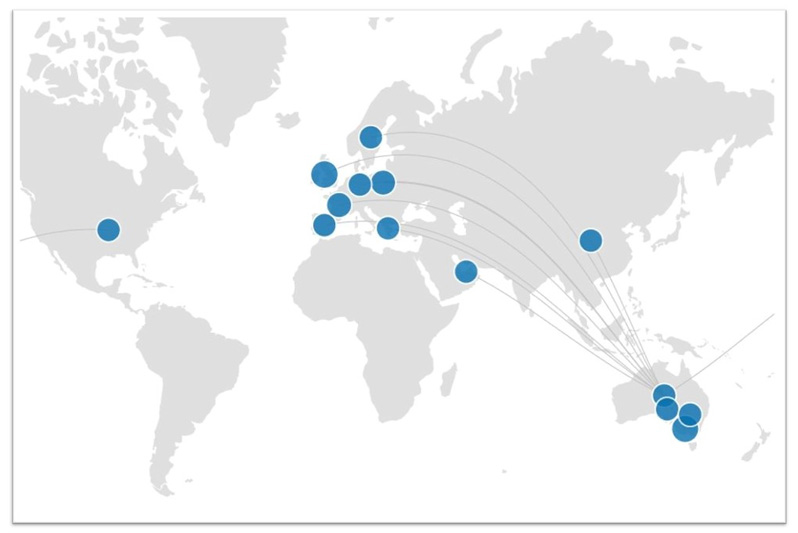
We collaborate with many scientists and research organisations around the world. Click on the map to see the details for each of these collaborators (dive into specific publications and outputs by clicking on the dots).
Student research projects
The Combes Lab offers a variety of Honours, Masters and PhD projects for students interested in joining our group. There are also a number of short term research opportunities available.
Please visit Supervisor Connect to explore the projects currently available in our Lab.