Knaupp Group research
Collaborations | Student research projects | Publications
About Dr Anja S. Knaupp
Dr Anja Sylvia Knaupp is a molecular biologist and biochemist originally from Germany. She completed her university studies there before relocating to Australia to undertake her PhD at Monash University. Her long-standing interest in how proteins mediate physiological and pathological cellular functions developed during her PhD research with Prof Steve Bottomley in the Conformational Disease Laboratory in the Department of Biochemistry and Molecular Biology. There, she investigated the molecular mechanisms underlying several protein misfolding events linked to human disease.
In 2013, she transitioned into the field of epigenetics and transcriptional regulation by joining the Epigenetics and Reprogramming Laboratory of Prof José Polo in the Department of Anatomy and Developmental Biology at Monash University as a postdoctoral researcher. There, she applied her expertise in protein biochemistry to the field of cellular reprogramming and has since developed an independent research program focused on understanding how transcription factors control cell identity and transitions between different cell states. In recognition of her research achievements, she was promoted to Group Leader by the Monash Biomedicine Discovery Institute in 2022.
Our research
How transcription factors shape cell identity
Cellular identity, including a cell’s behaviour and function, is governed by the expression of specific gene sets that are tightly regulated by a small number of master transcription factors. These factors bind to regulatory elements such as enhancers and promoters and recruit cofactors, including chromatin remodellers and histone modifiers, to establish and maintain gene regulatory networks.
Unlike conventional transcription factors that require accessible chromatin to bind DNA, many master regulators act as pioneer factors. These can engage with closed chromatin and initiate structural changes that allow gene activation. This unique ability enables them to both maintain cellular identity and impose new identities on other cell types. For example, overexpression of the pluripotency factors OCT4, SOX2, and KLF4 can reprogram somatic cells into a pluripotent embryonic-like state, while lineage-specific transcription factors can direct differentiation into defined cell types.
Dr Knaupp’s research investigates how transcription factors, regulatory elements, and cofactors interact to control gene expression, and how changes in these interactions—such as those occurring during development or disease progression—alter cell identity. Her work has important implications for understanding human development, cell fate transitions, and cancer progression.
In parallel, Dr Knaupp develops molecular tools to investigate the composition of transcriptional complexes at specific genomic loci. She is the lead developer of TINC, a locus-specific proteomics technique, and continues to refine related methods to enable deeper insights into transcriptional regulation in development and disease.
Current projects
Visit Dr Knaupp's Monash research profile to see a full listing of current projects.
Research focus areas
1. Mechanisms of Pluripotency Induction and Maintenance
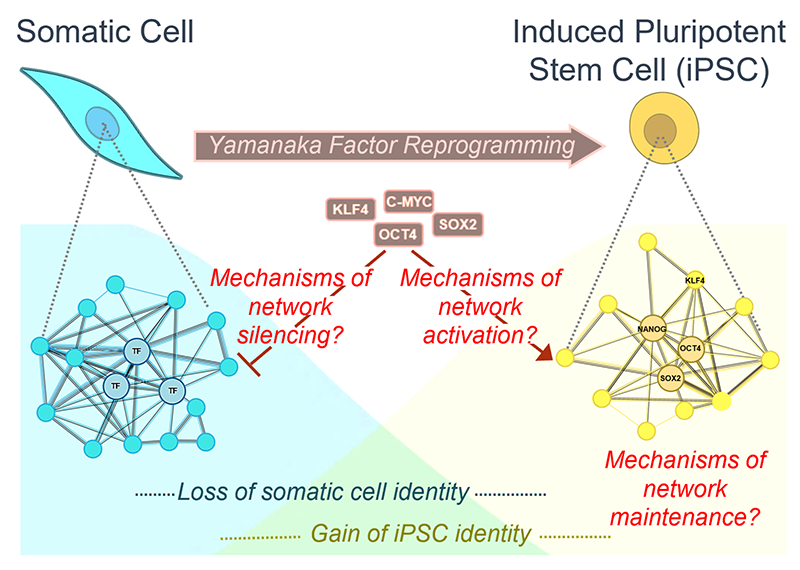
The reprogramming factors OCT4, SOX2, KLF4, and c-MYC have the extraordinary ability to reprogram differentiated somatic cells into induced pluripotent stem cells (iPSCs), which, like embryonic stem cells, can generate all cell types of the organism. This remarkable plasticity has vast therapeutic potential, yet the molecular mechanisms underlying reprogramming remain poorly understood. In particular, how these factors overcome diverse epigenetic and transcriptional barriers to silence the somatic program and activate the pluripotency network is still unclear. Our research focuses on identifying the transcriptional, epigenetic, and chromatin-based mechanisms that drive successful cell fate reversion and maintain the pluripotent state, with the goal of improving reprogramming efficiency and the fidelity of downstream differentiation.
2. Regulation of Pluripotency Factors in Development and Disease
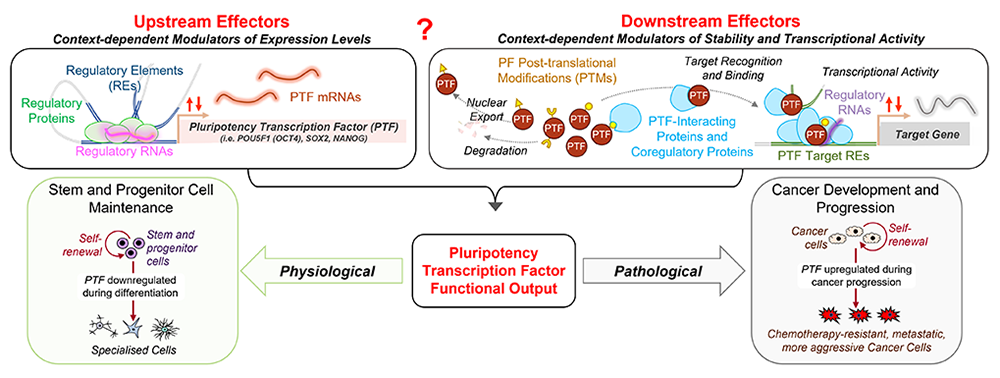
Pluripotency transcription factors such as SOX2, OCT4, and NANOG are not only central to early embryonic development and iPSC reprogramming, but are also aberrantly activated in various cancers, where they contribute to lineage plasticity and therapy resistance. While these factors function through interactions with cofactors and regulatory elements, their activity is highly context dependent, shaped by upstream signals, chromatin environment, and post-translational modifications. Understanding these regulatory mechanisms is essential for defining how the same factors can support normal development in one context and drive malignant transformation in another. Our research aims to uncover how transcription factors are regulated at multiple levels to mediate context-specific control of gene expression, cell identity, and plasticity in development and cancer.
3. Method Development for Locus Specific Proteomics and Regulatory Complex Discovery
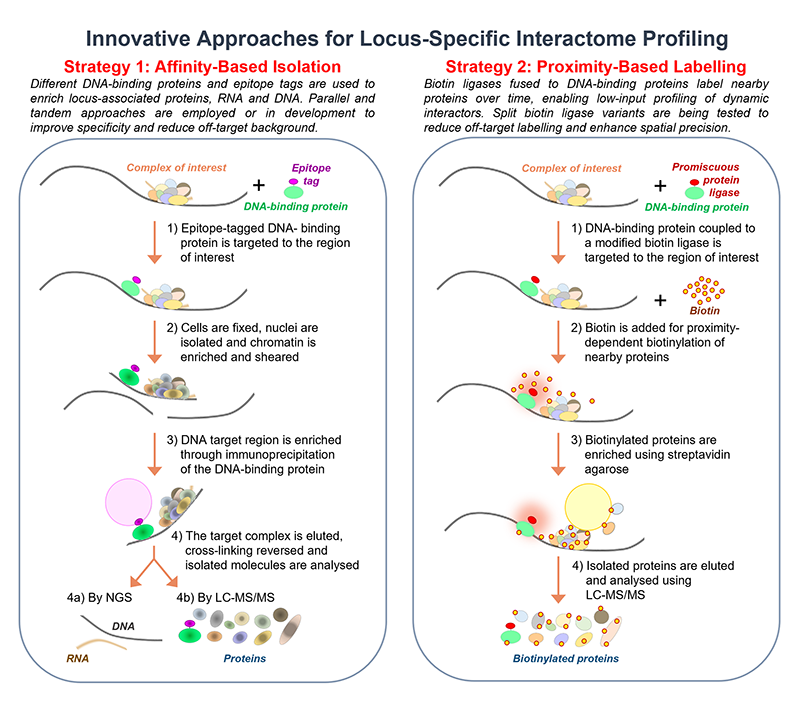
A major challenge in gene regulation is understanding which protein complexes assemble at specific regulatory elements to control gene expression in a context-dependent manner. To address this, we developed TINC (TALE-mediated Isolation of Nuclear Chromatin), a method for isolating and characterising regulatory complexes at defined genomic loci. Building on this, we are advancing new locus-specific proteomics strategies that improve flexibility, scalability, and applicability, particularly through the incorporation of CRISPR-guided targeting. Ongoing optimisation focuses on enhancing sensitivity and specificity, including the integration of split proximity labelling technologies. These tools provide a platform for systematically interrogating gene regulatory complexes across a wide range of cellular models and research contexts.
Techniques/expertise
We use a combination of cell culture systems, 3D in vitro models, mouse models, and a range of epigenomic and proteomic profiling techniques to decipher cell identity networks. These include RNA-seq, ATAC-seq, ChIP-seq, CUT&RUN, TINC, mass spectrometry (MS/MS), and CRISPR/Cas-based approaches.
Disease models
- CRISPR/Cas9 knockout cell lines
- Cancer cell models
Collaborations
We collaborate with many scientists and research organisations around the world. Click on the map to see the details for each of these collaborators (dive into specific publications and outputs by clicking on the dots).
Student research projects
The Knaupp Group offers a variety of Honours, Masters and PhD projects for students interested in joining our group. There are also a number of short term research opportunities available.
Please visit Supervisor Connect to explore the projects currently available in our Lab.