Knott Laboratory
Structure & Function of Nucleic
Acid Sensors
Structure & Function of Nucleic
Acid Sensors
The evolutionary back and forth between hosts and mobile genetic elements drives the innovation of remarkable molecular strategies to sense or conceal genetic material. The Knott Lab uses structural biology and RNA biochemistry to understand how CRISPR-Cas and other novel immune systems specifically sense RNA. We aim to better understand the function of novel nucleic acid sensors to harness their activity as tools for molecular diagnostics and as innovative biomedicines.
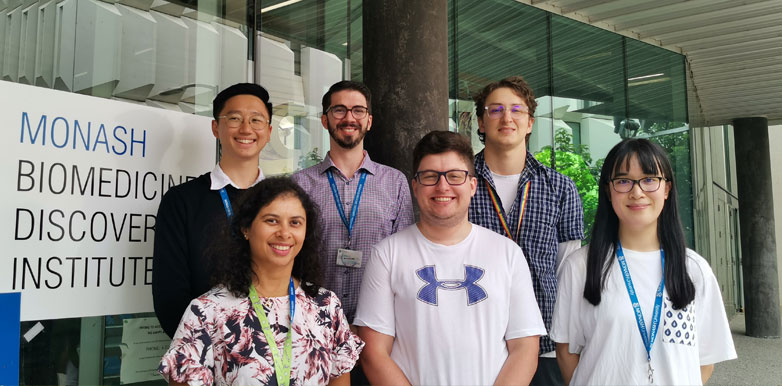
We're part of the Monash Biomedicine Discovery Institute, a member of the Infection Program,
and the Department of Biochemistry and Molecular Biology.
We're also a member of Monash RNA.
My global research connections, partners and funding can be viewed on my Monash Research Profile.
If you are a student interested in doing research in our lab, visit Supervisor Connect.
Click the links below to connect with me on Twitter, ORCID, Google Scholar and LinkedIn.




The evolutionary back and forth between hosts and mobile genetic elements drives the innovation of remarkable molecular strategies to sense or conceal genetic material. The Knott Lab uses structural biology and RNA biochemistry to understand how CRISPR-Cas and other novel immune systems specifically sense RNA. We aim to better understand the function of novel nucleic acid sensors to harness their activity as tools for molecular diagnostics and as innovative biomedicines.
We are committed to excellence in research.
We're always interested in collaborating with bright and motivated researchers, clinicians and industry. Whether you want to research, study or partner with us to accelerate our discoveries, find out about the work we do.