Lappan Group research
Collaborations | Student research projects | Publications
About Dr Rachael Lappan
Dr Rachael Lappan is a microbial ecologist, an ARC DECRA Fellow (2023 - 2025) and Group Leader in the Department of Microbiology in the Biomedicine Discovery Institute. Rachael has a background in microbiology and microbial ecology, and completed her PhD in 2019 at the University of Western Australia in Perth, where she led a study on the microbiome of ear infections in children.
During her postdoctoral appointment in Professor Chris Greening’s lab, Rachael broadened her expertise across human and environmental microbiology using One Health approaches for disease surveillance. In the RISE Program, she led the development and implementation of a TaqMan Array Card approach for enteric pathogen detection to understand the impacts of improved water and sanitation management in informal settlements.
In the Greening Lab, she has built a profile of work focusing on microbial communities that use atmospheric trace gases as an energy source in a range of environments. In 2022, she received the Australian Society for Microbiology's Jim Pittard Early Career Award for her achievements in microbiology.
In 2023, Rachael received an ARC DECRA Fellowship (receiving the Australian Academy of Science's J G Russell Award for top-ranked DECRA applications) and was appointed a Group Leader in the Department of Microbiology to study microbial communities in the atmosphere. Her research program aims to determine the nature and activity of the atmospheric microbiome, how this ecosystem contributes to human and environmental health, and to explore its role in seeding new ecosystems in unique settings including meteorites and glacier forelands. She is currently an Associate Investigator in the ARC Special Research Initiative Securing Antarctica's Environmental Future. Rachael collaborates across health, biological and earth sciences and has extensive fieldwork, laboratory and bioinformatics experience.
Our research
Current projects
Visit Dr Lappan's Monash research profile to see a full listing of current projects.
Research vision
We are a curiosity-driven research group that strives to explore how microbes survive in their environment: how they meet their energetic and nutritional needs, how they compete or interact with other microbes in their environment, and how their metabolic activities and functions contribute to the wider ecosystem. We also seek to understand the impacts of climate change on these ecosystems and their functions.
Research activities
1. Atmospheric and extreme microbiology
Microbial life on Earth is almost universally present, inhabiting a vast range of environments across the lithosphere (land) and hydrosphere (water). The atmosphere also harbours microbial life, but despite being the largest planetary-scale sphere, it is the least studied. It may be the Earth’s largest microbial ecosystem, yet a fundamental question remains unresolved: does the atmosphere simply move microorganisms between habitats, or does it harbour a community of microbes adapted to life in this extreme environment? We are addressing this and other questions to understand the nature and basis of microbial life in the atmosphere above a range of underlying ecosystem types. We also collaborate to understand microbial ecosystems and their survival strategies and activities in other extreme environments, including Antarctica, glaciers, and mineral-rich substrates.
See our work: The atmosphere: a transport medium or an active microbial ecosystem? (The ISME Journal, 2024)
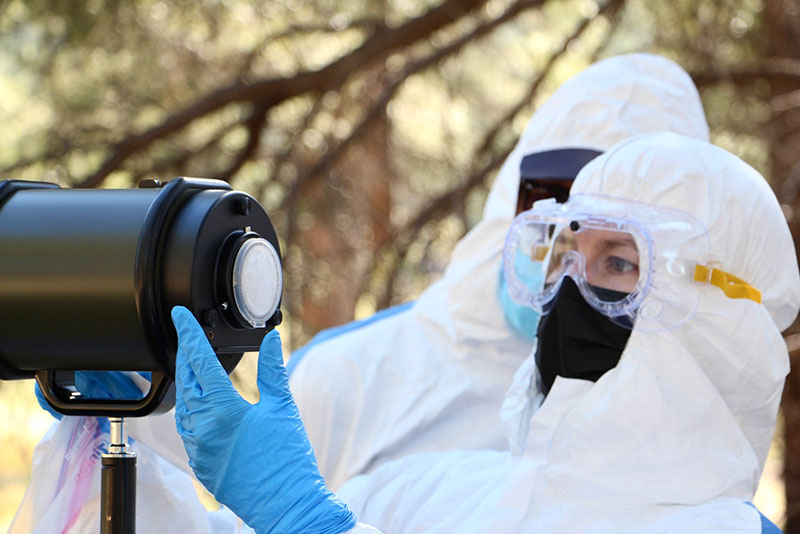
Sampling the atmosphere with high-volume samplers and PPE (Photo credit: Jackie Goordial).
2. Microbial primary succession
Primary succession is an ecological process where ‘pioneer’ organisms first colonise a barren or sterile habitat, and has historically been studied in the context of vegetation. The earliest stages of primary succession are in fact characterised by rapid microbial colonisation, with substantial changes occurring prior to succession with any plant or macroscopic life. Yet it remains poorly studied: where do these pioneer microbes come from, how do the microbial communities change over time, and how do their activities contribute to the function and the trajectory of the developing ecosystem?
We study this in two main contexts: 1) glacier forelands, where a retreating glacier exposes new and previously subglacial bedrock for a new ecosystem to form, and 2) meteorites, which are presumed sterile or otherwise sterilised by atmospheric entry, and provide a compositionally distinct and potentially nutrient-rich habitat for terrestrial microbes to colonise. Linking with our other work, we also examine the contributions of atmospheric microbes to this process.
See our work: Functional basis of primary succession: Traits of the pioneer microbes (Environmental Microbiology, 2023)
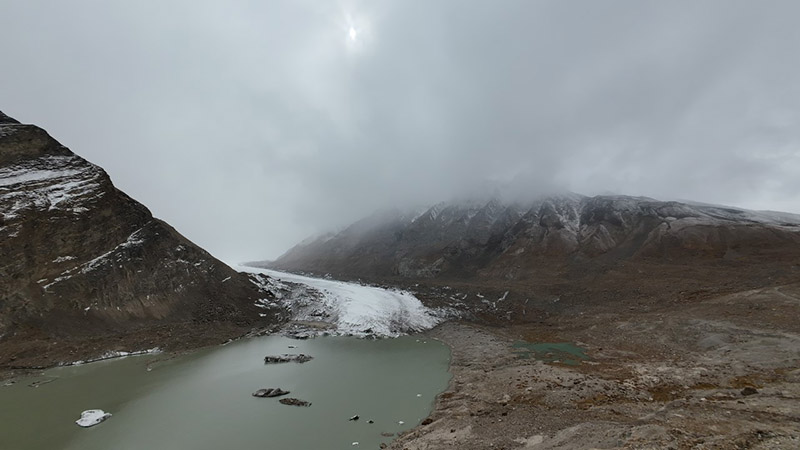
Drang-Drung glacier, Ladakh, India (Photo credit: Parth Sharma).
3. One Health and Planetary Health microbiology
The concept of One Health refers to the linkage between human, animal and environmental health: they are inherently connected, and strategies to impact One Health issues should optimally benefit the health of all three. In the context of pathogens and antimicrobial resistance (AMR), we have worked on the RISE Program to develop effective ways to monitor transmission between human, animal and environmental reservoirs. Our ongoing work on atmospheric microbiology links to One Health (and indeed Planetary Health) as we investigate the role of atmospheric microbes in long-range transmission of key pathogens and antimicrobial resistance genes, and how their activities in the atmosphere may connect to global biogeochemical cycles and processes. We also collaborate in the clinical space to apply our techniques for microbial air sampling to examine airborne transmission of pathogens and AMR in hospital settings.
See our work: Monitoring of diverse enteric pathogens across environmental and host reservoirs with TaqMan array cards and standard qPCR: a methodological comparison study (Lancet Planetary Health, 2021)
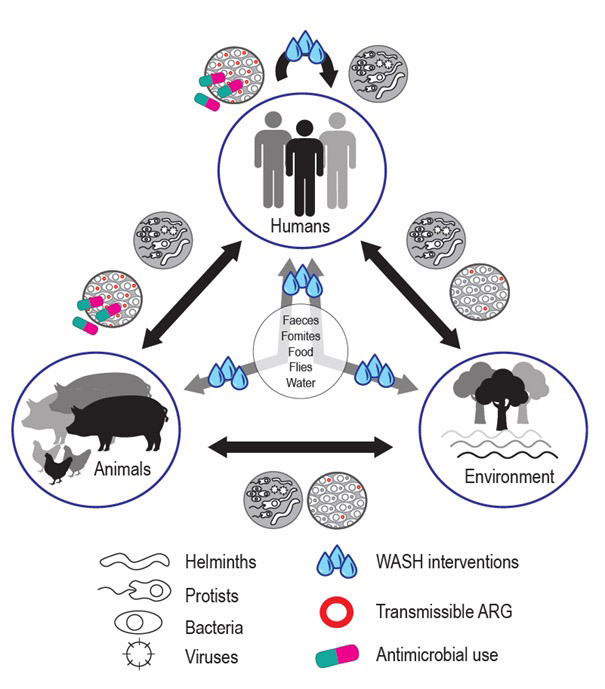
Human, animal and environmental health are linked, particularly in the context of disease transmission.
Techniques/expertise
- Metagenomics, microbial ecology and bioinformatics
- Molecular microbiology of air, soil, water and rock samples
- Remote and non-remote fieldwork
Collaborations
We collaborate with many scientists and research organisations around the world. Some of our more significant national and international collaborators are listed below. Click on the map to see the details for each of these collaborators (dive into specific publications and outputs by clicking on the dots).
We collaborate across the life and earth science disciplines, including with:
- Professor Chris Greening, Department of Microbiology, Biomedicine Discovery Institute, Monash University
- Professor Andy Tomkins, School of Earth, Atmosphere and Environment, Monash University
- Professor Andrew Mackintosh, School of Earth, Atmosphere and Environment, Monash University
- Professor Steven Chown, Securing Antarctica’s Environmental Future, Monash University
- Professor Melodie McGeoch, School of Biological Sciences, Monash University
- Asst Prof Jackie Goordial, University of Guelph
- Dr James Bradley, Aix-Marseille University
- Asst Prof Elizabeth Trembath-Reichert, Arizona State University
Student research projects
The Lappan Group offers a variety of Honours, Masters and PhD projects for students interested in joining our group. There are also a number of short term research opportunities available.
Please visit Supervisor Connect to explore the projects currently available in our Group.