Lazarou Lab research
Collaborations | Student research projects | Publications
About Dr Michael Lazarou
Michael's research interests are focused on autophagy pathways and various aspects of mitochondrial biology in health and disease. Michael was awarded his PhD in 2008 from La Trobe University studying the assembly of membrane protein complexes in mitochondria and their defects in energy generation disorders. In 2010, Michael conducted his post-doctoral research studies at the National Institutes of Health (USA) where he worked on mitochondrial dysfunction in Parkinson's disease. His research focused on the Parkinson's disease proteins PINK1 and Parkin and their role in maintaining mitochondrial health via selective autophagy. The work led to Michael receiving the 2013 ASBMB Boomerang Award, and in 2015 he established his laboratory in the Department of Biochemistry and Molecular Biology at Monash University where he is currently an ARC Future Fellow.
Our research
Current projects
- PINK1/Parkin mitophagy
- Mitochondrial quality control
- Autophagy mechanisms
Visit Dr Lazarou's Monash research profile to see a full listing of current projects.
Research activities
Autophagy, also known the cell’s garbage disposal system, is a fundamental intracellular degradation pathway that responds to various types of stress. Autophagy provides nutrients during starvation, maintains cellular quality control, helps cells defend against invading pathogens and is involved in cell death pathways. These roles have linked autophagy to neurodegeneration (e.g Parkinson's disease), cancer, innate immunity and metabolism regulation.

An autophagosome containing a mitochondrion imaged by transmission electron microscopy.
During autophagy, cytosolic components are engulfed by a double membrane structure called an autophagosome. Autophagosomal contents are subsequently degraded following fusion of the autophagosome with a lysosome. Autophagy can be activated in response to starvation where recycling of degradation products provides both energy and building blocks for essential cellular processes. Starvation induced autophagy is largely a non-selective process that randomly packages cellular material into autophagosomes. Selective forms of autophagy are activated in response to specific cellular stresses such as clearance of dysfunctional mitochondria through mitophagy, and removal of invading bacteria through xenophagy. Failure of either starvation induced autophagy, mitophagy or xenophagy can perturb cellular functions and cause cell death. It is therefore essential to understand how autophagosomes form during both selective and non-selective autophagy. Using high resolution imaging, cell biology techniques and 3D structural analyses of autophagosomes, we aim to decipher how autophagosomes are built during cellular stress as well as characterise the factors that drive autophagosome formation.
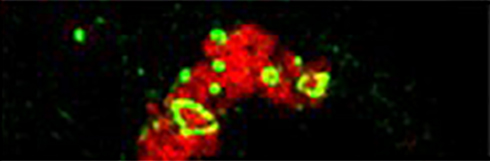
3D electron microscopy reconstruction of a damaged mitochondrion (red) being engulfed by an autophagosome (green),
surrounded by endoplasmic reticulum (blue) during PINK1/Parkin mitophagy.
PINK1/Parkin mitophagy and Mitochondrial quality control in Parkinson's disease
Parkinson's disease (PD) is one of the most common of the neurodegenerative disorders, affecting 1-2% of the population worldwide. Two proteins commonly mutated in familial PD, PINK1 and Parkin, play a key role in maintaining mitochondrial integrity by identifying damaged mitochondria and degrading them through a selective form of autophagy termed mitophagy.
PINK1 functions as a molecular sensor of mitochondrial health by specifically accumulating on the outer membrane of damaged mitochondria. PINK1 alerts Parkin to damage by recruiting it to the dysfunctional mitochondrion and activating Parkin's ubiquitin ligase activity. Parkin then adds ubiquitin chains onto substrates on the outer mitochondrial membrane. PINK1 phosphorylates these ubiquitin chains enabling them to act as molecular signals that recruit the machinery required to build autophagosomes. Damaged mitochondria that are engulfed by autophagosomes are delivered to the lysosome for degradation thereby maintaining the health of the mitochondrial population. We combine gene-editing techniques (using CRISPR) with advanced microscopy and biochemical approaches to understand the molecular signals of PINK1/Parkin mitophagy and the interconnected pathways that maintain mitochondrial health.

Basic model of PINK1/Parkin mitophagy
Techniques/expertise
- Electron microscopy
- Confocal microscopy
- Focused ion beam correlative light electron microscopy
- Gene editing
Collaborations
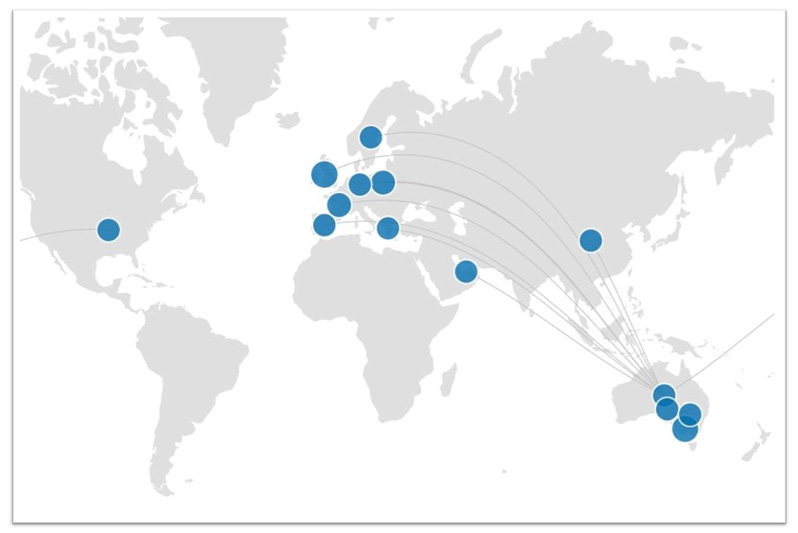
We collaborate with many scientists and research organisations around the world. Click on the map to see the details for each of these collaborators (dive into specific publications and outputs by clicking on the dots).
Student research projects
The Lazarou Lab offers a variety of Honours, Masters and PhD projects for students interested in joining our group. There are also a number of short term research opportunities available.
Please visit Supervisor Connect to explore the projects currently available in our Lab.
