Spanswick Lab research
Collaborations | Student research projects | Publications
About Professor David Spanswick
Dave Spanswick graduated from University of East Anglia, UK in 1986 (B.Sc).
He then obtained his PhD at University of Birmingham, studying neurophysiology. He remained in Birmingham as a Post-doctoral research fellow in Steve Logans group before moving to work in Canada with Leo Renauds group and Japan with Syogoro Nishi, Hideho Higashi, Hiroe Inokuchi and Megumu Yoshimura. He subsequently returned to the UK as a lecturer in the Department of Biomedical Sciences, University of Aberdeen before taking a sabbatical at the Department of Pharmacology, University of Cambridge and Parke-Davis.
He was appointed a senior lecturer, University of Warwick in 2000 and Professor of Molecular Neuroscience at Warwick Medical School in 2004. He arrived at the Department of Physiology, Monash University in October 2011.
Community service
- Referee for Journals: Nature, Journal of Neuroscience, Neuropharmacology, Journal of Physiology; Journal of Neurophysiology; Neuroscience Letters; Brain Research; Nature Neuroscience, Neuroscience; J. Neurosci., Methods; Cell Metabolism; Neuropharmacology; Trends in Endocrinology and Metabolism; Biological Psychiatry
- Referee for Grant Awarding Agencies: The Wellcome Trust; British Heart Foundation; BBSRC; MRC; Canadian Institutes for Health Research (CIHR); NIH; NHS
- PhD External Examiner: University of Manchester, University of Cambridge, Imperial College, London, University of Ottawa
- PhD Co-supervisor for Students at University of Ottawa Canada
Our research
Current projects
- Glucose-sensing neurons in the brain: how do they do it?
- Motivation and reward: glucose, ghrelin and the mechanisms regulating the dopaminergic neural circuits of the ventral tegmental area
Visit Professor Spanswick's Monash research profile to see a full listing of current projects.
Research activities
The long-term aim of our research is to address questions relating to the mechanisms by which neuroendocrine, autonomic and behavioural responses to disturbances in energy levels are integrated, and to identify and isolate the component parts at the cellular level that underpin this behaviour. Thus we seek to understand and identify central neural cellular mechanisms contributing to the development and manifestation of obesity and the associated co-morbidities, diabetes and hypertension. Previous research undertaken by the group has focused on the central integration of nutrient, hormone and neuropeptide signals in key hypothalamic and spinal areas involved in regulating food intake and energy homeostasis. Maintaining and co-ordinating energy balance is a function of specific key areas of the brain which act to integrate information regarding the energy status of the body and formulate appropriate responses to maintain energy balance. Dysfunction or disruption to these signalling mechanisms manifests as pathophysiological states.
Through an understanding of central neural cellular and molecular signalling mechanisms of nerve cells and circuits engaged in maintaining energy homeostasis we seek to investigate:
- The central neural mechanisms controlling energy balance, how they change with age and contribute to the development of obesity and diabetes.
- Glucose-sensing neural circuits, the mechanisms by which neurons detect changes in glucose levels and the age-and energy status-dependent plasticity associated with these neurons and circuits.
- The role of epigenetics in hypothalamic neuronal plasticity and obesity.
- The impact of protein and fermentable carbohydrate diets on the functional operation of neural circuits controlling energy balance.
- The role of the gut flora in the development of energy status-sensing neural circuits, diabetes and obesity.
- Central neural aspects linking obesity and hypertension: a focus on spinal sympathetic neural circuits and signalling pathways.
- To address these issues we have developed key strategic collaborations and partnerships, both nationally and internationally to ensure a multidisciplinary approach spanning the sub-cellular genetic, through isolated tissue approaches to whole organism physiology and pathophysiology.
Collaborations
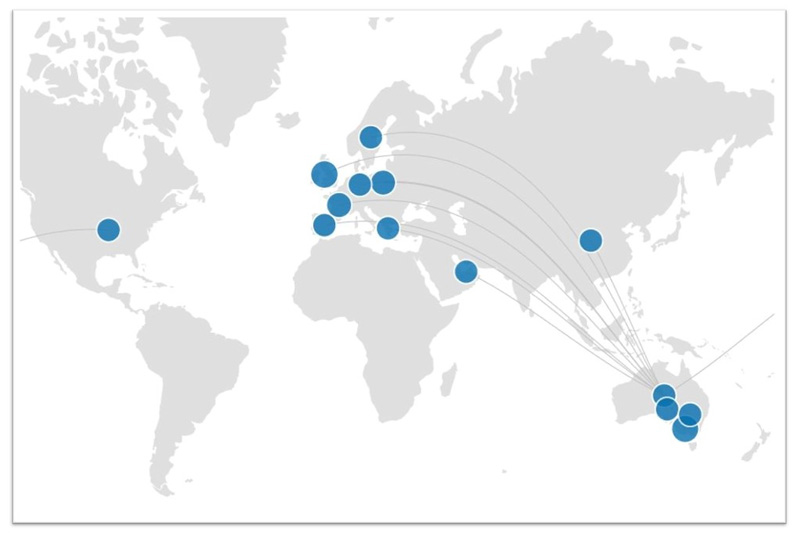
We collaborate with many scientists and research organisations around the world. Click on the map to see the details for each of these collaborators (dive into specific publications and outputs by clicking on the dots).
Student research projects
The Spanswick Lab offers a variety of Honours, Masters and PhD projects for students interested in joining our group. There are also a number of short-term research opportunities available. You are encouraged to contact Professor Spanswick regarding potential projects that align with the presented research themes.