
Creating Deceptive Machines
Creating Deceptive Machines
This talk is a summary of the speaker's PhD thesis entitled "Deception". It is the first full computational treatment in Artificial Intelligence (AI) on how to create machines able to deceive. The dissertation discusses the limited related research on deception that exists in AI, Philosophy and Psychology. The speaker will talk about the deception from two different directions. The main direction is from the cognitive modelling perspective of agents in Multi-Agent Systems (MAS). Working from this perspective has enabled the engineering and formal modelling of reasoning mechanisms that artificial agents could potentially use to deceive and to detect deception in a similar fashion to how humans perform these tasks. The other direction is from an evolutionary perspective on agent behaviour in multi-agent systems. Working from this second direction shows how deception can destabilise cooperation in hybrid societies, where humans and machines interact socially through exchange of knowledge, but it also shows how cooperation can be re-established if the right mechanisms for social interaction are in place.
This study leads to three main future research directions. These regard the refinement of the models presented in the thesis, the creation of MAS tools for deception analysis, and, finally, the creation of a machine worth talking to.
About the speaker
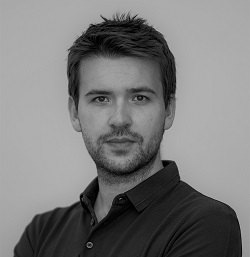
Research Fellow, King's College London; Associate Researcher at Inria Sophia-Antipolis
Stefan Sarkadi is a Research Fellow in the Dept. of Informatics at King's College London and an Associate Researcher at Inria Sophia-Antipolis. Stefan's research interests lie at the intersection of Artificial Intelligence and deception, an increasingly complex socio-cognitive phenomenon that is difficult to detect and reason about. His work tackles the integration of techniques from AI and deception analysis to generate narratives about multi-agent interactions in complex systems in order to help intelligence analysts perform inference to the best explanation. He has been awarded a fellowship grant by the Royal Academy of Engineering through the UK IC Postdoctoral Research Fellowship scheme for the project entitled Enhancing deception analysis with storytelling AI. This project is the continuation of his PhD thesis entitled Deception, which is the first full computational treatment of deceptive machines at the intersection of AI, Philosophy and Psychology. Before this, he worked as a Postdoctoral Research Associate at King's on the UK-wide REPHRAIN project, and as a Postdoctoral Research Fellow at Inria and the 3iA Côte d’Azur. Previously, Stefan did his PhD at King's College London, during which he spent time as a visiting PhD researcher at the MIT Media Lab. He also has an MSc in Mind, Language and Embodied Cognition (Cognitive Science) from the University of Edinburgh and a B.A. in Philosophy from the West University of Timisoara.
Monash University values the privacy of every individual's personal information and is committed to the protection of that information from unauthorised use and disclosure except where permitted by law. For information about the handling of your personal information please see Data Protection and Privacy Procedure and the relevant Data Protection and Privacy Collection Statement that applies to you depending on the nature of your interaction with us.
If you have any questions about how Monash University is collecting and handling your personal information, please contact our Data Protection and Privacy Office at dataprotectionofficer@monash.edu.