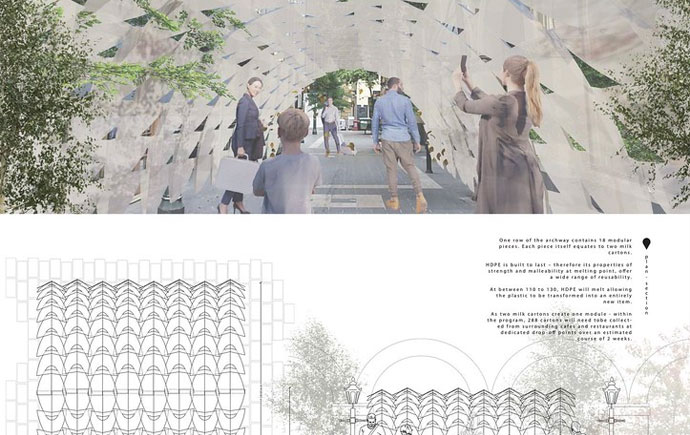
Many remnants of plastics from household items are thrown carelessly in different areas of Melbourne. As a result, they often end up in locations such as Port Phillip Bay, the Yarra as well as the Maribyrnong river. Consequently, Seabins are installed along the Yarra’s marina edge in order to capture the waste as well as to avoid causing harm to the biodiversity around. Through this, I aim to showcase the potential of waste by creating a pavilion that follows several circular design strategies to avoid the production of more rubbish.
Best in Studio: 'The Things We Throw Away'
Most outstanding design project in the studio 'The Things We Throw Away,' in the Bachelor of Architectural Design
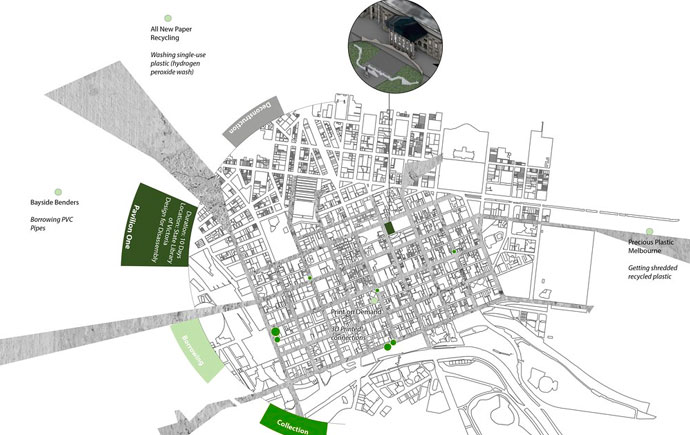
The Collection of Waste around Melbourne CBD
This map entails the areas of focus for waste collection, specifically thermoplastics such as high-density polyethylene (HDPE) and polypropylene (PP). HDPE and PP are usually found in food-grade packaging yogurt tubs; subsequently, these plastics can be seen around the CBD, where cafes and restaurants are located. HDPE and PP share great qualities such as higher tensile strength compared to other plastics, allowing them to withstand heavier loads. Other than this, both polymers are immensely malleable which makes it easier to create any desired shape.
Plastic Pavilion
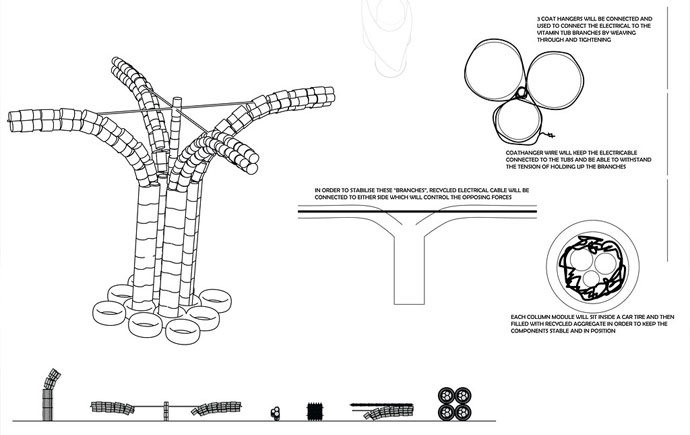
Located in the Birrarung Marr, the section drawing of the plastic pavilion aims to demonstrate the design for disassembly principle utilised. As shown on the callouts, the columns and beams are joined through pieces of 3D-printed connectors that allow the components to be dismantled for other uses. Furthermore, the plastic bricks are constructed similarly to lego, where the mechanisms are pressed together to create a firm structure. Because of this, the components are highly adaptable, allowing several opportunities for new items to be produced, such as non-structural walls and furniture.
Dinda Pradnyantari, The Collection of Waste around Melbourne CBD
In the spirit of reconciliation Monash University acknowledges the Traditional Custodians of country throughout Australia and their connections to land, sea and community. We pay our respect to their elders past and present and extend that respect to all Aboriginal and Torres Strait Islander peoples today.