Monash University logo

Monash Art, Design and Architecture Student Exhibition 2022

Josh Robinson

Best in Studio: 'Caring Culture'

Most outstanding design project in the studio 'Caring Culture,' in the Master of Architecture

A Community Cathedral

Located on the Brotherhood of St Laurence’s Fitzroy precinct, this project is an experiment in mixing care programs with culture-ultimately designing a shared space for making and occupational health services. Our design addresses first person perspectives; we constantly asked ourselves, how can the materiality of the spaces we create a positive, inviting presentation for individuals utilising this building? Our design response explores a parallel design narrative beginning with the existing church fabric, asking ourselves; how could the church have its former civic significance restored, in a way appropriate for the community service it currently provides?

Domestic Threshold

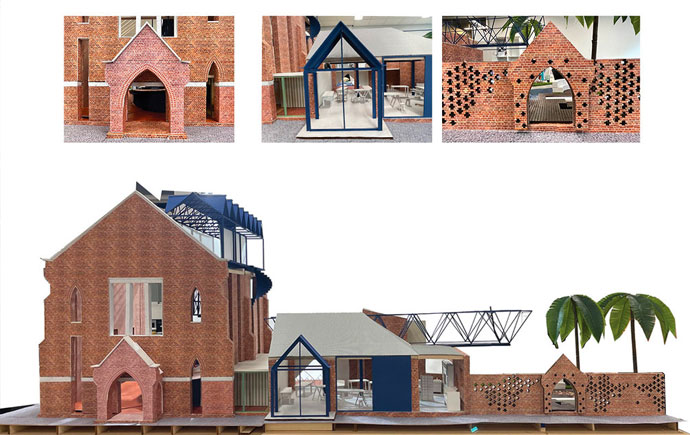
Rather than relying on institutional signifiers: reception desks, waiting areas and signage, we wanted the materiality and scale of our architecture to guide patients towards the occupational therapy area of our building. The entry to this space deliberately stands out from adjacent spaces, with the ceiling height, skirting boards, front door, wallpaper, and entry porch of a residential space, creating a sense of domesticity that is unique to therapy areas of the project. Following various Maggie’s Centre precedents, we found domestic spaces welcoming, so signalling entry in this way is supposed to provide a more comforting experience for a patient.

Maker's Space

Whilst the therapy part of our building is quiet and intimate, the two adjacent spaces are full of noise, mess, and activity. The first of these is a maker’s space. The existing building is opened out to the laneway, providing an opportunity for activity to spill beyond the building boundary into the outdoors. The idea of articulated thresholds appear here too, this time mimicking the church’s entry area with a new, DIY looking character. The openness and greater scale of this threshold means making activity is visible from the street, which, like a shop window, aims to create engagement around the activity it houses.

Civic Square

Another space adjacent to the therapy building is a public square, this area plays an important role in restoring the grandeur of the former church. Windows and doors are removed from the existing façade and the interior hollowed, to form a semi enclosed square. It is open to all, but it’s separation from the street offers users shelter and privacy. The square itself is given an infrastructure for the public to inhabit it as they wish; power points, sinks with drinking water, and seating. It is a place for meeting, gathering, eating lunch, or working. Beyond the intimate and domestic, architecture can be generous and welcoming through a large, civic embrace.

A Community Cathedral

Our architectural language also became a way to elevate and restore the civic significance of the old building; we thought of our structural additions as something which elevated the modest church to the status of a cathedral, but this time in service of community. We took cues from cathedral architecture, reimagining its elements in new lightweight frames and trusses. The design approach integrates these motifs in a way that is both useful for the new building and had a symbolic relevance to place. One example is a frame in the form of a ribbed vault which nearby residents could hang furniture and plants from, making it a useful infrastructure.

Structure

The existing building is treated as something to be modified by, and support the addition of a ‘new’. Here, reinforced concrete beams span the width of the church, supported by an existing buttress on each end. A bed of steel beams is dropped on top of the concrete, from which a frame is hung. An additional frame is dropped above this bed, creating an elevated space for residential units, with a view across the Brotherhood precinct to Atherton Estate.

Explore more

View all

Other years

Back to top