Monash University logo

Monash Art, Design and Architecture Student Exhibition 2022

Uyen Dien

Hi I’m Uyen, a creative technologist/designer interested in exploring the complex social relationships between human and machine. Much of my campaign, overall titled 'Digital Selfhood', grew from questioning capital-driven social media platforms where 'content' becomes a means to an end rather than a way for people to express ideas. Though this campaign, I aim to expose that in pursuing 'online authenticity', we become complicit in consumer desire, and its mystifications of our social condition. I hope to leave participants questioning: Are we really empowered by these digital systems? Or are we constrained by them?

[CONTENT?]

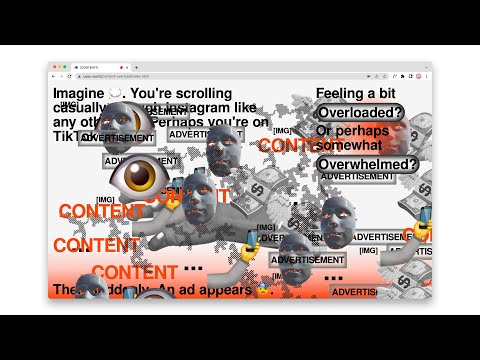
[CONTENT?] is a microsite and immersive experience that aims to visually emulate the overload of information that we are imbued with online and especially in social media spaces. Split into two parts: OVERLOAD and OVERWHELM, the site uses machine learning and facial recognition technology to detect the user’s blinking patterns. This creates speculative scenarios that exposes the algorithmic mechanisms used by social media, through which a user’s online experience increasingly becomes obsessive and overwhelming. Works best on a full-screen desktop using Google Chrome. Please check your settings to allow permission for camera access! Visit the site at: uyen.world/content-overload/.
Play

'[CONTENT?] – OVERLOAD'

As media becomes increasingly pervasive, how much of the content on our social feed is from pages or people that we willingly follow and subscribe to? In the OVERLOAD section of the microsite, users are encouraged to read and consume the information on the screen as they would with any social media platform and wait as they are suddenly bombarded with an influx of content that they ultimately cannot control or delete every time they blink.

Works best on a full-screen desktop using Google Chrome. Please check your settings to allow permission for camera access!

Visit the site at: uyen.world/content-overload/.

View full video at www.youtube.com/watch?v=i2QovmsXHP0
Play

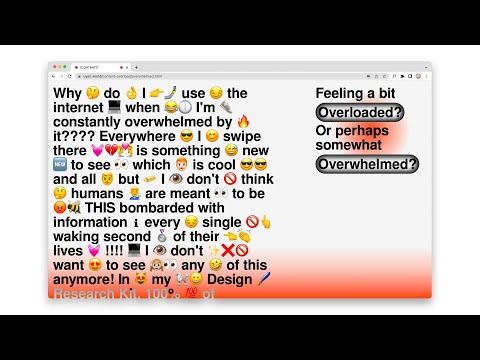
'[CONTENT?] – OVERWHELM'

In my Design Research Kit, 100% of participants who regularly consume content online felt overwhelmed and mentally affected by this very content. What if this content could magically disappear every time we dwell on it for too long? In the OVERWHELM section of the microsite, if users spend more than a certain number of seconds staring at the screen, all the information on the site will disappear, only returning once they have looked away or blink again.

Works best on a full-screen desktop using Google Chrome. Please check your settings to allow permission for camera access!

Visit the site at: uyen.world/content-overload/.

View full video at www.youtube.com/watch?v=qloO19c3JUM

I Have Seen Everything Except Myself

I Have Seen Everything Except Myself is a publication that acts as a formal continuation of my Design Research Kit. It focuses on the idea that technology isn’t simply just going to go away even as we make a conscious decision to avoid it, and that an algorithm can never truly replicate a human. Containing my own writing as well as various articles and essays on the topic of digital selfhood, the publication aims to give insight on the complexity of existing online and provides alternatives to cultivate a more mindful digital experience. The publication is printed on EcoStar recycled 120gsm.

Digital Selfhood – Poster series

We love being able to express ourselves freely, yet we feel constrained when online. We love being able to communicate instantly, yet we constantly feel overwhelmed. We feel connected, but more isolated than we’ve ever felt in our entire lives. Why? The campaign posters are designed to a thought-provoking series that showcase statements intended to make viewers more aware of their social media consumption habits. As most social media applications emphasise the colour blue, the bright orange posters and overall branding of the entire campaign act as an antithesis to social media's aesthetics.

Design Research Kit

A research kit was created before the inception of the Digital Selfhood campaign to gain insight on the campaign’s direction and objectives. Containing a flip-book with the same aspect ratio as a phone and a sheet of emoji stickers, the kit is not set up in a simple question and answer format, but rather a format that allows participants to interact with an omnipresent guide through what looks like a messaging app. By permeating digital artefacts such as placing emoji stickers to ‘react’ to certain statements, using gifs and QR codes to allow access to some of the social media activities, I hope to blur the lines between a digital and physical experience.

Explore more

View all

Other years

Back to top