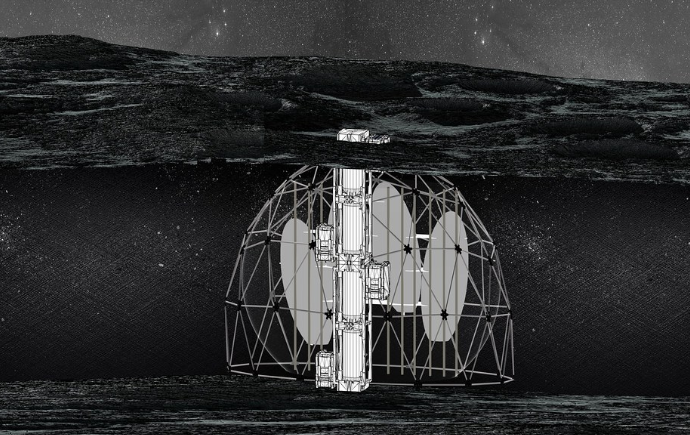
In this futuristic vision, my project imagines a lunar habitat designed for exploration on the Moon in 2123, inspired by science fiction films. It advocates for Earth's environmental preservation and employs unconventional shapes and muted colors to blend functionality with visual integrity.
In this future scenario, humanity adapts, wisely utilizing lunar resources for sustainable living on the Moon. This approach emphasizes mental and physical resilience, acknowledging the challenges of long-term lunar habitation. It encourages a reevaluation of our relationship with the environment, promoting sustainable living and nurturing hope for harmony between humanity and the cosmos.
Concept and orthographic drawings
Lunar Arc, the inaugural permanent human habitat on the Moon, features surface and underground levels positioned in the Northern hemisphere near the Lunar Alps. The surface area is dedicated to research and agriculture, connected to the underground quarters via a central spiral staircase. The spacious underground zone includes communal spaces, medical facilities, and bedrooms. Linked by underground tubes, three habitats house 60 individuals. Scientists leverage lunar conditions to cultivate vital food resources and conduct ongoing research, exploring human adaptation to the lunar environment sustainably.
Lunar Arc
The Lunar Alps, located near the northern edge of the Imbrium Basin and the lunar equator, stand in a permanently shadowed region near the northern lunar pole. This area features elevated terrain with a rich history of ancient impacts and volcanic activity. It presents a diverse range of geological features, making it an intriguing site for scientific research.
Plantation Lab, ground floor
The plantation lab is opposite side of standing office on ground floor. The plantation lab uses hydroponics, and more information can be found in first image.
Communal sofa, underground
Communal sofa sits directly under sky light and greenery. Lunar Arc values the importance of mental health difficulties on a foreign planet, highlighting the essential need for social ties and collaborative assistance.
Medical bay corridor, underground
Each habitat has a medical bay is equipped with 4 machines for scanning and treating medical conditions.
Health scan, underground
Closeup image inside of bubble
Yixuan (Katharine) Huang, Concept and orthographic drawings
In the spirit of reconciliation Monash University acknowledges the Traditional Custodians of country throughout Australia and their connections to land, sea and community. We pay our respect to their elders past and present and extend that respect to all Aboriginal and Torres Strait Islander peoples today.