As a spatial designer, I'm always passionate with exploring spatial aesthetics and focus on the achievement of functional aspects. I'm interested in digital 3D modeling and rendering methods to achieve my design concept. In addition, I also learned photography, graphic design and exhibition design, etc. I hope to reflect and enhance my skills through various media to express my unique design language. In my design career, I hope to take the principle that ‘less is more, and all designs need to be justified or practical’ as my designer's moral standard. I hope to explore more speculative projects that might be achieved in the future by maintaining the designer's ethics and principles.
THE SEAWEED LAND
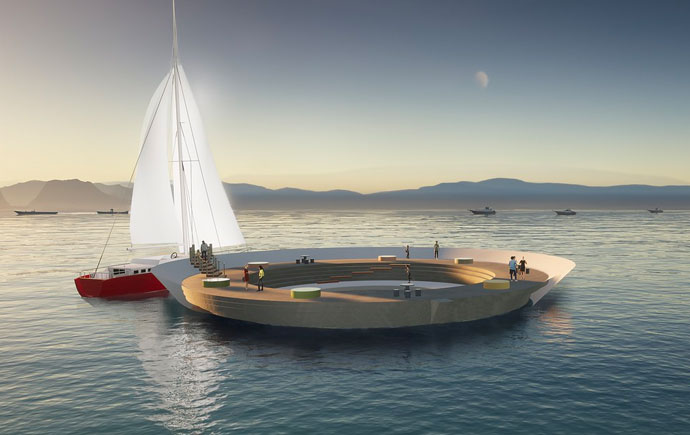
As sea level rise causes the ocean to occupy more areas of land and cities, it is necessary to create new space-use solutions in coastal areas. My chosen site location is St Kilda Beach, where there is sufficient space and easy access to materials to carry out the design work. In the vicinity of the shoreline, a new playground is created that has both recreational and educational functions. Families and children can enjoy and explore how new organic materials can be used in construction. Overall this is a coastal restoration and expansion project.
Render 2
In this project, I take the global warming and sea level rise caused by human industrial activities as the background of social problems, speculate on the natural crisis that the natural environment will face in a hundred years and how to build a new playground within the coastal area under such circumstances, to cope with the shortage of living space inside the city. At the same time, it will also explore how to achieve this project goal through the use of environmentally friendly building materials, without further pollution and stress on the ocean.
Render 3
Due to climate change and the gradual deterioration of the environment caused by commercial and industrial environmental production, there are many biotechnologists and designers looking for more environmentally friendly and innovative building materials as alternatives. Algae materials have been proven to be able to replace traditional building materials to a certain extent, because they have a relatively fast growth rate, reaching nearly 50 cm per day.
Bird eye perspective view
The cover roofs of the sandpit are made of algae materials, providing kids with an opportunity to observe and think of organic materials. The middle area is the major one and the first proposed space that includes a maze and the dynamic structure of a slide and ramp. People are able to explore and observe the seaweed and algae material, and have fun within this area at the same time. The maze and a few trampolines are put together as well. Children are able to experience these two entertainments with a sense of vertigo.
Activatable lighting
Lighting strips are attached to the timber flooring, which could be activated by seawater when tides come. A concave groove that could receive salt water and react with the metal plates inside the light strips.
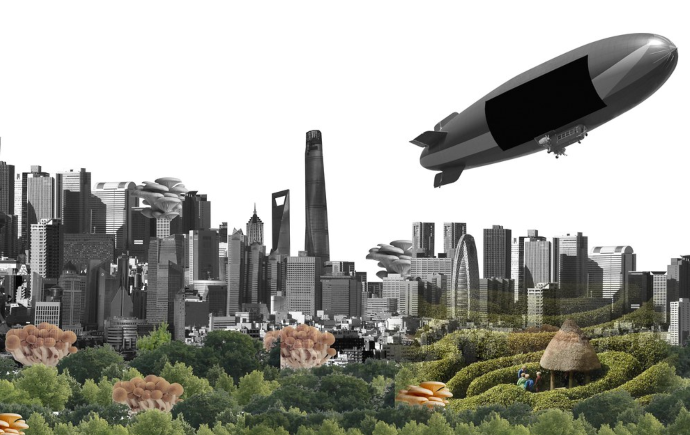
Concept collage
This is a speculative project using organic materials to achieve ecological restoration and mitigation of sea level rise in coastal areas. Through the incremental topography, the reconstruction of the wave-shaped coastline and the rational use of organic matter, the elastic treatment of the tide is generated, and to some extent, the project is expected to achieve the re-expansion of the coastline and provide a new environmentally friendly play area for the public.
In the spirit of reconciliation Monash University acknowledges the Traditional Custodians of country throughout Australia and their connections to land, sea and community. We pay our respect to their elders past and present and extend that respect to all Aboriginal and Torres Strait Islander peoples today.