Monash University logo

Monash Art, Design and Architecture Graduate Exhibition 2024

The Quarry Station focuses on the redevelopment of the former Lilydale Quarry, located between the Melbourne CBD and the Dandenong Ranges. Once an active limestone quarry, the site has approximately V≈5.36×10^6 of infill. The current proposal envisions the site fully filled, our focus is on its pre-fill 2015 stage.

Due to the infill's low purity for alternative uses, we propose repurposing this material into a concrete mix for 3D printing instead of fully filling the quarry. This innovative approach aims to create a sustainable new station, enhancing connectivity along the Lilydale Line with aim to establish a monument that reflects the area's heritage while addressing contemporary needs.

The Peter Elliott Architecture + Urban Design prize for Drawing Architecture_ Commendation

Most accomplished drawings of architecture, from traditional through to new frontiers. This prize is about the love of drawing as a means of communicating ideas in any medium. Endowed by Peter Elliott Architecture + Urban Design

Gateway to Lilydale: Reimagining the Quarry Station Experience

The Quarry Station focuses on the redevelopment of the former Lilydale Quarry, located between the Melbourne CBD and the Dandenong Ranges. Once an active limestone quarry, the site has approximately V≈5.36×10^6 of infill. The current proposal envisions the site fully filled, our focus is on its pre-fill 2015 stage.

The station as monument also provides space and access to the quarry edges for a variety of programs, from club spaces for adventure activities like rock climbing to the 'school of morphology, and an integrated cafe within the station itself.

Detail Axonometric + Views

The station is supported by and utilises the technique of 3D printing in comparison to the pre-casting method of concrete. The aim is to use limestone aggregate, (limestone primarily calcium carbonate (CaC03) which differs from the silicates and aluminates in conventional concrete aggregates.

Reduced cement content: conventional concrete is a major source of CO2 emissions, integrating limestone as an aggregate can allow for a reduced volume of Portland cement used, directly decreasing emissions. Combining limestone calcined clay cement also significantly lowers impact also.

Plan + Plan Detail

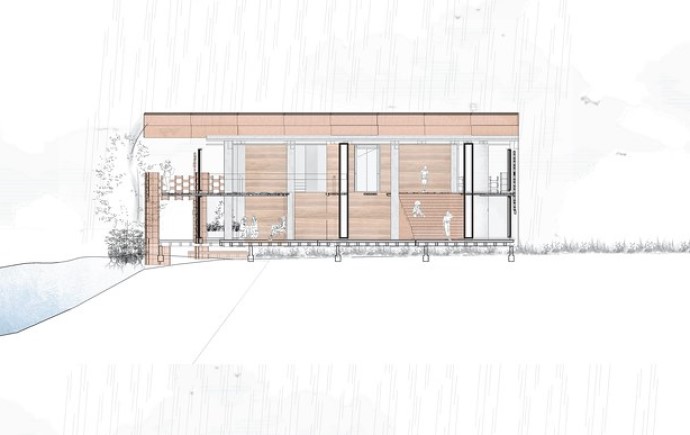
As there is the main function of serving as a train station, the development utilises club rooms and a café space on the southern most side (with views to the quarry). So not only a hub and access point of the site, but also a direct access point for various adventure clubs, or ‘school of morphology’ community members.

Elevation + Elevation Detail

In combination of the new innovative construction method of 3d printing, traditional tiling and facade detailing added to the cladding externally and internally of the station.

With the vertical shaft kilns existing on the site, creating cladding and terra cotta tiles with a rich ochre shade, which is made possible with the addition of limestone in its glazing processes.

Limestone, composed of calcium carbonate, acts as a flux in ceramic glazes. Ochre shades and earthy tones from yellows, browns and reds are often achieved by adding iron oxide to the glaze. Limestone helps stabilize these iron oxides, allowing for a consistent ochre tone across batches.

Catalogue of Parts

Explore more


View all


Back to top