My main theme is water, and I’m particularly interested in its lack of visibility , how the water bodies in Cranbourne are often hidden and underused I wanted to explore how water can be used to its advantage.
Alongside this, I’ve been addressing other issues such as the endangerment of bandicoots, lack of community & education facilities, flood-prone areas, light pollution, gaps in visitor amenities & lack of transport. To respond, I proposed two locations: one for non-human species with minimal human presence, and one focused on human interaction. This separation helps reduce ecological tension while letting both thrive.
Storyboard – Introduction Panel
This storyboard works like an information notice board, introducing the key issues in Cranbourne.
The board features a location plan mapping out the two proposed sites. It also presents a planting study that focuses on selecting tree and plant species that strengthen local biodiversity by providing habitat and shelter for wildlife.
Alongside this, a section drawing illustrates how humans can interact with the water, and an axonometric highlights one of the key structures within the second, human-focused location.
Site Plan: Location 1
The first location sits within the Gardens and is dedicated to non-human species, a space for native habitats like bandicoots and aquatic life to thrive. Human structures are kept minimal to discourage heavy visitation. The edges are designed with rocks and dense planting to form a natural boundary. This creates a subtle “hands-off” moment, reminding visitors that it’s not always about humans, and helping to ease ecological tension.
Site Plan: Location 2
The second location was chosen for its easy accessibility and proximity to surrounding neighbourhoods. It is designed mostly for human use and responds directly to issues identified on site, such as the lack of community spaces, gaps in visitor amenities & lack of transport. Features like an amphitheatre, café, market area, and bus station are introduced to strengthen community connection.
Section
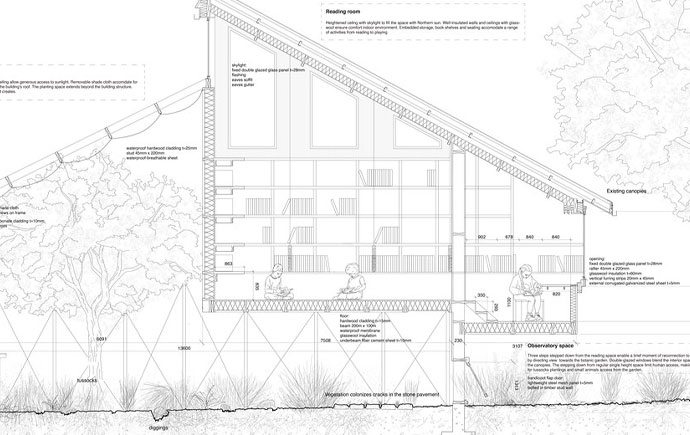
This drawing shows a section from Location 2 (the human-focused area), highlighting the café and the elevated platform. The platform is supported by 4m footings to respond to Cranbourne’s flood-prone conditions. Timber is the primary material, chosen for its sustainability and its ability to blend naturally with the surrounding landscape, allowing the built elements to feel connected to the existing environment rather than imposed on it.
Market
This area represents the market space within Location 2 (the human-focused area). It responds directly to Cranbourne’s lack of community spaces and gaps in visitor amenities. The market acts as a social anchor, bringing people together, supporting local activity, and creating a lively, communal atmosphere.
Perspective Section
This perspective section shows a structure within Location 2 (the human-focused area), designed to bring people as close to the water as possible and encourage interaction with it. The design includes a boating dock with seating elements that allow visitors to sit over the water and launch small boats, creating an immersive experience that connects people closely with the aquatic environment.
In the spirit of reconciliation Monash University acknowledges the Traditional Custodians of country throughout Australia and their connections to land, sea and community. We pay our respect to their elders past and present and extend that respect to all Aboriginal and Torres Strait Islander peoples today.