
Inside an Applied R&D Project at Monash Innovation Labs
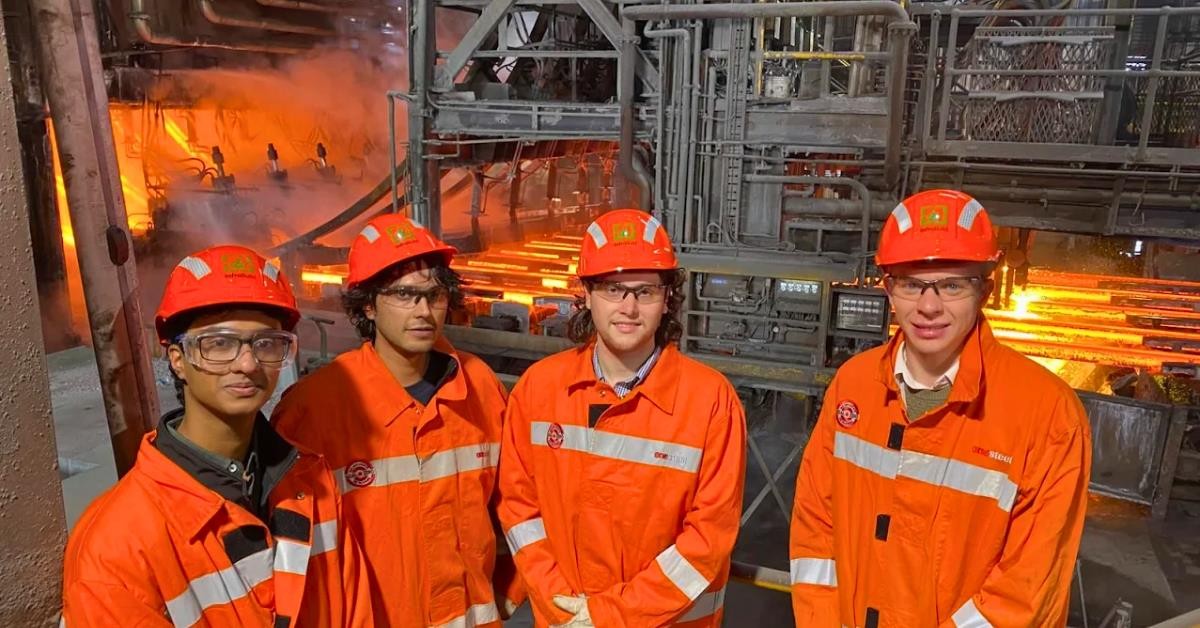
The Smart Infrastructure Lab project team at Infrabuild Melt Shop, based in Laverton. Featuring from left to right Rahul Mudaliar, Dr Keenan Granland, Lachlan Dragovic & Matthew Willaton.
We sat down with Lachlan Dragovic to hear how the Industry Innovation Project (IIP) changed the direction of his degree, and what an applied R&D project at Monash Innovation Labs looks like from the inside.
When Lachlan began his IIP in 2024, he was in his third year of mechanical engineering at Monash, and he had no particular reason to think it would change the direction of his degree.
"I started the project in mechanical," Lachlan says, "but once I got into it, I realised I was more interested in the systems, the vision, the electronics. That's what pushed me into mechatronics."
Lachlan is now in his fifth year, having switched degrees midway through the project. Still, he has no regrets about his pathway, with the collaboration with InfraBuild seminal to his education and future career.
How It Started
Lachlan joined the Monash Automation student team first, recruited by Dr Keenan Granland after meeting the founding members at a Monash Engineering Student Society event on campus.
"Keenan was like, 'You're good at what you do, help me out with this project,'" Lachlan says. "And I was like, absolutely."
Within six months of joining the team, he was working on the InfraBuild project, a collaboration with Australia's largest reinforcing steel manufacturer, focused on applying machine vision to quality inspection of reinforcing steel on the production floor. What had begun as student team activities had largely given way to the demands of a live industry project, and it was a significant shift to experience what engineering felt like day-to-day.
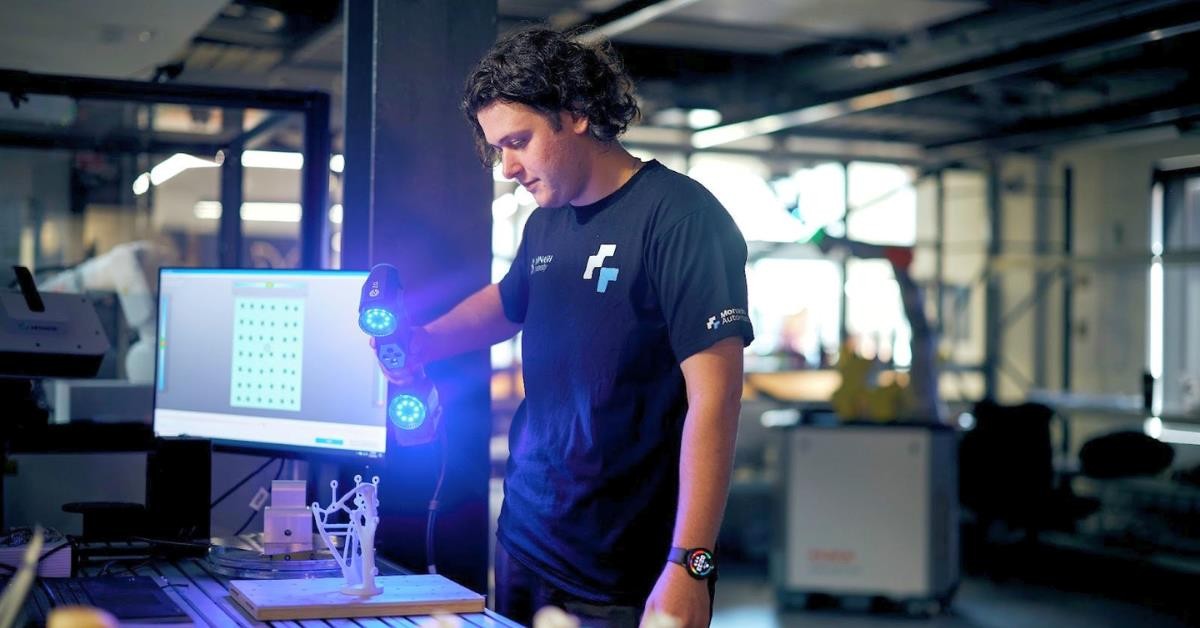
For the project, Lachlan was designing a machine vision system for a live factory environment, which is not theoretical work; it means cameras, optics, lighting, triggering, networking and hardware integration, all operating reliably under industrial conditions.
"Everything to do with capturing photons is with me," he says. "The electrical setup, camera positioning, optics; all of that."
It is a role that suits someone who has spent years working professionally in photography and videography, drawn to the mechanics of how light behaves and how images are made. On an industrial project measuring steel to millimetre tolerances, that instinct for optics proved directly useful.
On paper, the task sounded straightforward: detect the shape of a bar and measure it. In practice, it was far more complex. The team of students, drawn from both the Smart Manufacturing Lab and Smart Infrastructure Lab at Monash Innovation Labs, and supported by academics from Monash, explored multiple approaches; capturing images on the conveyor belt, then while bars were falling from the machine. Neither proved reliable.
"The hardest part was segmentation," Lachlan explains. "You need a clean mask of the bar, but the background is constantly changing; you're dealing with vibration, lighting shifts, and movement."
Finding the Right Approach
Like most applied R&D projects, the path to the right solution involved iteration. The team initially developed a system based on capturing bars as they dropped from the machine, but through close collaboration with InfraBuild, it became clear that measuring each bending operation as it happened would better serve their needs; capturing the length and angle at every movement the machine made, rather than assessing the finished bar at the end.
"We developed the system iteratively, working closely with InfraBuild to understand exactly what they needed. That back and forth is just part of the process, and it led us to a better solution than we started with."
That process of refinement also surfaced a further opportunity: InfraBuild expressed significant interest in diameter profiling as an additional output of the system, an area with its own potential for further development.
Why It Matters
The operational case for the technology is straightforward. InfraBuild's off-coil machines currently run at below 30% utilisation; even a five% improvement would yield significant productivity gains. Batches produced outside tolerance need to be remade, further consuming machine time and resources, with recycled steel having to go back through the entire steel-making process. Delayed concrete pour fees add further cost when rebar is recalled from the site while concrete trucks wait.
"By having dimensional analysis, it can increase machine uptime and reduce waste," Lachlan says.
He describes sitting in his car recently, watching a truck loaded with rebar pass by, and thinking about what full traceability would mean in practice.
"At some point, I want to be able to say, if I wanted to, I could go onto the system and find the dimensions of that exact piece of rebar. It would have full traceability. That's the end goal."
From Proof of Concept to Pilot
The original IIP proved the concept was achievable; the current pilot phase is focused on making it useful, integrating with InfraBuild's backend systems to deliver real-time dimensional data that can be verified against what the machine is supposed to be producing.
"It went from being a project to something that could actually be deployed," Lachlan says. "Now it's about making it robust and scalable."
The pilot ran until the end of April 2026. From there, further integration and refinement will be needed before the system is production-ready; a timeline Lachlan is relaxed about.
"I'll have grey hair," he jokes. "But hopefully before I graduate."
A Shift in Direction
The degree change from mechanical to mechatronics was not something Lachlan planned; it emerged from the experience of doing the work.
"The project showed me what I actually enjoy doing," he says. "It aligned much more with systems, automation, and machine vision."
Beyond the degree, the project has opened doors that a conventional engineering pathway would not have. Lachlan has had companies reach out to him directly off the back of the work, interested in what he is doing with machine vision.
"It's brought a lot of opportunity, not only from InfraBuild, but I've had people reach out who are interested in what I'm doing," he says. "The project has created a lot of opportunities for me."
What made that possible was not just the project itself, but the environment around it. At Monash Innovation Labs, Smart Manufacturing Lab, Smart Infrastructure Lab and industry partners operate in proximity. Lachlan sits at the intersection of the two labs, with his hardware background connecting the physical and digital dimensions of the project.
Looking Ahead
The project may have started as an Industry Innovation Project, but for Lachlan it became something more: a shift in direction, a step into applied R&D, and a clearer sense of what engineering looks like outside the classroom.
As he finishes his final year of mechatronics, the options ahead reflect the depth of experience the project has given him. Whether that leads into industry, continuing applied research through a pathway like the Industry Doctoral Program, or something else that emerges from the connections the work has already opened, Lachlan is finishing his degree with a clearer sense of direction than most.
Alongside the rebar work, Lachlan is now assisting on a second project with InfraBuild, based at their facility in Sydney and focused on safety compliance during truck loading operations. Two IIP students are leading the work, with Lachlan contributing as a research assistant, given his machine vision experience.
At Monash Innovation Labs, the bridge between theory and industry is built, tested and refined under real constraints, rather than anything abstract. All this work is being done by students working on real problems alongside the researchers and companies trying to solve them.
For Lachlan, it changed the trajectory of his degree, and the work is still very much underway.
Interested in the Industry Innovation Program?
The Industry Innovation Program, run by Monash's Faculty of Engineering, connects businesses with high-performing students to tackle real technical challenges across machine vision, automation, applied AI, advanced manufacturing, smart infrastructure, biomedical engineering, and more.
Projects are structured and supervised by academics, but what sets MiLabs-based IIPs apart is the environment: students work alongside resident companies, applied R&D labs, and industry partners in the same building, turning a structured program into a genuinely immersive industry experience.
If you have a problem worth solving, start a conversation with Monash Innovation Labs.