
Taking aim at billion-dollar problem hampering critical minerals output
Monash researchers take aim at billion-dollar problem hampering critical minerals production
21 August 2026
Ultrafine clay particles are sabotaging mining operations worldwide, masking valuable metals, choking operations, and driving up costs. But a team from the Monash Critical Minerals Initiative may have found a solution inspired by an unlikely source: flowers.
Australia’s push to expand critical minerals production is running into a hurdle that’s measured in microns.
Fine clay particles, smaller than 10 micrometres, infiltrate mineral processing circuits and wreak havoc, thickening slurries, disrupting recovery, and dramatically increasing costs.
In ore bodies where strategic metals are hosted within the clay itself, conventional extraction essentially destroys the very thing operators are trying to recover.
Associate Professor Chris Ritchie, from the Monash Critical Minerals Initiative, has spent years working on the challenge.
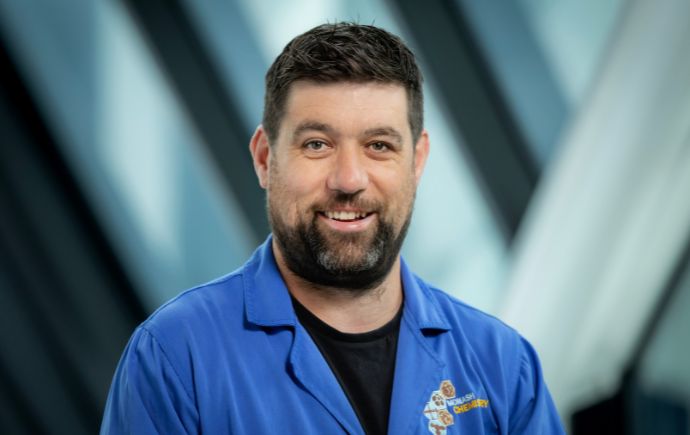
Associate Professor Chris Ritchie.
Now he and members of his team, supported by the ARC Centre of Excellence for Enabling Eco-Efficient Beneficiation of Minerals, have developed a class of reagents that behaves in a fundamentally different way from anything currently used in industry.
A/Prof Ritchie said the industry had plenty of ways to ‘fight’ clay during mineral separations, but they were largely built to disperse or reject it, and processes struggle the moment particles get truly fine.
“Most of these clays end up in the tailings stream by default because they’re simply too fine for conventional separation methods to capture,” he said.
Once there, they create disproportionate problems, locking up water, slowing drying and leaving operators with large volumes of unstable waste that are difficult to rehabilitate.
“In practice, clay is a major reason tailings storage facilities remain a long-term liability rather than a manageable by-product,” he said.
Lessons from nature
A/Prof Ritchie and his research team, including Dr Samadhi Fernando and Professor San H. Thang, drew inspiration from flavylium compounds – the pigment molecules responsible for the vivid reds, blues and purples found in flowering plants.
Working collaboratively with academic peers, as part of Centre of Excellence research projects in this area, the Monash team synthesised a new class of flavylium-based surfactants (a type of reagent) and polymers that bind selectively to ultrafine clay particles, allowing them to be intercepted and removed earlier in the process, cutting reagent consumption and lowering overall costs.
Lab-scale testing has shown clay recoveries of up to 90 per cent, and greater selectivity for clay minerals compared with conventional methods.
Results also show potential for improved froth stability and lower aquatic toxicity, and because the new reagents are pH-responsive, they can potentially be recovered and recycled.
“What’s exciting isn’t that we’ve solved clay processing, but that by matching the reagent to the target mineral at the molecular level we can outperform an industry-standard reagent on the hardest particle size class, in a recoverable, more sustainable way, and do it whether the goal is to reject the clay or to concentrate it,” A/Prof Ritchie said.
The road to commercial scale
Test results have been striking enough to secure a Patent Cooperation Treaty application and four peer-reviewed publications.
The technology currently sits at Technology Readiness Level 3 - proven at bench scale, but not on real-world ore samples or at operational scale.
A/Prof Ritchie said the team was now focused on the next step - attracting industry partners willing to run collaborative trials.
“The barrier ahead of us isn’t manufacturability, it’s validation on real ore, and that’s a matter of the right partnerships and pilot-scale trials,” he said.
“Real ore bodies bring complications a laboratory sample doesn’t: mixed mineralogy, saline or recycled water, and all the variability of a working circuit. That’s where a reagent either earns its place or doesn’t.”
The stakes for Australian mining are high. As global demand for transition metals and rare earth elements accelerates, pressure is mounting on the sector to improve processing efficiency while shrinking its environmental footprint.
A/Prof Ritchie’s reagent could deliver both.
“A great deal of the world’s accessible rare earth resource sits in ionic clays, where the value is held in the clay itself,” he said.
“Being able to concentrate it could open up resources that are currently uneconomic. If it works at scale, that’s not just a processing improvement, it’s a way to help Australia extract more value from its own ground, more cleanly.”
The Monash Critical Minerals Initiative is seeking industry partners to help validate the technology through collaborative pilot-scale trials. To learn more about the project, contact Associate Professor Chris Ritchie or the Critical Minerals Initiative.