
Unearthing Australia’s critical mineral potential
Buried Treasure: Unlocking Australia’s critical mineral potential
14 May 2026
Could Australia’s clay-rich soils hold the key to powering the nation’s net-zero transition?
Australia could be sitting on a hidden mineral goldmine: vast reserves of rare earth elements trapped in clay soils that form as rocks break down over millions of years.
The challenge is knowing where these minerals are concentrated and how to extract them responsibly.
A team from the Monash Critical Mineral Initiative, led by Professor Andy Tomkins, is working to close that knowledge gap.
“Rare earth elements are critical for the transition to renewable energy technologies like electric vehicles, and hydro, wind and solar power, but we’ve mostly relied on coal and petroleum until now,” Prof Tomkins said.
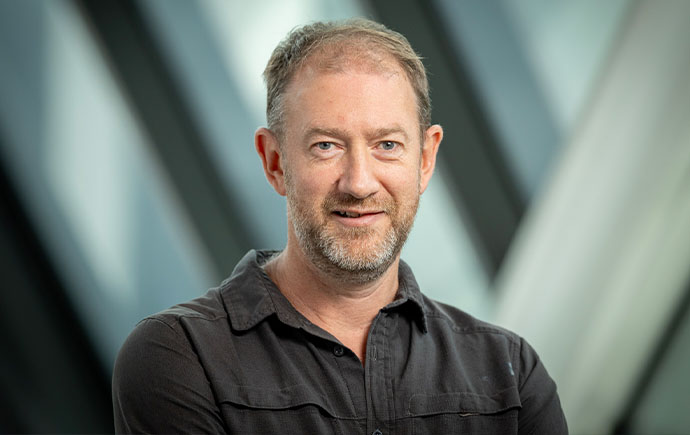
Professor Andy Tomkins.
Without these resources, Prof Tomkins said Australia’s and the world’s renewable energy transition is impossible.
“It’s a crisis – there is a significant global undersupply, and we don’t yet have enough scientific understanding of how to find rare earth resources,” he said.
“Fortunately, Australia appears to have many areas where rare earth elements could be naturally concentrated, offering a huge opportunity for sustainable mining and the chance to become a global leader in critical minerals.”
How rare earth elements form in clay
At the Earth’s surface, rocks are chemically unstable.
Over millions of years, they react with air and water, breaking down and transforming into new minerals such as clays.
Prof Tomkins said that these processes can release rare earth elements from primary minerals and allow them to bind to clay particles. However, not all rocks produce these deposits.
“Australia is vast, with a huge variety of rock types; some areas are promising, some aren’t,” he said.
“Our project is focused on understanding the processes that cause the greatest enrichment in rare earths - how these reactions concentrate these metals in clays - so we can identify where economically viable deposits might form, to help guide the mineral exploration industry.”
Mapping our mineral future
The team is investigating which rock types are most likely to host clay-based rare earth elements, narrowing the focus for exploration across Australia’s vast and geologically diverse landscape.
Fieldwork involves collecting samples from sites including Mt Isa, Arkaroola, and Harts Range.
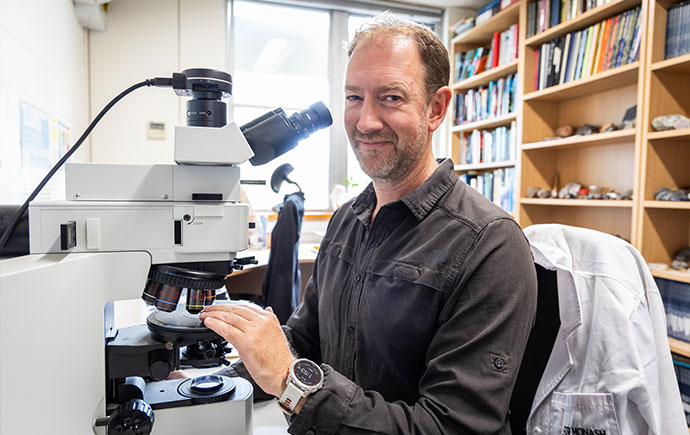
Professor Andy Tomkins.
Back in the lab, advanced tools such as electron microscopes and the Australian Synchrotron are used to map element distribution at microscopic scales and build an understanding of the processes that concentrate the rare earths.
The team also replicates natural chemical processes using experiments to see how rare earths accumulate over time.
“These methods help us to build the picture of where rare earths are likely to be found and how they can be extracted with minimal environmental impact,” Prof Tomkins said.
“Our research provides a way to discover new critical mineral deposits and also offers insight into how they can be extracted responsibly.”
Turning discovery into impact
Insights from the research are already guiding exploration toward more promising targets.
Models developed by the Monash team are being integrated into the national critical minerals strategy and exploration targeting frameworks under the Critical Minerals Research and Development Hub.
The Hub is a collaboration between CSIRO, Geoscience Australia and Australia’s Nuclear Science and Technology Organisation.
Looking ahead, the team hopes their work will support a new generation of low-impact, high-value mineral deposits.
“These clay-hosted rare earths could reduce exploration and extraction costs, create jobs in regional communities, and strengthen Australia’s ability to supply critical minerals ethically and sustainably,” he said.
“The knowledge we are generating could allow Australia to become a global leader in the supply and production of critical minerals.”