Abud Lab research
About Professor Helen Abud
Professor Helen Abud is Head of the Department of Anatomy and Developmental Biology, Co-Head of the Development and Stem Cells Program, and Head of the Stem Cells and Cancer Laboratory at Monash. Professor Abud completed her undergraduate degree at Melbourne University, and then trained at the Walter and Eliza Hall Institute before undertaking her doctorate at Oxford University, United Kingdom in Cell and Developmental Biology. This was followed by postdoctoral training in the Department of Anatomy (Oxford), Peter MacCallum Cancer Centre (Melbourne) and the Ludwig Institute for Cancer Research (Melbourne). She obtained her academic appointment at Monash in 2007 and completed a graduate certificate in higher education. Professor Abud combines teaching and research with a key role in Developmental Biology education. Her research is centred on understanding the molecular mechanisms and environmental influences that regulate stem cells within normal tissues and tumours. Professor Abud has a particular interest in molecules that promote intestinal epithelial development and regeneration following damage and how these factors may be altered during aging, inflammatory diseases and colon cancer. She utilises mouse models and human organoid models for a variety of biological studies including response to drug treatments and environment. Professor Abud served as President of the Australian Society for Stem Cell Research (2020-2022).
Our research
Current projects
1. Defining the mechanisms that control intestinal stem cell fate during development and regeneration of tissue following damage.
2. Developing organoid models of intestinal disease.
3. Using patient-derived organoids to personalise treatments for bowel cancer.
4. Delineating the role of stem cell activity in the initiation and progression of colorectal cancer.
5. Defining interactions of bacteria with the gastrointestinal epithelium.
Visit Professor Abud’s Monash research profile to see a full listing of current projects.

Molecular regulation of intestinal stem cell fate.

Developing organoid models of intestinal disease and using patient-derived organoids to personalise treatments for bowel cancer.


Environmental influences on intestinal stem cells.

Research activities
Watch Professor Abud explain aspects of her research which uses stem cells in the bowel and how they contribute to diseases such as IBS and bowel cancer. Video courtesy of Stem Cells Australia.
With cutting-edge medical engineering offering new approaches to managing and treating disease, Professor Helen
Abud and Associate Professor, Paul McMurrick from Cabrini Health, are paving the way for the development of
better-targeted cancer drugs by growing replica organs outside of the body. This ground-breaking research has the
potential to take the guesswork out of future treatments.
Our PhD student Harrison Boka won the Three Minute Thesis (3MT) competition at the Biomedicine Discovery Institute and also received the people’s choice award. Watch Harrison explain his research.
Disease modelling using patient-derived organoids
Disease modelling using patient-derived organoids
Techniques/expertise
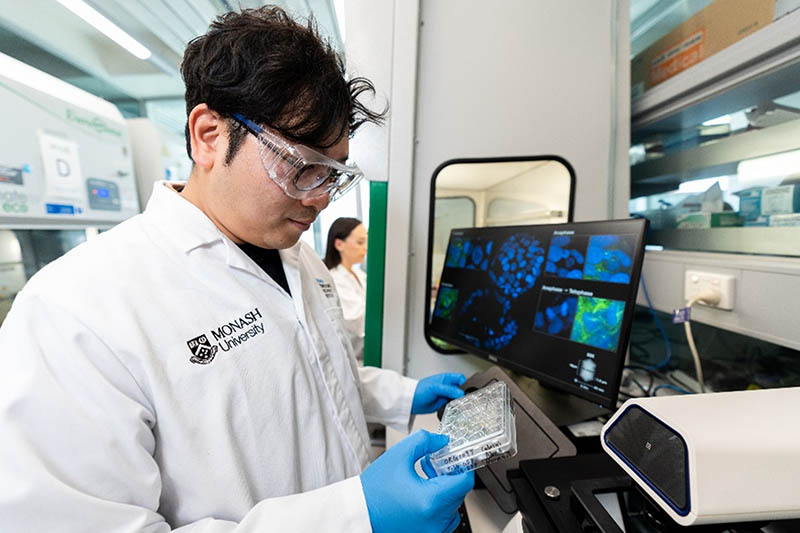
Our studies of intestinal development and disease utilise a wide range of cellular and molecular techniques. We use mouse models to investigate the function of specific genes in regulating stem cell renewal, maintenance and differentiation in the intestinal epithelium. We also analyse primary tissue from the human intestinal tract, including tissue from colorectal carcinomas at various stages. We study tissue phenotypes at the cellular level using immunohistochemistry, confocal imaging and fluorescent activated cell sorting (FACS). Molecular analyses include transcriptional profiling and bioinformatics spatial transcriptomics and proteomics.
Our laboratory extensively uses organoid cultures and embryonic intestinal cultures to analyse stem cell function in tissue from mice. We also collaborate with clinicians to collect and grow organoids from patients with inflammatory bowel disease and primary and metastatic colorectal tumours. These organoids are currently being used for a variety of biological studies including response to drug treatments, interactions with stromal and immune cells, microbes and environmental factors.
Disease models
Patient-derived organoid cultures from colon and rectal tumours
Patient-derived organoids from control and patients with inflammatory bowel disease
Mouse models of impaired stem cell function
Mouse models of colorectal cancer
Collaborations
We collaborate with many scientists and research organisations around the world. Some of our more significant national and international collaborators are listed below. Click on the map to see the details for each of these collaborators (dive into specific publications and outputs by clicking on the dots).

Prof Paul McMurrick - Cabrini Monash Department of Surgery
Prof Dena Lyras - Microbiology, Monash Biomedicine Discovery Institute
Prof Kate Loveland - Hudson Institute of Medical Research
Prof Jose Polo - Anatomy and Developmental Biology, Monash Biomedicine Discovery Institute
Dr Thierry Jarde - Anatomy and Developmental Biology, Monash Biomedicine Discovery Institute
Prof Gary Hime - University of Melbourne
Prof Christine Wells, University of Melbourne
A/Prof Ed Giles - Hudson Institute of Medical Research
A/Prof Forster - Hudson Institute of Medical Research