Chai Lab research
Collaborations | Student research projects | Publications
About Associate Professor Siew Chai
Siew Yeen Chai completed her Bachelor of Science with honours degree in Pharmacology at Monash University, and her PhD at the University of Melbourne. She was then awarded a C.J. Martin PostDoctoral Fellowship to work at the Karolinska Institutet in Stockholm. Upon her return to Australia, she established her own research laboratory at the Howard Florey Institute. She was funded on an NHMRC senior research fellowship until 2014. She was recruited to the Department of Physiology, Monash University in 2011 where she is now a teaching and research academic. Her recent research has focussed on the roles of metalloenzymes in the brain, in particular an aminopeptidase known as insulin-regulated aminopeptidase (IRAP). Her laboratory discovered previously unsuspected roles for the enzyme, particularly its involvement in memory processing, glucose homeostasis and cardiovascular function.
Our research
Current projects
Visit Associate Professor Chai's Monash research profile to see a full listing of current projects.
Research activities
Metallopeptidases cleave amino acids from either the N- and C-termini of peptide substrates to either generate or degrade biologically active peptides and the activity and their activities are dependent on the presence of zinc in the catalytic sites. These enzymes play important roles in the body and alterations in their activities can impact on a diverse range of physiological processes in both healthy and diseased states. Our research has concentrated on 2 metallopeptidases involved in the processing of angiotensin peptides, namely angiotensin converting enzyme (ACE) and insulin-regulated aminopeptidase (IRAP). Our findings have revealed previously unsuspected and more widespread roles for these enzymes, particularly their involvement in memory processing, glucose homeostasis, cardiovascular function and water and electrolyte balance. We have a drug development program targeting one of these enzymes (IRAP) and have identified two families of lead compounds that await development into a new class of clinically effective therapeutic agents useful in treating dementia and tissue fibrosis (patents filed and awarded).
Our current research is focussed on elucidating novel physiological and pathophysiological roles for the aminopeptidase, IRAP, using a whole series of research tools developed in the laboratory including IRAP antibodies, small molecule IRAP inhibitors and tissue-specific knockout mouse lines.
Research Projects
I. Development and Characterisation of New Classes of IRAP Inhibitors
(Collaborators: Dr Simon Mountford and Prof Philip Thompson, Department of Medicinal Chemistry, Monash Institute of Pharmaceutical Sciences, Monash University, Prof Anders Hallberg and Dr Hugo Gutierrez de Teran, Department of Medicinal Chemistry, Uppsala University, Sweden)
This body of work builds on our laboratory’s successful drug discovery program to identify and develop new classes of IRAP inhibitors using state of the art techniques including in silico docking, fluorimetric assays, site directed mutagenesis and pharmacokinetic analysis. These newly developed IRAP inhibitors are being utilised as research tools with which to investigate the roles of IRAP in regulating the intracellular trafficking of vesicles containing important proteins involved in mounting an innate immune response or the facilitated transport of glucose into the cell. These IRAP inhibitors also serves as potential ‘lead’ molecules which will be developed into a new class of therapeutic agents.
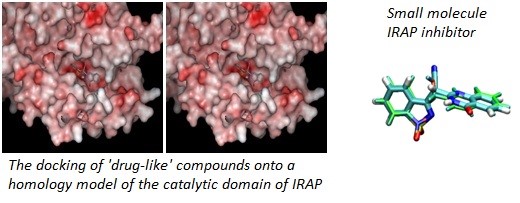
II. Role of IRAP in the brain
(Collaborators: Dr Shanti Diwakarla, Florey Institute of Neuroscience and Mental Health, Parkville, Prof Mathias Hallberg, Department of Pharmaceutical Biosciences, Uppsala University, Sweden)
Although it is well-established that inhibition of IRAP leads to facilitation of memory, the role of the enzyme in memory processing has not been elucidated. It has also not been clearly established which stages of memory formation process (acquisition, consolidation and/or recall) the IRAP inhibitors were most effective at. IRAP is also found highly expressed in the ventricular and subventricular zone during brain development suggesting a role for the enzyme in neurogenesis. We aim to investigate the role of IRAP in brain development and elucidate the mechanism of action by which IRAP inhibitors enhance memory and reverse memory loss using the tissue specific IRAP knockout mouse lines as well as the newly developed IRAP inhibitors.
III. Role of IRAP in mediating the neuro-inflammatory response to ischemic damage
(Collaborators: Dr Claudia McCarthy, Department of Pharmacology, Monash University)
Stroke is Australia’s second greatest cause of death after coronary heart disease and is a leading cause of disability. We have three independent observations that provide clear evidence for the involvement of IRAP in ischemic damage (1) markedly reduced damage in the brains of the IRAP KO mice following middle cerebral artery occlusion, (2) IRAP inhibitor treatment attenuating volume of ischemic damage and (3) the detection of IRAP immunostaining in activated astrocytes and microglia after damage. This project aims to elucidate a role for IRAP in the brain following focal or global ischemia and develop the concept of IRAP inhibitors as a potential treatment for ischemic damage.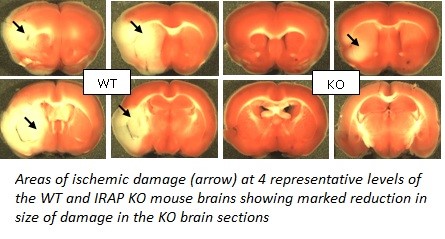
IV. Role of IRAP in cardiovascular and renal function
(Collaborators: Dr Tracey Gaspari and Professor Rob Widdop, Department of Pharmacology, Professor Kate Denton and Dr Sarah Walton, Department of Physiology, Monash University)
We have recent preliminary data that suggest that the IRAP KO mice have enhanced vascular reactivity to vasodilators, decreased ability to retain and deposit fat and are less susceptible to the development of atherosclerosis. We have also demonstrated that IRAP gene deletion protected against age-associated cardiovascular and renal dysfunction. We are currently determining the cardiovascular and renal phenotype of the IRAP KO mice and investigating the effects of IRAP inhibitors in cardiovascular and renal disorders
V. Role of IRAP in the development of tissue fibrosis
(Collaborators: Dr Tracey Gaspari and Professor Rob Widdop, Department of Pharmacology, Monash University, Professor Philip Thompson, Department of Medicinal Chemistry, Monash Institute of Pharmaceutical Sciences, Monash University)
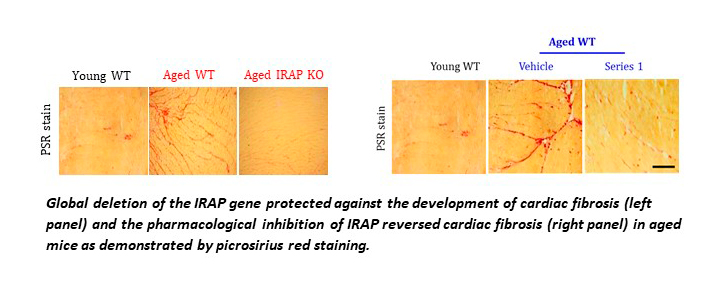
We have exciting data that the global deletion of the IRAP gene protected against the development of age- and injury-induced cardiac and renal fibrosis. We also found that 3 structurally distinct but specific inhibitors of IRAP all reversed age-induced cardiac fibrosis. More importantly, we found that this reduction in fibrosis translated into improved cardiac function. We found that IRAP inhibitor treatment protected against the development of and reversed pathological fibrosis in a number of animal models. We propose that IRAP is a novel target for the development of a new class of anti-fibrotic agents – see press release in Industry Involvement.
Collaborations
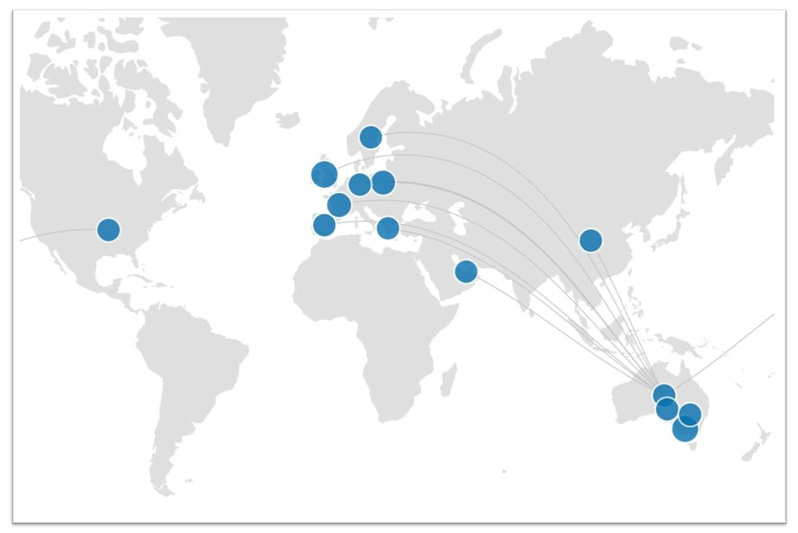
We collaborate with many scientists and research organisations around the world. Click on the map to see the details for each of these collaborators (dive into specific publications and outputs by clicking on the dots).
Student research projects
The Chai Lab offers a variety of Honours, Masters and PhD projects for students interested in joining our group. There are also a number of short-term research opportunities available.
A brief summary of available projects is provided below, but please visit Supervisor Connect to fully explore the projects currently available in the Chai Lab.
Role of IRAP in mediating the neuroinflammatory response in ischemic damage
Stroke is Australia’s second greatest cause of death after coronary heart disease and is a leading cause of disability. We have four independent observations that provide clear evidence for the involvement of IRAP in ischemic damage.
Does IRAP regulate glucose and fat metabolism?
This project will investigate if the IRAP KO mice or mice treated with IRAP inhibitors are protected against the health complications associated with diet‐induced obesity.
Does diet‐induced obesity exacerbate Alzheimer’s disease?
A high body mass index (a clinical measure of adiposity) at mid‐life is an acknowledged risk factor for Alzheimer’s dementia (AD). The aim of this project is to investigate if dietary fats alter the development of AD pathology and the associated cognitive and memory deficits in mouse models of AD. Our hypothesis is that a high fat diet exacerbates AD pathology (amyloid plaques and cerebral amyloid angiopathy) and memory dysfunction resulting in a less favourable outcome than mice on a normal diet.
Modulation of neuronal oxytocin – effects on social behaviour
Oxytocin is known as the social hormone, regulating complex social behaviours including promoting trust, pair‐bonding and has been explored as potential therapy for social behaviour impairments observed with autism spectrum disorders. This project will investigate the behavioural phenotypes in the oxytocinase deficient mice to determine if regulation of endogenous oxytocin levels will affect social behaviour.