Fletcher and Knoblich Lab research
Collaborations | Student research projects | Publications
About Associate Professor Anne Fletcher
Anne completed her PhD from Monash University, Melbourne, Australia, and her postdoctoral training at the Dana-Farber Cancer Institute and Harvard Medical School in Boston, Massachusetts, USA, with support from a CJ Martin Fellowship. She was appointed a Birmingham Fellow at the University of Birmingham, West Midlands, UK in 2014. In 2017 she moved back to Australia at Monash University at the Biomedicine Discovery Institute to establish a new group together with Dr Konstantin Knoblich. Her research focuses on the immunobiology of lymph node stromal cells, including mechanisms of tolerance induction and crosstalk with leukocytes.
About Dr Konstantin (Kostas) Knoblich
Konstantin received a Cancer Research UK studentship to complete his PhD at the University of Birmingham, West Midlands, UK in 2010. He was awarded a Benacerraf Fellowship for postdoctoral work at Harvard Medical School / Dana-Farber Cancer Institute. He moved to Australia for 18 months at the Walter and Eliza Hall Institute, then the University of Birmingham where he was awarded a European Research Commission Early Career (Marie Curie Sklowdoska) fellowship. At the end of 2017, he moved to Monash University as a co-lead of the STIMM lab group where he focuses on the interaction of stromal cells with the immune system.
Our research
Current projects
- How do lymph node fibroblasts contribute to macrophage development?
- How do cancer associated fibroblasts interfere with anti-tumour immunity?
- Cancer-associated fibroblast heterogeneity in human tumours
Visit Dr Anne Fletcher's and Dr Kostas Knoblich's Monash research profiles to see a full listing of current projects.
Research activities
Our research program is focused on fibroblast-like stromal cells found in secondary lymphoid organs and tumours. These cells create the structure on which leukocytes crawl and interact. We and others have shown that fibroblasts in lymph nodes are fundamental to healthy immune function, through interactions with T cells, B cells, dendritic cells and macrophages, directly supporting cell survival, function and migration.
The laboratory studies key mechanisms of action, aiming to target these cells directly with therapeutic effect. We are also now focusing on exploring how these cells manipulate the immune response against cancer, a topic at the forefront of cancer immunology.
Our group studies Lymph Node Stromal Cells (LNSCs) and their interactions with leukocytes in the context of clinically relevant diseases and disease models. We are looking into their interactions with the leukocytes that promote autoimmunity, inflammatory shock, and cancer, examining both basic immunobiology and therapeutic angles. We focus closely on fibroblastic reticular cells (FRCs) and their ability to control inflammatory responses.
The immunology of FRCs has become a hot topic in the past ten years due to their far-reaching influence on T cells, B cells and dendritic cells. FRCs are typically found in lymph nodes where they form a 3D mesh upon which immune cells travel along communicating with each other. They are essentially the “highway” for immune cells, and to some extent the traffic warden as well, as they secrete molecules that direct the cells to the appropriate spaces within the lymph node and instruct the immune cells to ignore certain molecules that are a natural part of the body. A lot of autoimmune diseases are caused by immune cells that disregard such instructions and attack the body’s own molecules.
We were among the first to routinely isolate and characterise these cells and we have used them in mouse models to show that they are highly effective against septic shock (Fletcher et. al. 2014). We are investigating their potential as a cell therapy candidate.
Our recent studies focus on their role in the human immune system and we are establishing their mode of action and identifying effective ways to control their operation. We have a number of projects that look into their interactions with different immune cells. We have established collaborations with academia and industry and are working on bringing these cells to the clinic in the future.
- Cancer
One of our research projects is establishing the role of cancer-associated fibroblasts (CAFs) in solid tumours. We have projects studying these cells in the context of breast, colon and pancreatic cancer. Specifically, we are intrigued by their mechanisms of action on other immune cells. - T cells
We are interested in the role of FRCs in T cell proliferation, activation and differentiation. We have recently discovered mechanisms of action in the human setting and are actively pursuing ways and developing assays to control these mechanisms. - Monocytes
This project examines the important role of human FRCs in monocyte maturation and differentiation.
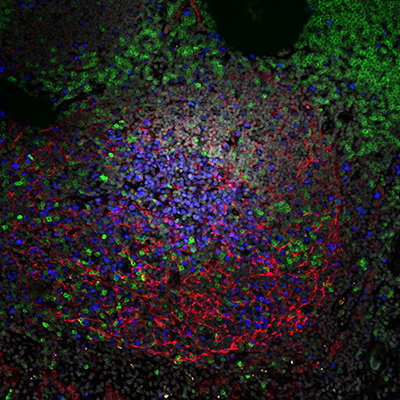 Immunofluorescence of the human tonsil, depicting the FRC microenvironment. FRCs closely shape the response of T cells
and proliferating lymphocytes. Red = FRC network. Green = T cells. Blue = proliferating nuclei. Grey = nuclei.
Techniques/expertise
Our research program utilises primary human tissues as well as mouse models, cutting-edge flow cytometry, cell culture, immunofluorescence, single cell RNA-Seq and live cell imaging.
Collaborations
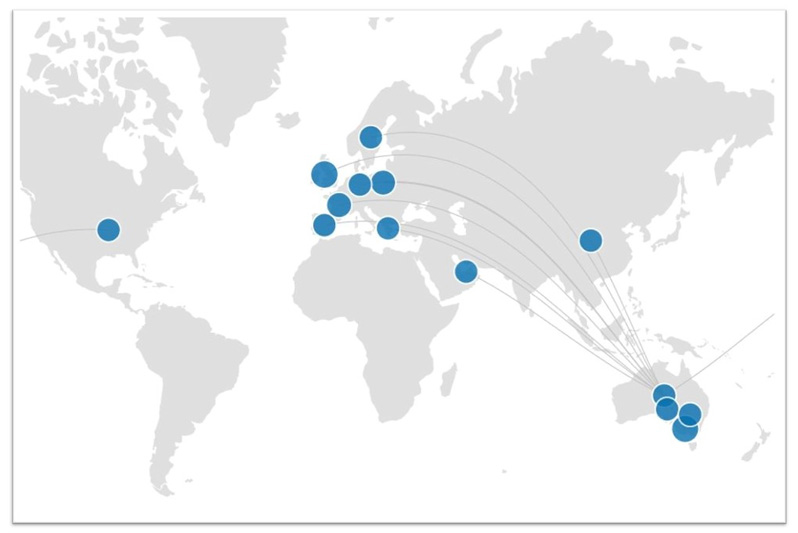
We have strong, ongoing collaborations with clinical and industry partners. Ask us for more information! Click on the Associate Professor Anne Fletcher map and the Dr Kostas Knoblich map to see the details for each of these collaborators (dive into specific publications and outputs by clicking on the dots).
Student research projects
The Fletcher and Knoblich Lab offers a variety of Honours, Masters and PhD projects for students interested in joining our group. There are also a number of short term research opportunities available.
Please visit the Associate Professor Anne Fletcher and Dr Kostas Knoblich Supervisor Connect entries to explore the projects currently available in our Lab.