Shahine Group research
Collaborations | Student research projects | Publications
About Dr Adam Shahine
Dr Shahine was previously funded by an Australian Research Council DECRA Fellowship (2021-2023), and is currently a National Health and Medical Research Council Emerging Leader Fellow (2024-2028). Since 2023, Dr Shahine is a Group Leader within the Immunity Program at the Biomedicine Discovery Institute, and leads the lipid mediated structural immunology lab.
Dr Shahine received a BSc (2008) from the University of Melbourne, before moving to Monash University to complete an M.BSc(part 1) (2009) and PhD (2016). Upon completion, Dr Shahine has been employed by The Department of Biochemistry and Molecular Biology, Monash University, since 2014. Dr Shahine received advanced cellular immunology and lipid mass spectrometry training at Cardiff University funded by the UUKi Rutherford Fellowship. Dr Shahine research has focused on the field of structural immunology, where they aim to understand the critical events in lipid-mediated immunity in the context of autoreactivity and bacterial infection.
Our research
Current projects
1. Lipid antigen mediators of T cell responses against Mycobacterium tuberculosis infection
CD1 molecules present lipid antigens from Mycobacterium tuberculosis (Mtb), the causative agent of Tuberculosis, a disease that infects one third of the world's population and results in 1.6 million deaths each year. The Mtb cell wall is highly lipid rich and complex, comprised of unique lipids specific to pathogenic Mtb strains. Recent research suggests that CD1 molecules play a vital role in immune responses to Mtb infection through the presentation of lipid Ags found in the Mtb cell wall. This project aims to investigate the molecular mechanisms of lipid Ag presentation by CD1 molecules to T cells that stimulate immune responses against Mtb infection. The ultimate goal is to provide a molecular rationale for generating new therapeutics to treat and eradicate Mtb.
The research project has a number of distinct aims:
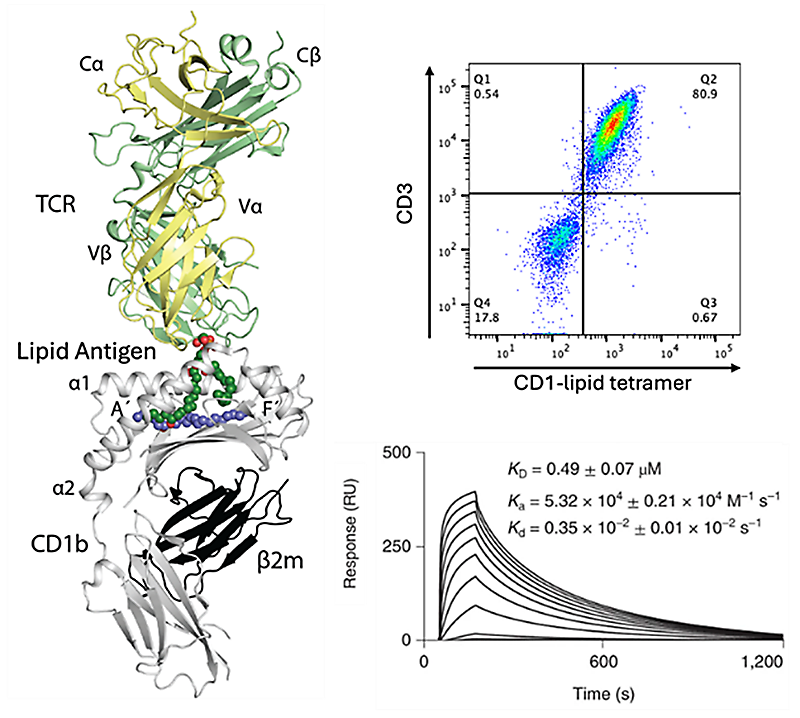
- To investigate Mtb lipid Ag presentation by CD1 molecules, and subsequent interactions with study molecular mechanisms of CD1-Mtb lipid and TCR interactions. Using X-ray crystallography and surface plasmon resonance, this project will investigate the molecular mechanisms that govern lipid presentation by CD1 molecules, the complex interactions formed with specific T cell receptors, and their related impact on T cell activation and function.
- To characterise the CD1+ Mtb lipid Ag reactive T cell populations in humans. This project marries together immunological and biochemical techniques and reagents to isolate CD1 reactive T cells ex vivo using healthy and TB cohort peripheral blood mononuclear cells (PBMCs) via tetramer technology, characterising T cell phenotypes and function by cytokine release and activation assays, characterising TCR gene usage repertoires by RNAseq, and defining fine-tuned Ag specificities and activation using characterised TCR cell line clones.
- To develop preliminary lipid and biochemical reagents that target these interactions to enhance immune clearing of Mtb, as a basis for therapeutic development. This will employ refined biochemical techniques to create novel CD1-lipid reagents, as well as nanobody based technologies to generate CD1-TCR complex-specific antibodies that block deleterious immune responses, or enhance anti-TB immunity. Biophysical assays and X-ray crystallography will be used to quantitatively measure CD1-TCR-Ag binding and characterise molecular mechanisms of Ag presentation and interactions.
2. Defining the structural basis of cellular lipid mediated T cell immunity
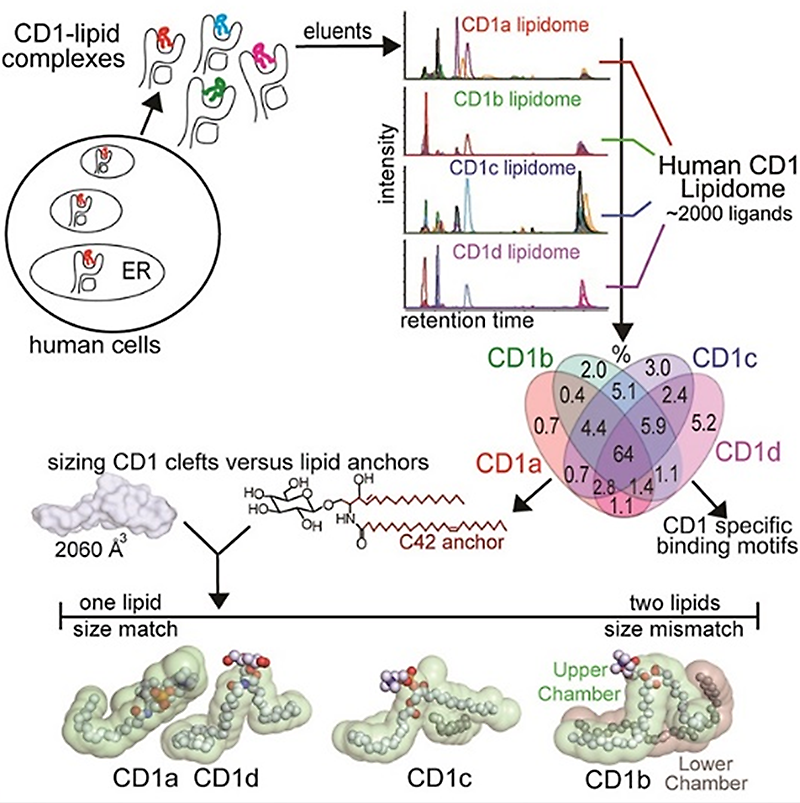
This project aims to undertake discovery research to investigate the molecular mechanisms underpinning the role of cellular lipids in T cell immunity in the context of autoimmune diseases, including psoriasis, contact dermatitis, and multiple myeloma.
This research project has three distinct aims:
- Generation of a comprehensive profile of cellular lipid antigens presented by CD1 antigen presenting molecules to T cells. Utilising novel mass spectrometric pipelines generated for this lipid discovery project, this program aims to further understand the molecular mechanisms governing lipid antigen presentation by CD1, with the goal of further developing and advancing this fundamental aspect of immunology.
- Isolation and extensive characterisation of T cell populations that demonstrate specific reactivity towards CD1 antigen presenting molecules. This approach, using functional immunology and biochemistry techniques, will expand the T cell repertoire reactive to CD1 molecules presenting lipid antigens, with the goal of furthering our understanding of T cell biology.
- To provide a comprehensive understanding of how CD1 antigen presenting molecules present lipid antigens, and how they are recognised by the T cell receptor (TCR). Using structural biology, this project will investigate the molecular mechanisms that govern lipid presentation by CD1 molecules, the complex interactions formed with specific T cell receptors, and their related impact on T cell activation and function.
Visit Dr Shahine's Monash research profile to see a full listing of current projects.
Research activities
Dr Shahine’s research employs a complementary set of biochemical, cellular, and biophysical techniques, including recombinant protein production, x-ray crystallography, surface plasmon resonance, enzymatic assays, flow cytometry, and mass spectrometry. Expression systems available within our laboratory include bacterial (E. coli, M. smegmatis), mammalian (HEK, K562, THP-1), and insect (Hi5, Sf9) cells that allow us to generate high yields of difficult-to-produce human immune receptors.
Collaborations
We collaborate with many scientists and research organisations around the world. Some of our more significant national and international collaborators are listed below. Click on the map to see the details for each of these collaborators (dive into specific publications and outputs by clicking on the dots).
- Professor Branch Moody, Brigham and Women’s Hospital, USA
- Associate Professor Ildiko van Rhijn, Brigham and Women’s Hospital, USA
- Professor Graham Ogg, Oxford University, UK
- Dr Yi-Ling Chen, Oxford University, UK
- Professor Dale Godfrey, University of Melbourne, Australia
- Dr Nicholas Gherardin, University of Melbourne, Australia
Student research projects
The Shahine Group offers a variety of Honours, Masters and PhD projects for students interested in joining our group. There are also a number of short term research opportunities available.
Please visit Supervisor Connect to explore the projects currently available in our Lab.