
Facilities
◈ Equipment
High-temperature drop tube furnace (HT-DTF)

The high-temperature DTF is able to simulate all the combustion environment in the industry, including the regenerator for spent catalysts. It has a height of 2.0 m and made of quartz reactor. The heating area consists of 6 electrically heated zones that can be controlled individually up to a maximum temperature of 1100 °C. The quartz reactor contains an inner chamber of 5 cm in diameter. An outer annulus of thickness 1.5 cm surrounds this inner chamber, making the reactor diameter 8 cm total. The outer annulus is designed to allow gasses to be preheated. The gas controls allow the addition of three different gasses simultaneously.
Drop tube furnace (DTF)
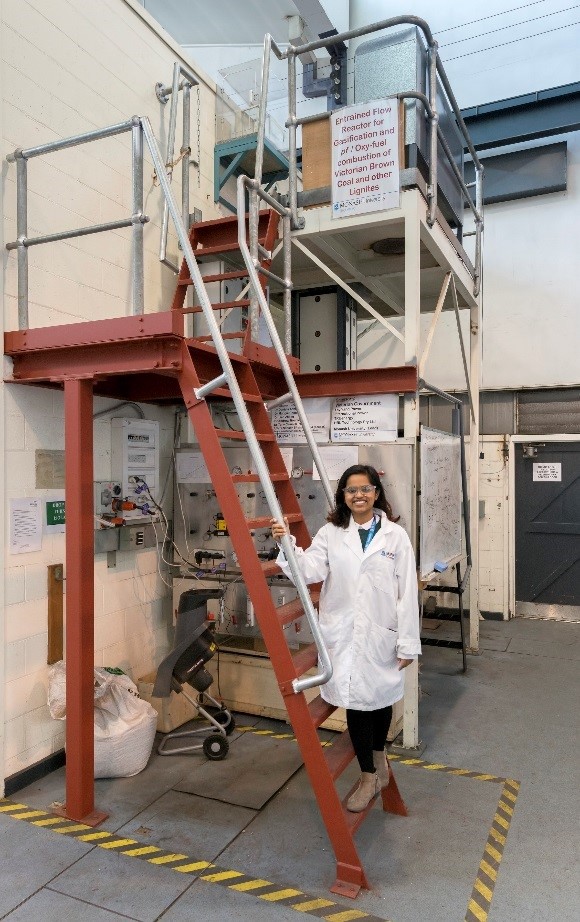
The DTF is able to simulate all the combustion environment in the industry, including the regenerator for spent catalysts. It has a height of 2.0 m and made of quartz reactor. The heating area consists of 6 electrically heated zones that can be controlled individually up to a maximum temperature of 1100 °C. The quartz reactor contains an inner chamber of 5 cm in diameter. An outer annulus of thickness 1.5 cm surrounds this inner chamber, making the reactor diameter 8 cm total. The outer annulus is designed to allow gasses to be preheated. The gas controls allow the addition of three different gasses simultaneously.
Vertical tubular furnace + Feeder system + FTIR gas analyzer

This down-flow reactor system is coupled with a piezo-electric micro-feeder and FTIR gas analyser for the testing of heterogeneous solid catalysts and flash pyrolysis in different gas environment, and different heating rate and different reaction schemes such as temperature programmed decomposition (TPD), temperature-programmed oxidation (TPO) and rapid heating. The reactor is made of high-purity quartz reactor, with an ID of 9 mm and effective length of 50 mm in the middle of the heating furnace (VTF1200, Australia) with a temperature accuracy of ±1 oC. The outlet gas from the bottom of the furnace goes through a thimble filter that was protected by heating tape at 120 oC, and then an ETG9500 FTIR multi gas analyser to monitor the concentrations of CO, CO2, H2O, NO, NO2, NH3 and HCN real-time.
Vertical tubular furnace + Multigas analyzer

This up-flow reactor system is coupled with a quartz tube with an inner diameter of 10.7 mm, and a length of 520 mm in an electrically heated vertical furnace with a maximum temperature of 1100 oC. The outlet gas from the top of the reactor is protected by heating tape, and goes through impinger trains and a Rapidox 5100 gas analyser to monitor the dry gas composition real-time. The reactor can be used for a broad of applications, such as thermal decomposition/reduction, and temperature-programmed decomposition and oxidation (TPD and TPO).
◈ Sample analysis and characterization
Gas chromatography–mass spectrometry (Agilent 5977B GC/MSD+TCD+FID)
+ High-temperature, high-pressure PyroProbe (CDS 5200 HPR)

The Agilent 5977B GC/MSD is the latest in the series of most trusted single quadrupole GC/MS instruments. It is ideal for labs that focus on applications such as environmental, chemical, petrochemical, food, forensic, pharmaceutical, and material testing. Equipped with TCD and FID, the instrument also measure the non-condensable gases and H2O along with hydrocarbons at high sensitivity.
The CDS 5200 HPR Pyroprobe allows pyrolysis at elevated pressure with built-in reactor. Users can conduct study both high temperature and pressure in a micro-scale environment, with the convenience of the resultant gas/liquid being sent directly to GC-MS. The unit is built on 5200 platforms with a backpressure regulator and heated catalyst bed. Samples can be pyrolyzed at max 500 PSI (3400 kPa), passed through a user-selectable catalyst bed, and collected onto the built-in trap. The maximum temperature and pressure can go to 1400 oC and 34 bar, respectively. The heating rate varies from 0.01 to 20.00 °C/ms.
PerkinElmer Spectrum 3 FT-IR with Harrick DRIFT Cell
This FT-IR system is capable of operating at temperatures up to 910 ºC (under vacuum) and pressures up to 1.5 MPa, offering the flexibility to analyze samples under various atmospheres. It includes a high-pressure dome with zinc selenide windows (15 x 4 mm) designed for the HVC High-Temperature Reaction Chamber, as well as an MCT Mid-IR Second Detector. The system is equipped with an automatic atmospheric H2O and CO2 correction algorithm (AVC) to ensure enhanced accuracy. Its sealed and desiccated Ge-coated KBr optics enable a scan range of 8,300-350 cm-1, delivering a resolution of 0.4 cm-1 and 10,000/1 peak-peak noise for a 5-second scan.
Thermogravimetric analysis/ Differential Thermal Analysis (TG-DTA)
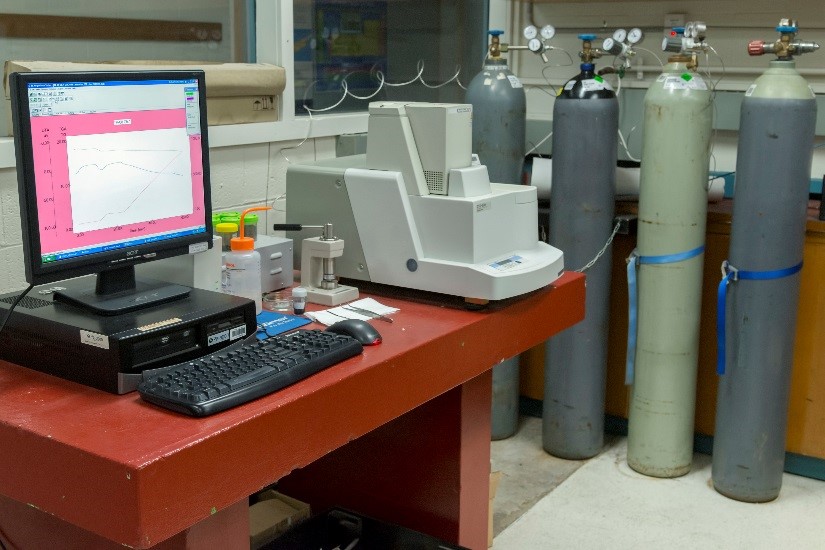
- Model: Shimadzu DTG-60H
- Balance type: Parallel guide differential top pan type
- Temperature range: Room temperature to 1500 °C
- Measurable range: ± 500mg; ± 1000µV
- Readability: 0.001mg
- Sample quantity: 1g max, in gross weight
- Atmosphere: Reaction gas, pure gas
X-ray fluorescence (XRF) spectroscopy

- Model: Spectro iQ II
- Excitation: X-ray end-window tube with Pb anode; Air-cooled; Max Power: 50W; C-force optics employing a doubly curved HOPG crystal
- Detection System: Large active detector area; 8µm Moxtek Dura-Be Window; Stable peak position and spectral resolution up to an input count rate of 120 cps
X-ray diffraction spectroscopy (XRD)

- Model: Rigaku MiniFlex 600
- Generator: Max Power 600W; Tube Voltage 40V; Tube Current: 15Ma
- Optics: X-ray tube: Cu, Co, Fe of Cr; Filter: Kβ Foil filter
- Detector: NaI scintillator;
- Goniometer: Type: vertical; Radius: 150mm; Scanning range: 3~145 °; Scanning speed: 0.01 to 100°/min; Accuracy: ±0.02°
Microwave digestion
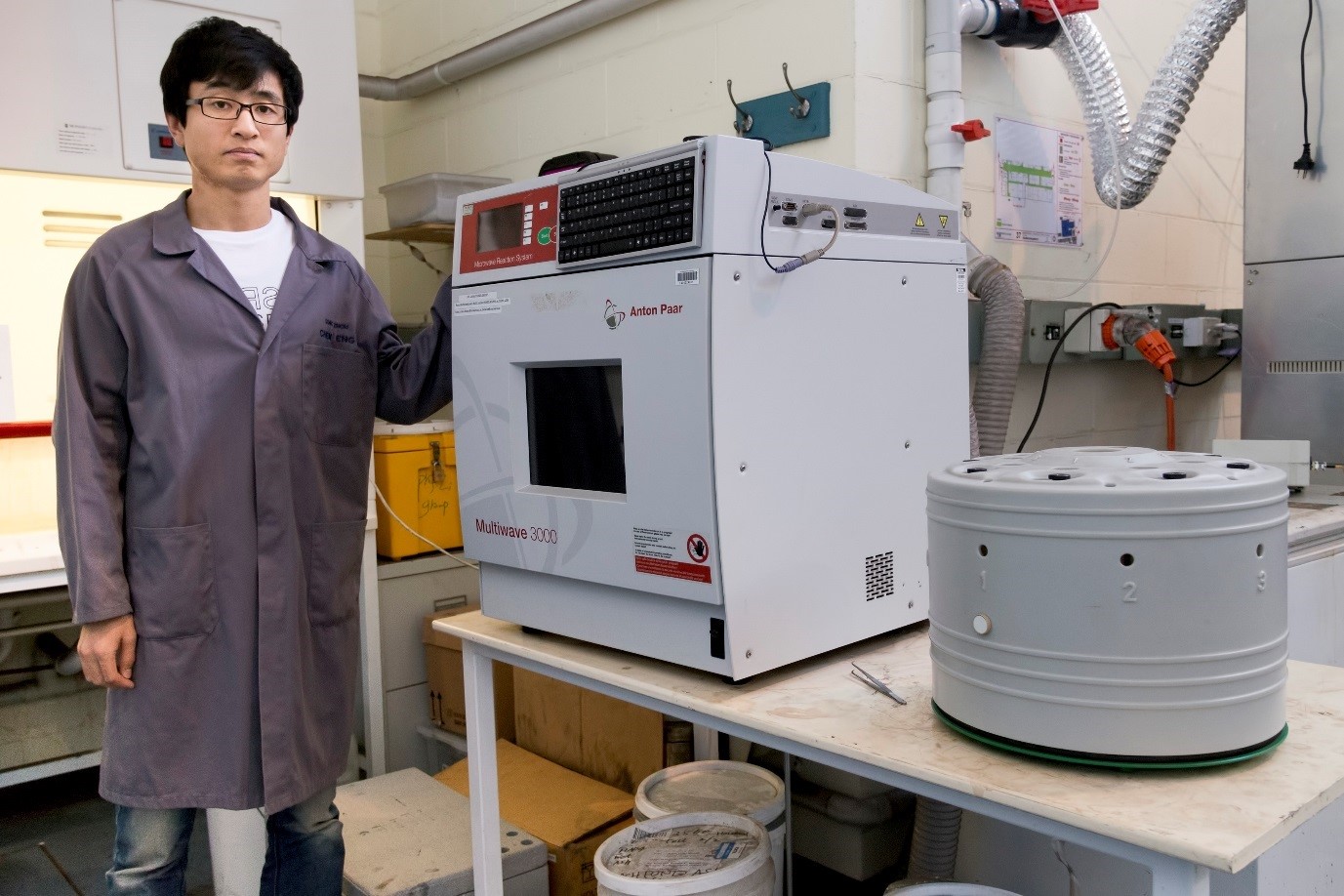
- Model: Anton Paar Multiwave 3000
- Functions: Digestion, leaching, solvent extraction, evaporation, drying
- Rotors: Model: 8SXF100; Liner materials: PTFE-TFM; Pressure jacket: Ceramic; Controlled pressure: 60 bar; Max pressure: 120bar; Max temperature: 260 °C; HF resistant: Yes
Inductively coupled plasma - optical emission spectroscopy (ICP-OES)

- Model: Perkin Elmer Optima 7000 DV
- Features: Auto-integration by Element; Dual-view design; solid-state RF power supply; a high-speed, high-resolution double monochromators
- Wavelength range: 160~900nm
- Stability: RSD≤1.0% (within 1 h), RSD<2.0% (within 4h)
Surface Area and Porosimetry

- Model: Micrometrics ASAP 2020
- Pressure measurement: 0~950mmHg
- Accuracy: >0.15% of reading
- Features: Unique Isothermal Jacket Cold Zone Control; Simultaneous preparation of two samples while analyzing another
- Software: MicroActive, data fitting, reports includes isotherm, BET surface area, pore size.
Synchrotron X-ray Absorption Spectroscopy (XAS)

X-ray absorption spectroscopy (XAS) is a widely used technique for determining the local geometric and/or electronic structure of interested metal elements with a low concentration. The oxidation state (by XANES ), atomic structure (by EXAFS) including coordination number and atomic bond can be determined by EXAFS, the molecular skeleton of the metal can then be sketched based on the above information. We have conducted a variety of studies on elements including Fe, Cr, As, Mg, Ca, Cl, etc. using XAS and keep long-term cooperation with Taiwan National Synchrotron Radiation Research Center and Australian Synchrotron.
◈ Calculation Software
Thermodynamic equilibrium software FactSage

FactSage is a worldwide thermodynamic equilibrium software for the analysis of chemical thermodynamics. Its database includes almost every element in the periodical table, every different species and their mixtures, including oxides, spinels, solutions, solid-solids, slags, alloys, light metals, and rare earth metals. It can be used to calculate: the thermodynamic parameter of a reaction, the conditions for multiphase, multicomponent equilibria, generate various types of phase diagrams for systems, calculates and plots isothermal Eph (Pourbaix) diagrams.
Computational fluid dynamics (CFD) modeling software ANSYS Fluent

CFD modeling can be employed to complement the combustion test results from DTF and FFBR. It is the use of numerical analysis to solve fluid flow problems using the Navier-Stokes equations. The purpose of using CFD software is to perform a comprehensive analysis on flows that occur during combustion in such a detail that is not possible in a laboratory DTF. It can also be used for the speed and ease of parameter adjustment.
ANSYS Fluent is one of the most popular computational fluid dynamics (CFD) software which can be used to simulate the flow distribution, as well as the combustion process.