
Projects
Our expertise in action
Collaborating across faculties, organisations, countries and disciplines, we combine technology, mathematical theory and experiments to simulate and analyse social phenomena.

Environmental stress and insect colonies
This project aims to create a more complete picture of how environmental factors and stress influence the division of labour in a colony, and with this, its viability. Our work here combines mathematical models and computer simulations with biological experiments in the lab and field.

Balancing demand with smart energy
Renewable energy sources are crucial for the future, but intermittent suppliers such as wind and solar farms make the supply side of the power system increasingly difficult to control. In this initiative, we aim to develop algorithms, based on sophisticated optimisation and data analytics techniques, to more efficiently balance supply and demand.

The influence of reputation in social networks
The goal of this project is to study how reputation dynamics impact social outcomes in games of cooperation. Using cutting-edge computational techniques, we adopt a game theoretical perspective to explore which norms for assigning reputation can guarantee the desired outcomes – and which norms are prone to be fragile and abused.

A world without bees
We model how insect population changes are likely to affect the production of vegetable seed and food, in order to predict floral traits to breed into crop plants for ongoing pollination success. This is essential for economic viability and global food security in a changing climate.
Networks as a foundation of large, complex societies
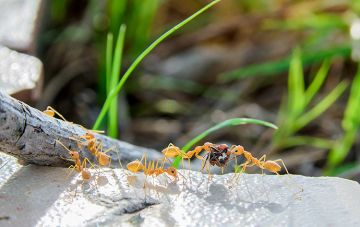
We investigate how evolution has shaped the self-organisation of robust communication networks that emerge in large animal collectives from the actions of individuals following only simple, local rules. We hope to unveil fundamental principles guiding the self-organisation of networks that can sustain a complex society. Empirical work with ant colonies informs the construction of simulation models to push the investigation beyond experimental limits.