
Immersive Forensic Investigation
First stage (2021-2025)
Forensic investigation is a cornerstone of the justice system, ensuring accountability, safety, and public trust. This project explores immersive analytics and spatial computing to enhance forensic pathology workflow—enabling experts to visualise and interpret complex medical imaging data in more intuitive ways.
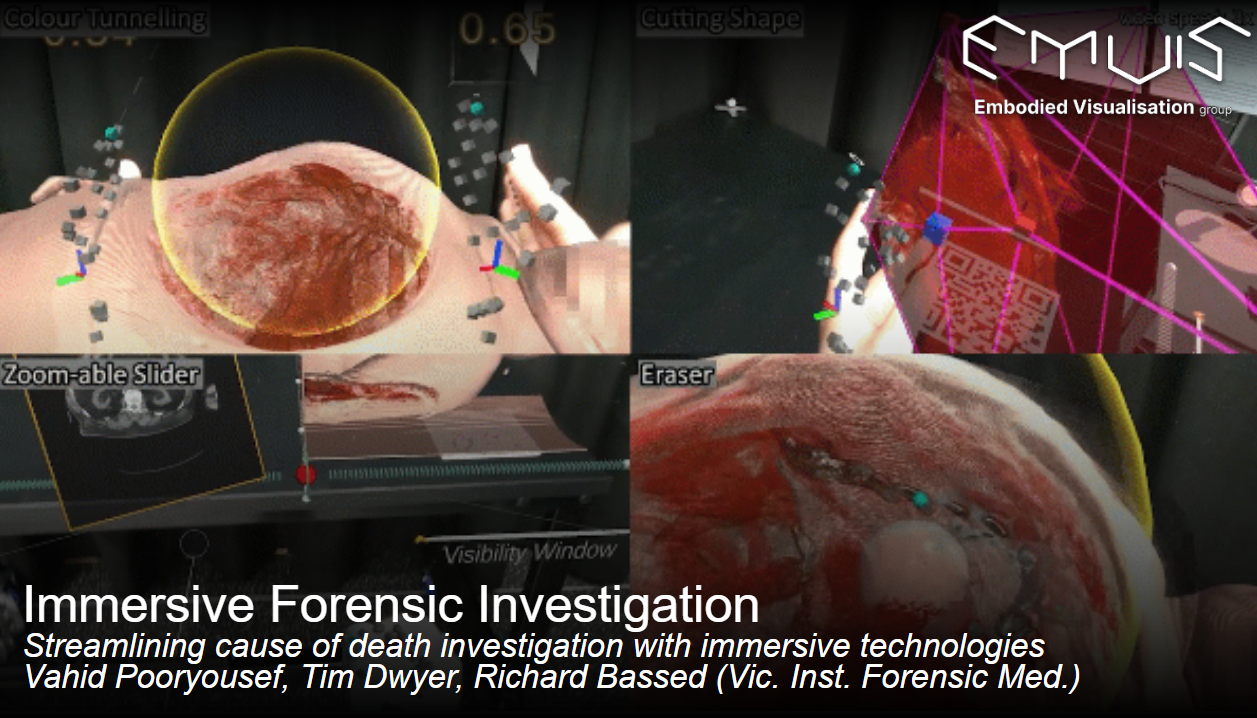
Developed through a PhD research program at Monash University, in partnership with forensic pathologists and government forensic services from the Victorian Institute of Forensic Medicine, the system demonstrates how extended-reality (XR) technologies and artificial intelligence (AI) can enhance the quality, speed, and reliability of autopsy procedures and reporting.
Key Features: Immersive 3D Autopsy Analysis (mixed-reality headsets displaying CT/MRI scans as interactive 3D anatomy), AI-Assisted Report Generation, multi-user sessions for training. Full content and publications retained from 2025.
Research Funding: Victorian Institute of Forensic Medicine (2021-2025)
Research team - Stage 1
- Vahid Pooryousef (PhD Student, Monash University)
- Prof. Tim Dwyer (Supervisor, Monash University)
- Prof. Richard Bassed (Co-Supervisor, Monash University and the Victorian Institute of Forensic Medicine)
- Dr. Maxime Cordeil (External Supervisor, The University of Queensland)
- Dr. Lonni Besançon (Linköping University)
Second stage (2025-present)
The second stage of this project focuses on developing immersive remote training for the next generation of forensic pathologists. Building on the immersive investigation platform, the research enables trainees, educators, and specialists to participate in shared mixed-reality learning environments, providing access to realistic forensic cases, guided instruction, and expert mentorship regardless of geographic location.
Working with the University of the Philippines, this stage explores how XR and Photorealistic 3D representations can strengthen forensic education, particularly in regions with limited access to specialist expertise. The long-term vision is to establish scalable training and remote support that helps build sustainable forensic capability.
Research team
-
Dr Vahid Pooryousef
Research Fellow
-

Professor Tim Dwyer
Discipline Lead, Embodied Visualisation
-
Associate Professor Richard Bassed
Deputy Director, Victorian Institute of Forensic Medicine
-

Dr Maxime Cordeil
University of Queensland
-

Professor Jianfei Cai
Director, Research (DSAI)
-
Nick Dempsey
Program Manager, University of the Philippines
-

Dr Kadek Satriadi
Discipline Group Coordinator, Embodied Visualisation
-

Mr Jim Smiley
Senior Technical Officer