
Home

About the Facility
Led by Professor Alan Dorin, the NativeBee+ Tech Facility harnesses AI, data science, computer vision and simulation to develop new technology that monitors, simulates and improves our understanding and management of insect-plant interactions. Insect pollinators directly contribute to 34% of global food production – approximately AUD$238 billion per year. Even the tiniest changes in pollinator efficiency can cause production losses that have the potential to undermine global food security. Integrating computer science, ecology, entomology, engineering and agriculture, this climate-controlled and digitally-wired facility is home to Australian native insect species. Here the Facility staff and students research, design and test monitoring, simulation and management tools for the good of the planet’s natural and agricultural ecosystems. | The breathtaking diversity of insect-plant relationships underpins food chains that support both human life and terrestrial ecosystems. Some interactions being explored include:
|
‘We drive innovative technologies that reveal and preserve the relationships between insects and plants in natural and agricultural ecosystems – sustaining life on earth.’
Professor Alan Dorin, Director
Experience a living research space
During your visit
Hive visibility
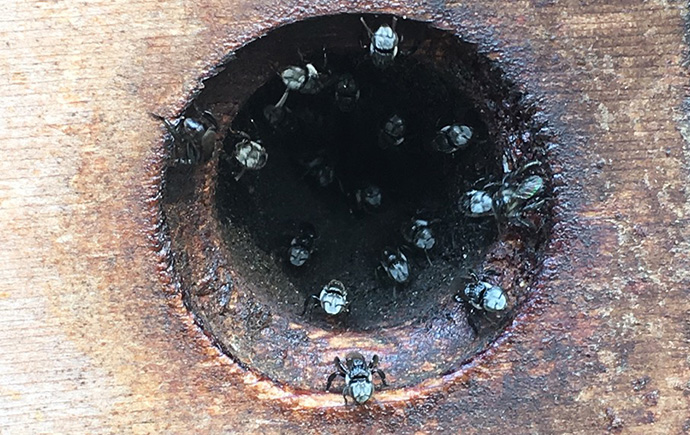
We offer several ways for you to observe the busyness of our bees. Watch them through the observation windows of the facility or via the micro-cameras installed in the hive and on flowering plants. We also have images available online for remote monitoring and to allow curious students, industry visitors and staff to see the insects onsite at greater than life size.

IoT hive
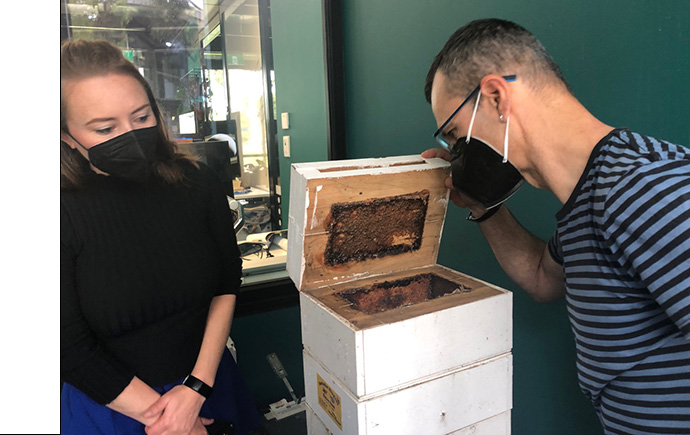
Illustrated is a commercial HiveHaven hive, one of several we are exploring. This hive is designed in Australia, specifically for our native stingless bees.
We connect our hives via IoT hardware and software developed with our industry partners. This allows beekeepers, students and staff to remotely monitor activity and access invaluable data logs on bee health, behaviour and pollination.

Computer vision and machine learning
Computer-generated heatmap of bees foraging on wildflowers (Image from the work of Dr. M. Ratnayake).
The computer vision and machine learning technology we’re developing allows us to track insect behaviour, including when they depart and enter the hive, and how long they spend foraging on flowers.
Ultimately, researchers and growers will be able to identify deficits in greenhouse and field pollination, and interpret insect behaviours under agricultural and natural conditions to benefit crop and native flowering plant pollination.

Computer simulation
3D computer simulation of bees pollinating flowers arranged in cropping rows. (Image from the work of Mr. E. Dann)
We’ve developed extensive simulations of bees foraging on crops and wildflowers which are on display in our facility.
