Monash University logo

Monash Art, Design and Architecture Student Exhibition 2022

Kelly Chua

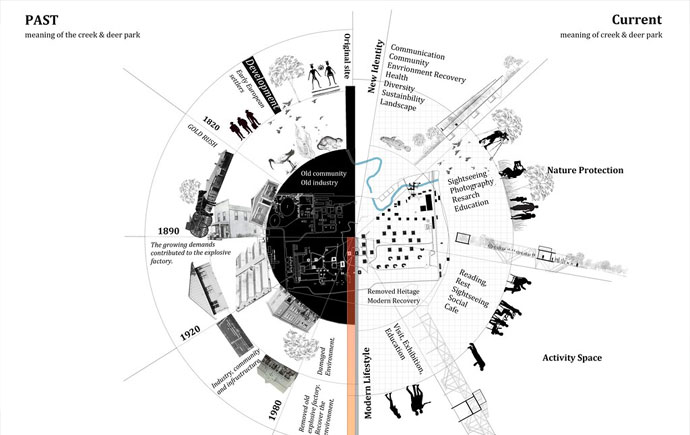
Deer Park (once named Kororoit Creek) was a place of lush nature pre-colonization era. Various sorts of life flourished in the area and at its prime and many forms of life, particularly that of migratory birds, saw the creek as a place of rest and resource. However, coming into the age of colonization and the gold rush, the once flourishing environment of Deer Park was slowly taken for granted and the life of Deer Park and Kororoit Creek slowly deteriorated alongside its many bird sitings. This project aims to cultivate a lush environment in hopes of reviving Deer Park’s lost bird ecology while serving as a place of rest and interest to avid bird watchers and park goers.

Kororoit Creeks damage

Settlers had built upon Deer Park, renamed it and left their own trail of past ownership upon the land even years after their leave. The creek had been exploited by explosive companies for its water supply and its isolation from the city, leaving behind a mess of toxic unthinkables and the damnation of Deer Park’s earth and water, causing almost irreversible damage to the ecosystem. The life and vigor that once occupied Deer Park and its creek could no longer compare with that of the creek downstream which had, in contrast to its industrialized counterpart, received treatment such as tree planting from groups such as Friends of Lower Kororoit Creek.

Site Plan

The project starts by identifying already existing tree lines (in black) before planting new trees alongside them. Man-made wetlands of varying depth that resemble those in Altona North are made by digging up the polluted soil of the site. Tall bird feeders of varying heights are then placed in these wetlands, maintaining a distance away from the land for a seemingly undisturbed landscape for birds. Pavilions are then placed around these wetlands as well as a central gathering space for bird watchers to observe from and come together

Perspectives of Gathering space

The gathering point is a central hub for bird watchers to gather and discuss their findings or kick back as a place of rest and recuperation. It represents a social point and stands partially on land and in water for a closer look at the bird feeders that stand atop the wetlands. Visitors can gather their findings by sitting together in an auditorium space or at casual outdoor seats and are strongly encouraged to share any photos of birds they have spotted by printing and sticking them to designated boards in a viewer gallery which is the heart of the gathering point.

Detail Section

The gathering space is supported by timber stilts in an act to lightly touch the ground and reduce any additional damage that might come from building directly on the ground. The structure’s viewing gallery and auditorium space is sheltered via a tensile roof for lightweight reasons. Its eaves extend far and outwards in a gradual gesture, allowing for birds to perch or rest atop it. The bird feeders that the space overlooks into are tall concrete structures with trays of birdfeed. Due to it’s distance from land and human contact, these feeders are periodically refilled via the usage of drones.

Sections and Elevations

The façade of the structure is that of timber fins that support the growth of plants along its height while giving a more lightweight outlook to the structure, supporting its stance of lightly touching the ground while blending in with its environment. In this sense, the gathering space also acts as a point for visitors to immerse themselves into the landscape as well as a point of socializing and rejuvenation.

Explore more

View all

Other years

Back to top